
Menu
Get Expert Legal Support Today

This article provides representative UK personal injury case examples grouped by injury type, with typical settlement outcomes and the evidence that determined them. Whether you are trying to understand what a road traffic claim looks like in practice, what clinical negligence cases involve, or how a workplace injury is valued, the summaries below give you a realistic picture.
The injury categories covered are:
Two dates matter immediately. The standard limitation period for personal injury claims in the UK is three years from the date you first knew you had suffered an injury. For minor road traffic injuries, the Official Injury Claim service has applied to accidents on or after 31 May 2021. Miss either deadline and your claim is almost certainly lost.
The case summaries below are representative of the types of personal injury claims pursued in England and Wales. Settlement figures are drawn from publicly available solicitor guidance and published case data; where no specific figure is in the public domain, a typical range is given instead. None of the figures below should be read as a guarantee of outcome in any individual case.
Case 1: Rear-end collision, soft-tissue neck and back injury (driver)
A driver was stationary at traffic lights when struck from behind. She suffered whiplash-associated disorder affecting the neck and upper back, with symptoms persisting for approximately eight months. The decisive evidence was a police report confirming the other driver’s fault, dashcam footage from a following vehicle, and GP records documenting the injury within 48 hours of the accident. Settlement: £3,500–£5,000 (typical range for moderate whiplash under the Official Injury Claim tariff for accidents post-31 May 2021). Timeline: approximately six to nine months from accident to settlement.
Case 2: Cycling collision with disputed liability
A cyclist was struck at a junction where both parties claimed right of way. Liability was contested. The claimant’s solicitor obtained witness statements from two pedestrians and CCTV from a nearby business. Despite the defendant arguing contributory negligence, robust witness evidence and negotiation secured a settlement of £12,500. Timeline: approximately 14 months from accident to settlement.
Case 3: Pedestrian struck on a zebra crossing
A pedestrian suffered a fractured tibia and soft-tissue knee damage after being struck by a car that failed to yield. Police attended the scene and filed a report confirming the driver’s failure to stop. Photographs of the crossing, vehicle damage, and A&E records were central to the claim. Settlement was within a typical range for a fracture with moderate ongoing symptoms. Timeline: 10–14 months.
Case 4: Motorcyclist injured in a lane-change collision
A motorcyclist suffered a fractured clavicle and road rash injuries when a car changed lanes without signalling. Police reports, dashcam footage, and vehicle damage photographs were decisive. The motorcyclist’s speed was queried by the defendant, but independent accident reconstruction evidence supported the claimant’s account. Settlement was within a typical range for similar injuries involving fracture and road rash. Timeline: 12–18 months.
Case 5: Warehouse operative, manual handling back injury
A warehouse worker developed a prolapsed disc after repeatedly lifting loads that exceeded safe manual handling guidelines. His employer had no documented risk assessment for the task. The decisive evidence was the absence of a RIDDOR report (which the claimant’s solicitor obtained through a Subject Access Request), the employer’s own training records showing no manual handling instruction, and an orthopaedic expert report confirming causation. Settlement was within a common range for moderate to severe back injuries with partial disability. Timeline: 18–24 months.

Case 6: Factory worker, machinery crush injury to hand
A factory operative suffered crush injuries to three fingers, resulting in permanent partial loss of grip. The employer’s accident book entry was contemporaneous and consistent with the claimant’s account. CCTV from the factory floor showed the machine guard had been removed. An engineering expert confirmed the guard’s removal was the proximate cause. Settlement was within a typical range for permanent disability affecting hand function and earnings. Timeline: 20–28 months.
Case 7: Supermarket slip on a wet floor
A shopper slipped on a wet floor near a refrigeration unit, fracturing her wrist. The store had no cleaning log for the relevant period and no wet floor sign had been placed. CCTV from the store showed the spillage had been present for over 20 minutes before the fall. Medical records confirmed the fracture and a six-month recovery period. Settlement was within a typical range for a fracture caused by slipping on a wet floor. Timeline: 12–15 months.

Case 8: Pavement trip, local authority liability
A pedestrian tripped on a raised paving slab and fractured her ankle. The local authority’s own inspection records showed the defect had been reported three months earlier but not repaired. Photographs taken immediately after the incident, alongside the council’s maintenance logs, established liability. Settlement was within a typical range for fractures requiring surgical treatment due to a pavement trip. Timeline: 15–20 months.
Case 9: Delayed diagnosis of appendicitis
A patient attended A&E twice with abdominal pain and was discharged on both occasions. On the third visit, a perforated appendix was diagnosed and emergency surgery performed, resulting in complications and a prolonged hospital stay. The claimant’s solicitor obtained the full medical records and instructed an independent consultant surgeon, whose expert report confirmed the diagnosis should have been made on the first visit. Settlement was within a typical range for delayed diagnosis leading to additional surgery and recovery time. Timeline: 24–36 months (clinical negligence cases typically take longer due to expert evidence requirements).
Case 10: Surgical error causing nerve damage
A patient undergoing routine knee surgery suffered permanent nerve damage due to a positioning error during the procedure. The hospital’s own incident report acknowledged the error. An independent neurological expert confirmed the damage was permanent and would affect the claimant’s ability to work in her previous role. Settlement was within a typical range for permanent nerve damage resulting from surgical error. Timeline: 30–42 months.
Case 11: Spinal cord injury, incomplete paraplegia
A construction worker fell from scaffolding due to an unsecured platform, sustaining an incomplete spinal cord injury. He retained some lower limb function but required significant ongoing rehabilitation and home adaptations. Evidence included the site’s own scaffold inspection records (which showed the platform had not been checked for 11 days), witness statements from co-workers, and a comprehensive care needs assessment. Settlement was within a typical range for severe spinal cord injuries requiring lifelong care and adaptations. Timeline: 3–5 years.
Case 12: PTSD following a serious road traffic accident
A passenger in a vehicle involved in a high-speed collision developed post-traumatic stress disorder, confirmed by a consultant psychiatrist. Physical injuries were minor, but the psychiatric diagnosis was supported by GP records, a detailed psychiatric report, and evidence of the claimant’s inability to return to work for 14 months. Settlement was within a typical range for moderate to severe PTSD resulting from a serious accident. Timeline: 18–24 months.
Pro Tip: Psychiatric injury claims live or die on the medical narrative. A GP referral made within weeks of the incident, followed by a formal psychiatric assessment, creates the contemporaneous record that makes causation hard to dispute. Waiting months before seeking help gives defendants room to argue the condition is unrelated.
Two people can suffer what looks like the same injury and receive very different settlements. The gap is almost always explained by a handful of valuation drivers.
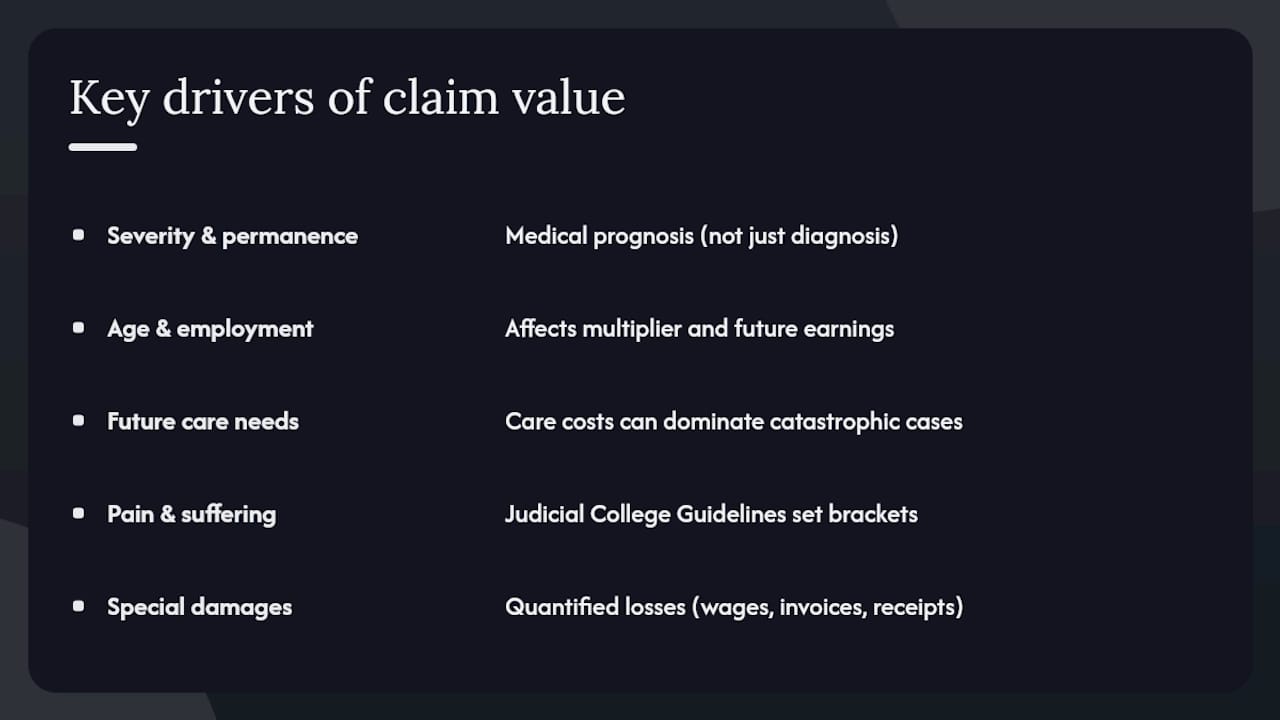
Severity and permanence. A fracture that heals fully in three months is valued very differently from one that leaves permanent stiffness or chronic pain. Courts and insurers look at the medical prognosis, not just the diagnosis.
Age and employment. A 35-year-old manual worker who can no longer perform their job faces a future loss of earnings claim that a retired claimant does not. Age affects both the multiplier applied to future losses and the weight given to career impact.
Future care needs. Catastrophic injury cases often turn almost entirely on the cost of future care. A care needs assessment by an independent expert can add hundreds of thousands of pounds to a settlement.
Pain, suffering, and loss of amenity (PSLA). This is the general damages component. Courts use the Judicial College Guidelines to set a bracket for the injury type and severity, then adjust within that bracket based on the individual claimant’s circumstances.
Special damages. These are the quantifiable financial losses: past and future loss of earnings, private treatment costs, travel to appointments, care provided by family members, and equipment or property damaged in the accident. Wage slips, P60s, invoices, receipts, and contemporaneous care logs are the documents that build this part of the claim.
The evidential levers that increase value are straightforward in principle but often neglected in practice. Contemporaneous medical records, objective imaging (MRI, X-ray), an independent expert prognosis, and employer records showing pre-accident earnings all strengthen the claim. CCTV and witness statements settle liability disputes before they become expensive.
Pro Tip: Two documents claimants routinely overlook: a pre-accident medical baseline (your GP records before the incident, which establish that the injury was not pre-existing) and a contemporaneous care log kept by a family member who helps with daily tasks. The latter can be worth thousands in special damages and is almost impossible to reconstruct after the fact.
Every personal injury claim rests on three evidence categories: liability evidence (who caused the accident and how), injury evidence (medical records and prognosis), and loss evidence (financial impact). The Pre-Action Protocol for Personal Injury Claims sets out what is expected from both parties before proceedings are issued, including early disclosure and medical reporting.
Road traffic accident: police report, dashcam or CCTV footage, photographs of the scene and vehicle damage, witness contact details, A&E or GP records taken promptly after the incident.
Workplace accident: accident book entry (request a copy immediately), RIDDOR report if one was filed, risk assessment documents, training records, CCTV from the workplace, witness statements from colleagues.
Slip, trip, or public liability: photographs of the defect taken on the day, CCTV from the premises or nearby businesses, the premises’ cleaning or inspection logs, witness details, and medical records.
Clinical negligence: full medical records from the treating hospital or GP practice (obtainable via a Subject Access Request), any incident reports filed by the provider, and an independent expert report from a specialist in the relevant field.
Industrial disease: occupational health records, employment history, exposure records, and a specialist medical report linking the condition to workplace exposure.
| Milestone | Timing | Source |
|---|---|---|
| Limitation period (general) | 3 years from date of knowledge | Citizens Advice |
| Official Injury Claim (minor RTA) | Accidents on or after 31 May 2021 | Citizens Advice |
| Defendant acknowledgement of Letter of Claim | 14 days | Uklegalguides |
| Defendant investigation and response window | Up to 3 months (commonly cited) | Uklegalguides |
| CCTV retention (typical) | 28 days | Claims Bible |
The CCTV retention window is the most dangerous deadline most claimants do not know about. Footage is routinely overwritten within 28 days. A solicitor can issue a preservation letter within days of instruction; waiting even a few weeks can mean the most decisive evidence is gone permanently.
For a full procedural walkthrough, the Ali Legal personal injury claims process guide sets out each stage from notification to settlement.
Fatal accidents attract the largest awards when dependants can claim for financial dependency and bereavement. The Judicial College Guidelines set bereavement awards at a statutory figure, but dependency claims can run to millions where the deceased was a high earner.
Severe brain injury generates the highest individual awards in practice, driven by lifelong care costs, loss of all future earnings, and the need for specialist accommodation. Seven-figure settlements are not unusual.
Spinal cord injury (complete or incomplete paraplegia or tetraplegia) follows a similar pattern: care needs, home adaptations, and loss of earnings combine to produce very large awards.
Amputation claims attract high general damages for the injury itself, plus substantial special damages for prosthetics, adaptations, and occupational impact.
Severe orthopaedic injuries with permanent disability, particularly where the claimant is young and employed in a physical role, can produce settlements well above what the injury type alone might suggest once future earnings are factored in.
Concussion and mild traumatic brain injury are frequently contested because symptoms are subjective, imaging is often normal, and defendants argue the condition is exaggerated or unrelated. Neuropsychological testing and a detailed symptom diary are the most practical evidential tools.
Soft-tissue and whiplash injuries are the most commonly disputed claim type in the UK. The Official Injury Claim tariff system now applies to minor whiplash from road accidents post-May 2021, which limits recovery for low-value claims and reduces the scope for dispute, but moderate and severe soft-tissue injuries outside the tariff remain contested.
Chronic pain conditions (including fibromyalgia and complex regional pain syndrome) require a robust medical narrative linking the condition causally to the accident. Without a clear contemporaneous record and specialist expert evidence, defendants will argue the condition is pre-existing or functional.
PTSD and psychological injury without physical injury are harder to value and easier to contest. The psychiatric diagnosis must be formal, the causation link must be clear, and the impact on daily life and work must be documented.
Contributory negligence applies where the claimant’s own conduct contributed to the injury. A pedestrian who stepped into the road without looking, or a worker who bypassed a safety procedure, may have their award reduced proportionately.
For a deeper look at how injury types are categorised under UK law, the Ali Legal personal injury law guide covers the legal framework in detail.
A personal injury settlement is built from two components: general damages and special damages. Understanding both helps you see why the case examples above carry the figures they do.
General damages cover pain, suffering, and loss of amenity. These are non-financial losses, valued by reference to the Judicial College Guidelines, which set brackets for injury types and severities. A solicitor or court will place the injury within the appropriate bracket and adjust for the individual’s circumstances, age, and prognosis.
Special damages are the quantifiable financial losses. The main heads are:
Consider a 40-year-old office worker who suffers a moderate knee injury in a workplace accident, requiring surgery and six months off work, with a prognosis of ongoing symptoms but no permanent disability.
| Head of loss | Basis |
|---|---|
| General damages (PSLA) | Judicial College Guidelines bracket for moderate knee injury |
| Past loss of earnings | Six months’ net salary, supported by wage slips and P60 |
| Future loss of earnings | Partial, if return to work is at reduced capacity |
| Treatment costs | Physiotherapy invoices, surgical costs if private |
| Care (family-provided) | Hours logged by family member, valued at commercial care rate |
| Travel | Mileage receipts to appointments |
The total is the sum of each head, not a single figure plucked from a bracket. Citizens Advice recommends seeking a solicitor on the Law Society’s accreditation list for personal injury matters, and notes that conditional fee arrangements and legal expenses insurance may be available to fund a claim.
Where injuries are serious and the long-term prognosis is uncertain, provisional damages orders allow a claimant to return to court if the condition deteriorates in a defined way. This matters most in cases involving brain injury, spinal injury, or conditions with a risk of future deterioration.
The Ali Legal compensation guide explains how general and special damages are assembled in practice.
Pro Tip: Future care is the most commonly undervalued head of loss in moderate-to-serious injury cases. A care needs assessment by an independent occupational therapist, instructed early, often produces a figure that surprises claimants. Do not leave it to the defendant’s expert to set the agenda.
When Ali Legal Ltd receives a new personal injury enquiry, the first assessment focuses on three questions: is there a viable liability argument, how serious is the injury, and is the limitation period at risk? Those three factors determine how urgently the case needs to move and what the realistic settlement range looks like.
Liability is assessed against the available evidence. If CCTV exists, a preservation letter goes out within days. If there is an accident book entry, a copy is requested immediately. If the incident involved a public authority, inspection records are sought under the Freedom of Information Act or through pre-action disclosure. Early evidence preservation is not a procedural nicety; it is often the difference between a settled claim and a failed one.
Medical reporting is instructed early, both to establish the injury and to satisfy the Pre-Action Protocol’s expectations for disclosure. Where rehabilitation is appropriate, Ali Legal Ltd will identify that early, because claimants who engage with rehabilitation tend to present stronger claims and sometimes receive earlier settlement offers.
Negotiation strategy is built around the strength of the liability evidence and the medical prognosis. Where liability is clear and the medical picture is well-documented, most claims settle without court proceedings. Where liability is disputed, the solicitor’s role is to convert the evidential record into a position that makes litigation more expensive for the defendant than settlement.
Pro Tip: Act on CCTV within 48 hours of an incident. Retention periods of 28 days are common in retail and commercial premises; some systems overwrite in as little as 14 days. A solicitor can issue a formal preservation letter that creates a legal obligation to retain the footage. Waiting for a medical appointment first is one of the most common and costly mistakes claimants make.

Ali Legal Ltd offers personal injury claimants a clear, direct route to legal representation without the uncertainty of open-ended costs. The firm can assess your case, identify the strongest evidence, and pursue compensation on conditional fee terms where appropriate, meaning you do not pay solicitor fees if the claim is unsuccessful.
Practically, Ali Legal Ltd’s involvement covers: initial case assessment (liability, injury severity, and limitation risk), evidence preservation requests (CCTV, accident book, RIDDOR), instruction of independent medical and expert witnesses, pre-action negotiation with defendants and insurers, and litigation where settlement cannot be reached.
The firm’s approach is built on fixed fees and transparent communication. You will know what is happening at each stage and why. For claimants who have read the case examples above and want to understand where their own situation sits, the starting point is a direct conversation with a solicitor.
Contact Ali Legal Ltd through the enquiry page to arrange an initial assessment of your claim.
The case summaries in this article are useful, but they carry a risk: readers tend to find the example closest to their own situation and anchor on that settlement figure. That instinct is understandable and almost always misleading.
The cycling case that settled for £12,500 despite split liability is a good illustration. The settlement was not driven by the injury value alone. It was driven by the quality of the witness evidence, the solicitor’s willingness to push through a contested liability argument, and the defendant’s calculation that litigation would cost more than settlement. Change any one of those variables and the outcome changes. A claimant who handled the same claim without legal representation, or who failed to obtain the witness statements, would likely have received considerably less or nothing at all.
The same logic applies to the catastrophic injury cases. The difference between a £1.2 million and a £2.5 million settlement for a spinal cord injury is almost entirely in the care needs assessment and the future earnings calculation. Those figures are built by experts, challenged by defendants, and negotiated over months. The injury is the starting point, not the answer.
What the examples genuinely tell you is which categories of evidence are decisive across claim types: contemporaneous medical records, CCTV and witness statements for liability, and independent expert evidence for prognosis and care needs. Those three things appear in every successful claim regardless of injury type. The settlement figure follows from how well those three things are assembled and presented.
The other thing the examples reveal, less comfortably, is how much the outcome depends on acting quickly. The CCTV that was preserved in the supermarket slip case, the accident book entry in the warehouse case, the psychiatric referral in the PTSD case: all of them were obtained within days or weeks of the incident. None of them would have been available six months later.
The following UK sources are the most reliable starting points for claimants who want to verify the key points in this article or dig deeper into the process.
This article provides general information about personal injury claims in the UK and is not a substitute for legal advice. Limitation periods, procedural rules, and compensation values depend on the specific facts of each case. You should confirm current rules with Citizens Advice, the relevant primary sources, or a qualified solicitor before taking action.


