
Menu
Get Expert Legal Support Today

TL;DR:
- A personal injury claim is a formal legal request for compensation when someone is harmed due to negligence or wrongful conduct. In England and Wales, these claims are governed by tort law, involving solicitors, insurers, and courts, depending on the case. Success requires proving duty of care, breach, causation, and damages while adhering to procedural deadlines and correctly documenting evidence.
A personal injury claim is a formal legal demand for compensation made when someone is harmed due to another party’s negligence or wrongful conduct. In England and Wales, these claims are governed by tort law, and the process involves solicitors, insurers, and in some cases the courts. Whether you have been injured in a road accident, at work, or on someone else’s property, understanding how personal injury claims work gives you the clearest path to fair compensation. This guide covers what you must prove, how to file, what to expect, and how to avoid the mistakes that cost claimants dearly.
A successful personal injury claim requires proving four fundamental legal elements: duty of care, breach of duty, causation, and verifiable damages. Miss any one of these and your claim will fail, regardless of how serious your injury is. Understanding each element before you file puts you in a far stronger position.
Here is what each element means in practice:
Compensation is calculated by multiplying your economic losses by a severity factor of 1.5 to 5, depending on the seriousness of the injury. That means a well-documented set of economic damages directly increases your total award.
Pro Tip: Start a dedicated folder, physical or digital, from day one. Collect every medical receipt, prescription, payslip showing lost income, and photograph of your injuries. Courts and insurers respond to evidence, not assertions.
Filing a compensation claim follows a clear sequence. Skipping steps or rushing the process weakens your position significantly.
| Stage | Expected timeframe |
|---|---|
| Adjuster assigned by insurer | 1–3 days after notification |
| Initial inspection or assessment | 3–7 days after assignment |
| Initial decision from insurer | 1–4 weeks after filing |
| Negotiation and settlement | 3 months to 2 years |
| Court proceedings (if required) | 12–24 months additional |

One deadline that catches many claimants off guard: government entity claims may require a formal Notice of Claim within as little as 90 days. Miss that window and you permanently lose the right to sue, regardless of how strong your case is.
Pro Tip: Your initial notice to an insurer or defendant should state only the date, location, and that an injury occurred. Do not include fault descriptions or financial demands at this stage. Insurers can use premature statements against you later in negotiations.
The types of personal injury cases vary considerably in their complexity, evidence requirements, and typical timelines. Knowing which category your case falls into helps you set realistic expectations.
| Case type | Key evidence needed | Typical complexity | Common compensation |
|---|---|---|---|
| Road traffic accidents | Police report, dashcam footage, medical records | Moderate | Medical costs, lost earnings, vehicle damage |
| Workplace injuries | Accident book, risk assessments, CCTV | Moderate to high | Medical costs, lost income, rehabilitation |
| Slips, trips, and falls | Photographs, maintenance records, witness statements | Moderate | Medical costs, pain and suffering |
| Clinical negligence | Expert medical opinion, treatment records | High | Medical costs, future care, loss of earnings |
| Intentional torts (e.g. assault) | Police report, criminal conviction if applicable | Variable | Compensation from CICA or civil action |
A few distinctions are worth noting. Clinical negligence claims require independent expert evidence, which adds both cost and time. Intentional injury cases may run alongside criminal proceedings, and compensation can be sought through the Criminal Injuries Compensation Authority (CICA) even where the perpetrator is unidentified. Workplace claims often involve the Health and Safety Executive (HSE) and employer liability insurers, making early legal advice particularly valuable.
For a broader view of how these cases interact with UK law, the personal injury law guide from Alilegal covers statutory deadlines and procedural steps in detail.
The most damaging errors in compensation claims are almost always procedural rather than factual. The underlying injury may be genuine and serious, but poor process destroys otherwise strong cases.
Pro Tip: Many personal injury solicitors in the UK operate on a conditional fee arrangement, commonly called a “no win, no fee” agreement. This means you can access legal representation without upfront cost, removing one of the most common barriers to pursuing a legitimate claim.
Most personal injury cases are resolved through private settlements rather than court trials. That is not a compromise. A negotiated settlement can deliver full and fair compensation while avoiding the cost, delay, and uncertainty of litigation.
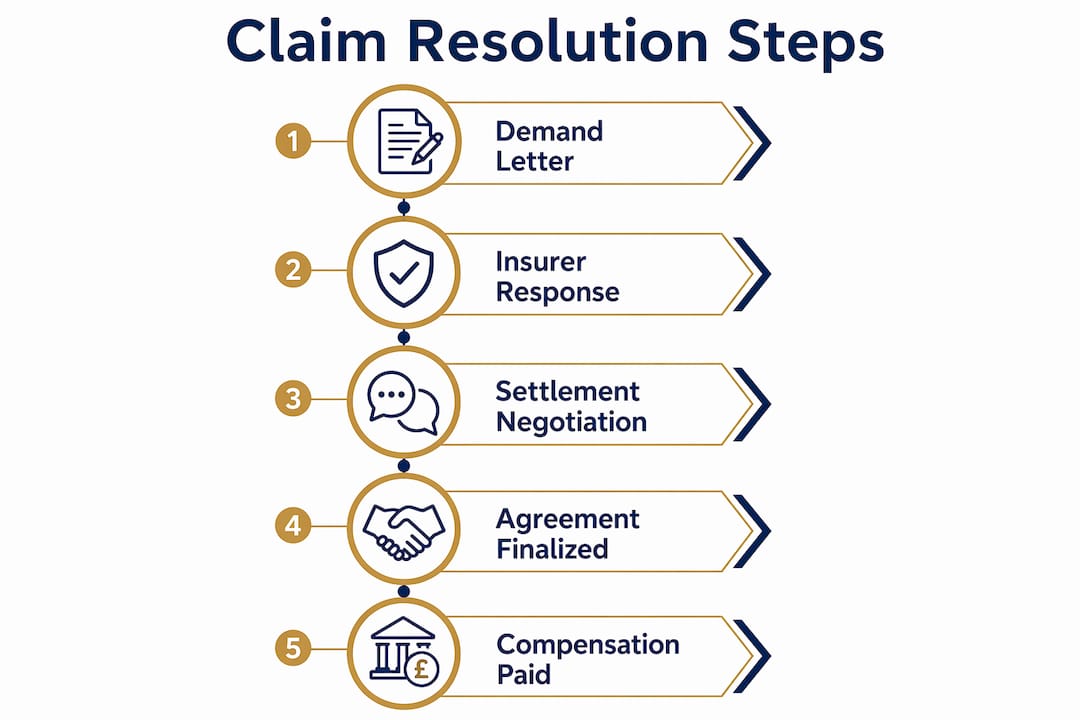
The settlement process works as follows. Your solicitor sends a demand letter setting out the claim. The insurer or defendant responds, often with a lower counter-offer. Negotiations continue until both parties reach an agreed figure, or until it becomes clear that agreement is impossible. At that point, court proceedings become the appropriate route.
Litigation is not a failure of the process. It is a strategic tool used when negotiations stall or when the defendant disputes liability and evidence must be tested before a judge. The personal injury litigation guide from Alilegal explains exactly when and how that step is taken.
What damages can you expect compensation to cover?
Most claims take 6 months to 2 years to resolve, depending on the severity of the injury and whether liability is disputed. Waiting until you have reached maximum medical improvement before settling is the single most important timing decision you will make. Settling early locks in a figure that may not reflect your long-term losses.
Pro Tip: If an insurer makes an early offer shortly after the incident, treat it with caution. Early offers are almost always lower than what a fully documented claim would achieve. Your solicitor can advise on whether an offer reflects the true value of your losses.
Having worked closely with individuals pursuing compensation claims, the pattern I see most often is not legal complexity. It is a gap between what claimants expect and what the process actually delivers.
People frequently assume that having a genuine injury and a clear wrongdoer is enough. It is not. The legal system requires proof, documentation, and procedural compliance. A claimant who seeks medical care immediately, preserves evidence carefully, and instructs a solicitor early is in a fundamentally different position from one who waits, assumes the insurer will be fair, and tries to manage the process alone.
The other misconception I encounter regularly is that going to court means winning more. In reality, settlements are the norm for good reason. They offer certainty, speed, and privacy. Litigation is reserved for cases where the defendant refuses to engage reasonably or where liability is genuinely contested. Knowing the difference between those two situations is where experienced legal advice earns its value.
My honest advice: treat your claim as a professional process from the first day. Document everything, communicate clearly with your solicitor, and resist the pressure to settle before you know the full picture of your recovery. The law gives you the tools. Use them properly.
— Panagiotis

Alilegal’s civil litigation team supports individuals through every stage of the personal injury compensation process, from initial evidence gathering to settlement negotiations and court proceedings where necessary. The team works with transparency and clear communication, so you always know where your claim stands and what the next step involves. Alilegal offers fixed-fee arrangements and straightforward advice, removing the uncertainty that often stops people from pursuing legitimate claims. If you have been injured and want to understand your options, speak to a solicitor at Alilegal today. You can also explore the full claims process guide to understand what to expect at each stage.
A personal injury claim is a legal demand for compensation made by someone who has been injured due to another party’s negligence or wrongful act. It can be resolved through negotiation with an insurer or, where necessary, through court proceedings.
Most claims take between 6 months and 2 years to resolve, depending on the severity of the injury and whether liability is disputed. Claims involving serious or long-term injuries typically take longer because settlement should wait until maximum medical improvement is reached.
A strong claim includes medical records, evidence of the incident, proof of financial losses such as payslips and receipts, witness statements, and a clear account of how the injury has affected your life. A solicitor will help you compile these into a formal demand letter.
Yes. The majority of personal injury cases settle through negotiation before any court proceedings are issued. Litigation becomes necessary only when the defendant disputes liability or refuses to make a reasonable offer.
The standard limitation period in England and Wales is three years from the date of the injury or from the date you became aware of it. Claims against government bodies may have much shorter notice requirements, in some cases as little as 90 days.


