
Menu
Get Expert Legal Support Today

TL;DR:
- Personal injury cases involve legal claims for harm caused by negligence or wrongful conduct, covering physical, psychological, and reputational damage. The process requires prompt medical attention, evidence preservation, and professional legal support to ensure proper valuation and avoid missed deadlines. Compensation aims to restore losses, with factors like injury severity and evidence quality influencing the final award.
Personal injury cases are legal actions brought by individuals who suffer harm due to another party’s negligence or wrongful conduct, seeking financial compensation through tort law. The term “personal injury” covers a broader legal umbrella than most people realise. Physical, psychological, and reputational harm all fall within its scope, meaning you do not need a broken bone to have a valid claim. The legal foundation rests on four elements: duty of care, breach of that duty, causation, and provable damages. Miss any one of these, and the claim fails. Understanding how these elements interact is the first step toward protecting your rights after an accident or injury.
Personal injury law does not describe a single course of study or statute. Tort law principles and legal precedents form the backbone of every claim, which means the category of your injury directly shapes the evidence you need and the compensation you can recover.
The most common categories include:
The distinction between negligence, strict liability, and intentional torts matters practically. Negligence requires proof of fault. Strict liability does not. Intentional torts, such as assault, carry different limitation periods and may attract additional remedies. Knowing which category applies to your situation determines the legal strategy from day one.
The claims process follows a clear sequence, though the timeline varies considerably depending on complexity and whether the other party disputes liability.
The limitation period in England and Wales is generally three years from the date of the accident or from the date you became aware of the injury. Missing this deadline extinguishes your right to claim in almost every circumstance.
Pro Tip: Keep a daily diary of your symptoms, medical appointments, and how the injury affects your daily life. Courts and insurers place significant weight on contemporaneous records when assessing non-economic damages such as pain and suffering.

Compensation in personal injury claims aims to restore you, as far as money can, to the position you were in before the injury occurred. Damages awarded cover both financial losses and emotional harm. The two main categories are economic and non-economic damages.
| Damage type | What it covers | Examples |
|---|---|---|
| Economic (special damages) | Quantifiable financial losses | Medical bills, rehabilitation costs, lost earnings, future care costs |
| Non-economic (general damages) | Subjective, non-financial harm | Pain and suffering, loss of amenity, psychological distress, reputational harm |
| Punitive damages | Punishment for egregious conduct | Rarely awarded in English courts; more common in other jurisdictions |
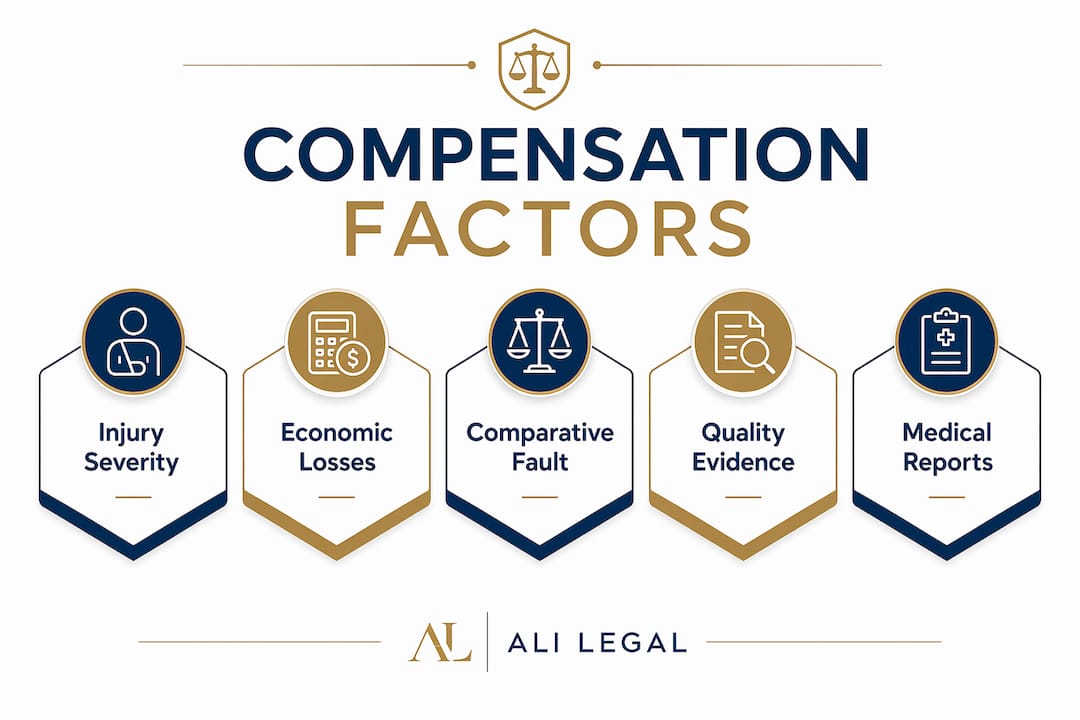
Several factors influence the final figure:
Injury severity and prognosis. A permanent disability commands significantly higher general damages than a soft tissue injury that resolves within months. Medical expert evidence is essential to establish long-term impact.
Comparative fault. English law applies contributory negligence under the Law Reform (Contributory Negligence) Act 1945. If you are found partly responsible for your own injury, your damages are reduced proportionally. In some jurisdictions, a plaintiff 50% or more at fault is barred entirely from recovery. English law takes a more proportionate approach, but a finding of contributory negligence still reduces your award materially.
Quality of evidence. A well-constructed claim supported by medical records, expert reports, and contemporaneous witness evidence achieves better outcomes than one relying on memory alone.
Pro Tip: Obtain a medical report from an independent expert, not just your treating clinician. Courts give greater weight to independent evidence, and insurers are less likely to dispute a well-supported prognosis.
Self-representation in personal injury litigation is rarely advisable. Proving causation requires bridging law with medicine, engineering, and physics, a combination that is genuinely difficult for anyone without legal training to manage effectively.
Experienced solicitors bring several advantages that directly affect your outcome:
The complexity of personal injury litigation means that even straightforward-looking cases can become contested disputes over causation or contributory negligence. Professional guidance from the start reduces that risk considerably.
The most common mistake I see is delay. People wait weeks before seeing a solicitor, sometimes because they hope the matter will resolve itself, sometimes because they underestimate the seriousness of their injuries. By the time they seek advice, evidence has been lost, witnesses have forgotten details, and the insurer has already formed a view of the claim.
The second mistake is accepting the first offer. Insurers make early offers precisely because they know claimants are often in financial difficulty and unfamiliar with the true value of their losses. An early offer rarely reflects future medical costs, long-term loss of earnings, or the full extent of psychological harm.
What actually works is simple: act quickly, document everything, and take professional advice before speaking to any insurer. The UK legal essentials around limitation periods and pre-action protocols are unforgiving. Missing a deadline is not a technicality. It is the end of your claim.
The legal landscape for claimants in 2026 is more claimant-aware than it was a decade ago, but insurers have also become more sophisticated in their defence strategies. The claimants who achieve fair outcomes are those who treat their claim as seriously as the other side does. Seek qualified legal support early, maintain realistic expectations, and trust the process.
— Panagiotis
Alilegal handles personal injury and civil litigation matters for individuals across the UK, offering clear advice, fixed fees where possible, and direct access to experienced solicitors from the first consultation.

Whether your case involves a road traffic accident, a workplace injury, or a medical negligence claim, Alilegal’s team builds the evidence-led approach that gives your claim the best chance of a fair outcome. The 2026 compensation guide on the Alilegal website covers the latest guidelines on damages in detail. For clients who need to pursue a disputed claim through the courts, Alilegal’s civil litigation service provides the full range of litigation support. Contact Alilegal today to discuss your situation with a solicitor who will give you a straight answer.
Personal injury covers physical harm, psychological suffering, emotional distress, and reputational damage caused by another party’s negligence or wrongful act. It is not limited to bodily injuries.
A claim is a formal demand for compensation submitted to the responsible party’s insurer. A lawsuit is court action taken when the insurer disputes liability or the settlement offer is inadequate.
The standard limitation period in England and Wales is three years from the date of the accident or from the date you became aware of the injury. Missing this deadline typically ends your right to claim.
Compensation covers economic losses such as medical costs and lost earnings, plus non-economic losses such as pain, suffering, and loss of amenity. Contributory negligence reduces the award proportionally if you are found partly at fault.
Most claims settle before trial through negotiation with the insurer. Court proceedings are issued when settlement fails, but the majority of cases resolve before a judge makes a final ruling.


