
Menu
Get Expert Legal Support Today
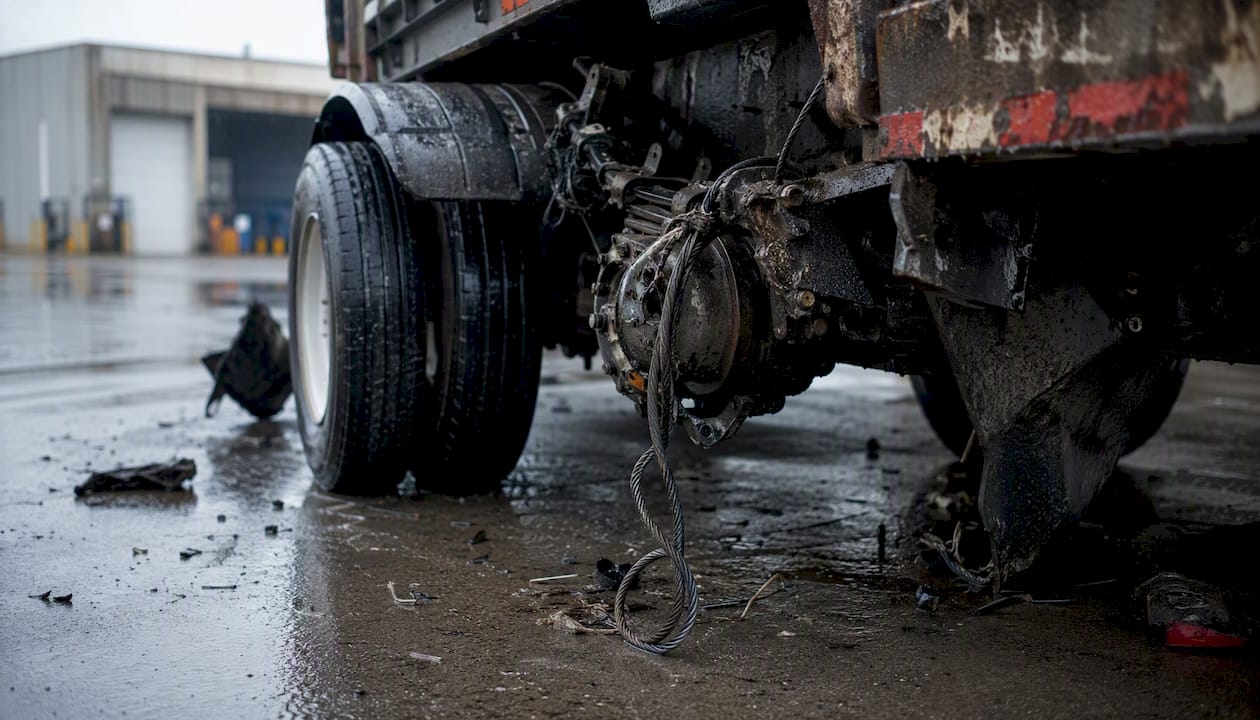
When a commercial vehicle incident occurs, the first call should be to a specialist commercial solicitor, not your insurer. Preserve all telematics and dashcam data immediately, and notify your insurer within the contractual notice period. Regulatory exposure from the DVSA and Traffic Commissioners can compound civil liability fast, particularly where operator licences or ECMT and bilateral permit compliance is in question. Ali Legal Ltd advises businesses on exactly this intersection of commercial liability and regulatory risk.
Pro Tip: Instruct your solicitor before forwarding evidence to insurers. Correspondence sent under legal privilege cannot be disclosed in subsequent proceedings; evidence sent directly to insurers generally cannot attract that protection.
For a corporate fleet operator, legal advice after a motor vehicle incident is not the same as a consumer road traffic accident claim. The relevant issues are fleet liability, insurer disputes, subrogation recovery, contractual exposure, and cross-border permit compliance — not personal injury compensation.
Escalate to specialist counsel when any of the following arise:
Under the Goods Vehicles (Licensing of Operators) Act 1995, Traffic Commissioners hold powers to revoke, suspend, or curtail operator licences. A single serious incident can trigger a public inquiry, which makes early legal involvement a commercial necessity rather than a precaution.
Speed matters here. Evidence degrades, telematics data overwrites, and contractual notice windows close. The timeline below sets out who does what and when.
0–2 hours
2–24 hours
24–72 hours
Pro Tip: Log every item of evidence with a chain-of-custody record: who collected it, when, and where it is stored. Courts and arbitral tribunals give significantly more weight to evidence with a clear, documented provenance.
Getting the right people in the room early prevents costly gaps in your response.

Internal stakeholders
Your fleet manager leads the operational response: vehicle recovery, driver welfare, and maintenance record retrieval. The compliance officer assesses operator licence and permit status. HR becomes relevant if the driver’s employment status, hours compliance, or conduct is in question. The operations director should be briefed within hours if the incident affects service continuity or a major client contract.
External advisers
A specialist commercial solicitor takes the lead on legal strategy, privilege, and insurer communications. Your claims handler and loss adjuster manage the insurance process, but their instructions should be coordinated with legal counsel to avoid inadvertent admissions. For incidents involving telematics disputes or vehicle reconstruction, a forensic telematics expert can be decisive. Where the incident occurred abroad or involves a foreign operator, overseas counsel familiar with the relevant jurisdiction should be instructed promptly. The DVSA and the International Road Haulage Permits Office are the primary regulatory contacts for permit and licence compliance queries.
The right route depends on the value of the claim, the relationship between the parties, and whether regulatory enforcement is also in play. Transport dispute resolution typically begins with contract review and direct negotiation before escalating.
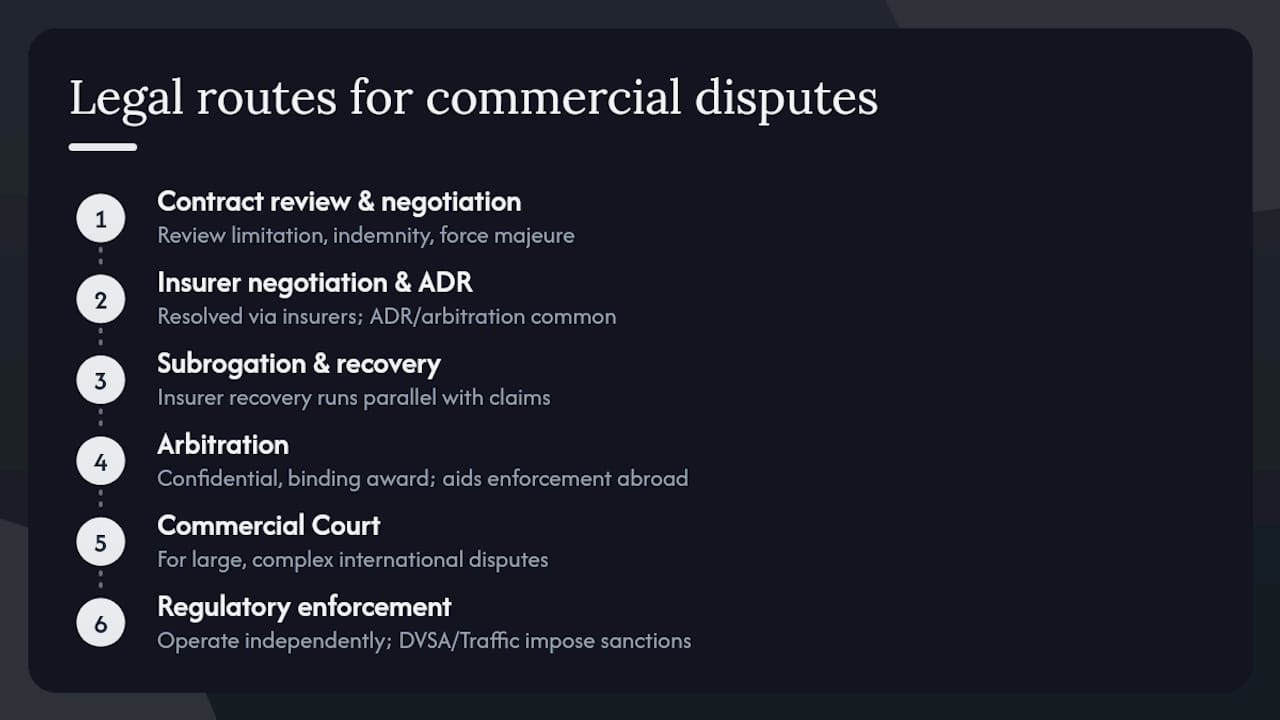
Insurer negotiation and ADR. Most commercial vehicle claims are resolved through insurer channels. Where coverage is disputed, insurance disputes frequently involve ADR or arbitration clauses, and complex or multi-policy cases often proceed to the Commercial Court. Reviewing the policy’s forum clause before any dispute crystallises is worth doing early.
Subrogation and third-party recovery. Where your insurer pays out and seeks to recover from a negligent third party, subrogation proceedings can run in parallel with your own contractual claims. Coordinating these avoids duplication and conflicting positions.
Contractual claims. Delivery failures, cargo damage, and liability cap disputes are governed by the contract. Early review of limitation, indemnity, and force majeure clauses is the foundation of any commercial dispute strategy.
Arbitration. Chosen frequently for commercial confidentiality and specialist expertise, arbitration produces a binding award enforceable across most jurisdictions. It suits cross-border incidents where enforcement abroad is a real concern.
Commercial Court. The Commercial Court handles large, complex, and international business disputes, including arbitration award challenges and international trade matters. Parties require solicitor or barrister representation and must follow CPR Part 58 where applicable. It is the appropriate forum for high-value or legally complex fleet and insurer disputes.
Regulatory enforcement. DVSA and Traffic Commissioners operate independently of civil proceedings. Operator licence sanctions, fines, and public inquiries run on their own track and can affect your business regardless of how the civil claim resolves.
Pro Tip: Arbitration clauses in transport contracts often specify the seat and governing law. If your contract is silent on this, a court may decide the forum for you, which can be expensive and unpredictable in cross-border cases.
Corporate legal buyers should treat this as a procurement decision, not a referral. The criteria that matter most are sector depth, jurisdictional reach, and fee transparency.
Selection criteria
Questions to ask a prospective firm
Red flags to watch for
A firm with no forensic or technical partners, no transport litigation track record, or an inability to explain its escalation plan for cross-border matters should prompt you to look elsewhere. Vague fee structures are a separate warning sign: cost uncertainty in commercial litigation is itself a risk.
Cost is driven by claim value, the need for expert evidence, the dispute route chosen, and whether cross-border enforcement is involved.
Mediation and ADR can resolve disputes in weeks to a few months at relatively contained cost. Arbitration typically runs over several months, with costs scaling to the complexity of the evidence and the seniority of the tribunal. Commercial Court litigation for complex or high-value matters commonly takes a substantial period from issue to judgment, often more than a year, with costs generally reflecting the complexity involved. The Commercial Court’s own guidance makes clear that parties should expect to engage experienced legal representation throughout.
The single largest cost driver in fleet disputes is expert evidence. Telematics reconstruction, vehicle inspection reports, and forensic analysis of driver data can each add materially to the overall spend. Instructing a solicitor who can coordinate these experts efficiently, rather than managing them separately, tends to reduce duplication.
For cross-border disputes and international arbitration, budget for overseas counsel fees and the possibility of parallel regulatory proceedings in the foreign jurisdiction.
Licence and permit status at the time of an incident can determine whether your insurer pays, whether you face prosecution abroad, and whether a Traffic Commissioner opens a public inquiry.
Operator licence types
ECMT and bilateral permits
ECMT permits remain relevant for triangular traffic and certain non-EU routes. The 2024 amendments to operator licensing and permit rules adjusted Norway bilateral permit requirements, clarified Northern Ireland own-account operator rules, and formalised exemptions for vehicles temporarily in Great Britain. Bilateral permits for some routes are obtainable at around £8 each, though the administrative implications for smaller operators are worth planning for.
| Licence or permit type | When required | Enforcement consequences |
|---|---|---|
| Restricted operator licence | Own-account goods, Great Britain only | Traffic Commissioner sanction if used for hire or reward |
| Standard national licence | Hire or reward, Great Britain only | Revocation, suspension, or fine for international use |
| Standard international licence | Hire or reward to EU/EEA and specified countries, vehicles over 2.5 tonnes MAM | DVSA fines, prosecution abroad, Traffic Commissioner inquiry |
| ECMT permit | Triangular traffic and certain non-EU routes where bilateral permits unavailable | Permit withdrawal, cross-border prosecution risk |
| Bilateral permit | Specific non-EU country routes as agreed | Permit cancellation, enforcement in destination country |
The decision is rarely about who is right. It is about cost, time, evidence strength, and what a judgment or award actually achieves.
Work through these factors before committing to full proceedings:
For commercial litigation decisions, the escalation path most transport disputes follow is negotiation, then mediation, then arbitration or court proceedings as the contract or commercial situation requires.
Pro Tip: Before committing to litigation, calculate your subrogation recovery potential and any set-off risks. A third-party recovery that partially offsets your costs can change the economics of the decision entirely.
Fleet incidents and cross-border transport disputes move fast. Ali Legal Ltd works with UK businesses and corporate clients who need decisive legal support from the moment an incident occurs, not weeks later when evidence has degraded and insurer positions have hardened.

Ali Legal Ltd’s practice covers commercial litigation, international disputes, and arbitration, with fixed-fee options and transparent communication at every stage. For businesses managing fleet liability, insurer disputes, or cross-border claims, that combination of speed and cost clarity is what makes the difference between a contained incident and a protracted dispute. The firm coordinates forensic evidence, instructs overseas counsel where needed, and handles the full range of resolution routes from ADR through to international arbitration and Commercial Court proceedings.
To instruct Ali Legal Ltd or arrange an initial review of your position, contact the team directly at Alilegal.
The businesses that handle fleet incidents well share one habit: they treat the first hour as a legal matter, not just an operational one. Evidence that is preserved under privilege in that first hour is worth more than any amount of reconstruction later. What I see most often is the opposite: insurers notified, statements given, and telematics data shared before a solicitor has been briefed. By that point, the legal options have already narrowed.
Fixed fees and a clear action plan from day one are not just commercial conveniences. They let your operations team focus on continuity while legal strategy runs in parallel, rather than the two functions pulling in different directions. That separation of roles, with clear communication between them, is what keeps a serious incident from becoming a prolonged dispute.
This article is general information, not a substitute for advice from a qualified lawyer. Consult a qualified legal professional about your own circumstances before acting on anything here.


