
Menu
Get Expert Legal Support Today

TL;DR:
- Most commercial disputes in England and Wales are resolved through negotiations, arbitration, or courts, without reaching a trial.
- Choosing the appropriate route depends on factors like dispute value, speed, confidentiality, and enforceability, with early action and settlement often being the best strategy.
A commercial dispute is a civil disagreement arising from business activity where one party alleges that another has failed to perform, pay, or govern as agreed. The immediate outcomes available are a negotiated settlement, a mediated agreement, an arbitration award, or a court judgment. Most commercial disputes never reach a courtroom at all.
In England and Wales, these disputes are governed by the Civil Procedure Rules (CPR), with specialist tracks including the Commercial Court and dedicated arbitration procedures under the Arbitration Act 1996. Knowing which track applies to your situation shapes every decision that follows.
Likely outcomes at a glance:
The term covers any civil claim arising from business activity: a breach of contract, a tortious wrong in a commercial context, a company law dispute, or a failure of governance. What distinguishes a commercial dispute from a personal civil claim is the commercial context, not the size of the sum involved.

Under CPR Parts 58, 61 and 62, the courts treat commercial, admiralty and arbitration matters as distinct procedural categories. CPR Part 58 governs the Commercial Court list specifically, setting out how claims are issued, managed and tried. The Commercial Court Guide reflects the practical experience of Commercial Judges and gives them flexibility to adapt procedure to the needs of each case, including how they exercise discretion on costs.
The Commercial Court itself is reserved for complex, high-value or international disputes: international trade, banking and financial services, commodities, insurance, and arbitration-related matters. Smaller or less complex cases are transferred to the Circuit Commercial Courts, which sit at key commercial centres across England and Wales and follow the same specialist-judge model. Not every business dispute belongs in the Commercial Court, and judges will transfer cases that lack the necessary complexity or value.
Where a contract contains an arbitration clause, the Arbitration Act 1996 governs how the dispute is referred and conducted. Awards made under institutional rules such as those of the London Court of International Arbitration (LCIA) are enforceable internationally under the New York Convention, which is why arbitration clauses are common in cross-border contracts.
Limitation periods matter. Most contract claims must be brought within six years of the breach; some specialist claims have shorter windows. Pre-action protocols under the CPR require parties to exchange information and explore settlement before issuing proceedings. Missing either deadline can extinguish a claim or attract cost penalties.
Recognising the category of your dispute helps you identify the legal issues and the most appropriate resolution route.
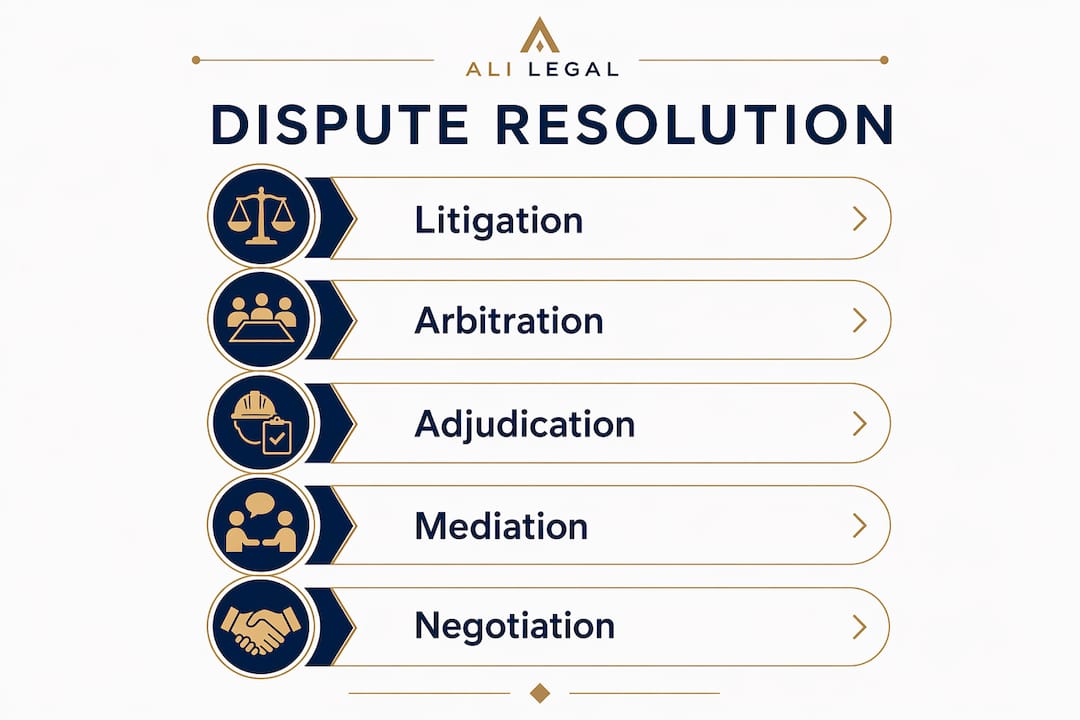
The five main routes are litigation, arbitration, adjudication, mediation, and negotiation. They differ on every dimension that matters to a business: cost, speed, privacy, and what happens if the other side ignores the outcome.
| Resolution route | Binding? | Private? | Typical speed | Relative cost | Enforceability | Best suited to |
|---|---|---|---|---|---|---|
| Litigation | Yes | No (public) | Months to years | High | Court judgment enforceable in England and Wales; reciprocal enforcement abroad varies | High-value, complex, or precedent-setting disputes |
| Arbitration | Yes | Yes | Months to years | Medium–high | New York Convention: enforceable in 170+ countries | Cross-border, specialist or contractually mandated disputes |
| Adjudication | Yes (temporarily) | Yes | Weeks | Low–medium | Enforceable as a court judgment; subject to final determination later | Construction and infrastructure disputes |
| Mediation | No (unless settled) | Yes | Days to weeks | Low | Settlement agreement is contractually binding if reached | Any dispute where relationship or confidentiality matters |
| Negotiation | No (unless settled) | Yes | Days to months | Lowest | Settlement agreement is contractually binding if reached | Lower-value or early-stage disputes |
Litigation through the Commercial Court is public, comprehensive, and backed by the full coercive power of the state. Judges can award damages, grant injunctions, make freezing orders, and order specific performance. The Commercial Court Guide sets out how judges manage cases proactively and how compliance with procedural obligations affects costs. The trade-off is time and expense: disclosure, expert evidence, and multi-day hearings add up.
Arbitration is private and produces a binding award. The Arbitration Act 1996 provides the statutory framework in England and Wales, and institutional rules such as those of the LCIA govern procedure where parties have chosen them. The New York Convention means an LCIA award can be enforced in over 170 countries, which is a decisive advantage for cross-border disputes. Ali Legal Ltd’s guide to arbitration in commercial law explains the mechanics in detail.
Adjudication is fast-track and designed primarily for construction contract disputes. A decision typically arrives within a few weeks of referral. The decision is binding and enforceable immediately, though either party can seek a final determination through arbitration or litigation afterwards.
Mediation is the most widely used ADR route in the UK. The Centre for Effective Dispute Resolution (CEDR) provides institutional mediation services and practitioner training. A mediator does not decide the case; they help parties reach their own agreement, which, once signed, is a binding contract. Negotiation operates similarly but without a neutral. Both are confidential, which matters when reputational or commercial sensitivity is high.
Pros and cons at a glance:
The right route depends on six factors: the value at stake, how quickly you need a result, whether confidentiality matters, where enforcement will happen, whether technical expertise is needed, and how much the relationship is worth preserving.
Questions to ask before committing to a route:
When ADR and litigation run in parallel, the mounting cost and timetable pressure of court proceedings often push parties towards settlement. ADR alongside litigation is a recognised strategy, not a fallback. The Chambers Dispute Resolution guide notes that ADR is increasingly embedded into litigation strategy rather than treated as a separate track.
Refusing to engage in ADR carries a real cost risk. Courts and practitioners increasingly expect early consideration of mediation or other processes, and unreasonable refusal can be reflected in adverse costs orders even if you win on the merits.
Pro Tip: Early neutral evaluation, where an independent expert gives a rapid, non-binding view of the merits, can break a negotiation deadlock without the cost of a full hearing. It gives both sides a reality check and often triggers settlement within weeks.
Speed matters. The steps you take in the first days determine what evidence you can use, what remedies remain available, and whether you preserve your limitation period.
Timeline template:
Winning a judgment or award is only half the task. Enforcement is where many disputes stall.
For disputes involving cross-border document preparation or notarisation requirements, the formalities vary by jurisdiction and are worth confirming with a specialist before enforcement proceedings begin, such as outlined in Court Affidavit Requirements: What Brampton Businesses Need.
There is no honest single answer, but the ranges below reflect typical UK experience.
Time ranges by route:
Cost drivers include legal fees (the largest element), expert witness reports, disclosure and document review, hearing length, and the risk of an appeal extending the process. Costs in Commercial Court litigation can run to hundreds of thousands of pounds for complex cases; mediation can often be concluded for a fraction of that.
The practical lesson is to plan costs in stages: initial advice, pre-action steps, ADR, and only then full proceedings if necessary. Fixed-fee scoping at the outset gives you a clear picture before committing to a route.
These steps reflect the approach Ali Legal Ltd takes when a client first brings a commercial dispute to the firm.
Most businesses instinctively reach for the phone to call a solicitor only when a dispute has already escalated. By that point, documents have been deleted, positions have hardened, and the cost of resolution has multiplied. The firms that consistently achieve better outcomes are those that treat a dispute as a project management problem from day one: evidence, budget, strategy, and a clear view of what a good result actually looks like.
The conventional wisdom is that litigation is the serious option and ADR is what you try when you cannot afford court. That framing is wrong. Mediation, used early and with proper preparation, often produces outcomes that litigation cannot: a preserved trading relationship, a confidential settlement, a result in weeks rather than years. The question is not whether to use ADR but when and how to use it alongside, not instead of, a credible litigation threat.
Confidentiality is undervalued. A public judgment that sets out the details of a failed contract or a governance breakdown can do lasting reputational damage even when you win. Arbitration and mediation keep those details private. For businesses in sectors where reputation is a commercial asset, that alone can justify the choice of route.
The other thing businesses consistently underestimate is the cost of doing nothing. A disputed invoice left unresolved for six months is not just a cash-flow problem; it is a signal to the other party that you will not enforce your rights. Early, clear action, even a well-drafted letter before action, changes the commercial dynamic.

A commercial dispute becomes a solicitor’s matter the moment it involves a contract clause you are unsure about, a cross-border counterparty, a claim above a value your business cannot absorb, or a risk that the other side will dissipate assets before you can enforce. Waiting for certainty before instructing a solicitor is one of the most common and costly mistakes businesses make.
Ali Legal Ltd offers fixed-fee scoping calls so you can understand your position, your options, and a realistic cost range before committing to any route. The firm handles the full spectrum of commercial dispute work: strategy and pre-action advice, ADR facilitation, Commercial Court litigation, and international arbitration for cross-border matters. For disputes touching on property or corporate governance, Ali Legal Ltd’s corporate litigation team can advise on the full range of remedies available.

Contact Ali Legal Ltd to arrange a fixed-fee initial consultation and get a clear picture of where your dispute stands.
This article provides general information about commercial disputes in England and Wales and does not constitute legal advice. For advice on your specific situation, consult a qualified solicitor or contact Ali Legal Ltd directly.


