
Menu
Get Expert Legal Support Today

TL;DR:
- Business dispute mediation is a confidential, voluntary process where a neutral mediator helps parties negotiate a settlement without imposing a decision. It preserves control for business owners and can resolve issues faster and more cost-effectively than arbitration or litigation, often maintaining ongoing relationships. Successful mediation requires thorough preparation, choosing experienced mediators, and having decision-makers present to ensure enforceable agreements.
Business dispute mediation is defined as a confidential, voluntary process in which a neutral mediator helps disputing parties negotiate a settlement without imposing a decision on either side. Unlike litigation or arbitration, mediation keeps control with the parties themselves. No judge decides the outcome. No arbitrator issues a binding award. The mediator facilitates communication, tests assumptions, and helps both sides move from entrenched positions toward a workable agreement. For business owners and executives, that distinction matters enormously, because it means you can resolve a dispute without surrendering control of the result.
Business dispute mediation is the recognised industry term for what practitioners also call commercial mediation or alternative dispute resolution (ADR). The process is confidential and voluntary by design. Nothing said in mediation can be used as evidence in court proceedings. That protection encourages candid conversation, which is precisely why it works in commercial contexts where reputations and ongoing relationships are at stake.

The mediator plays a specific role. They do not give legal advice, pass judgement, or decide who is right. Their job is to create conditions where both parties can communicate clearly and negotiate honestly. Sessions can take place in person, by video call, or through a combination of both. The Harvard Program on Negotiation describes the process as flexible, noting that formats range from joint conversations to shuttle diplomacy where the mediator moves between parties separately.
Mediation applies across a wide range of commercial disputes: contract disagreements, partnership breakdowns, supplier conflicts, employment matters, and property disputes. The types of dispute resolution available to UK businesses are broader than most executives realise, but mediation consistently stands out for its speed and cost efficiency.
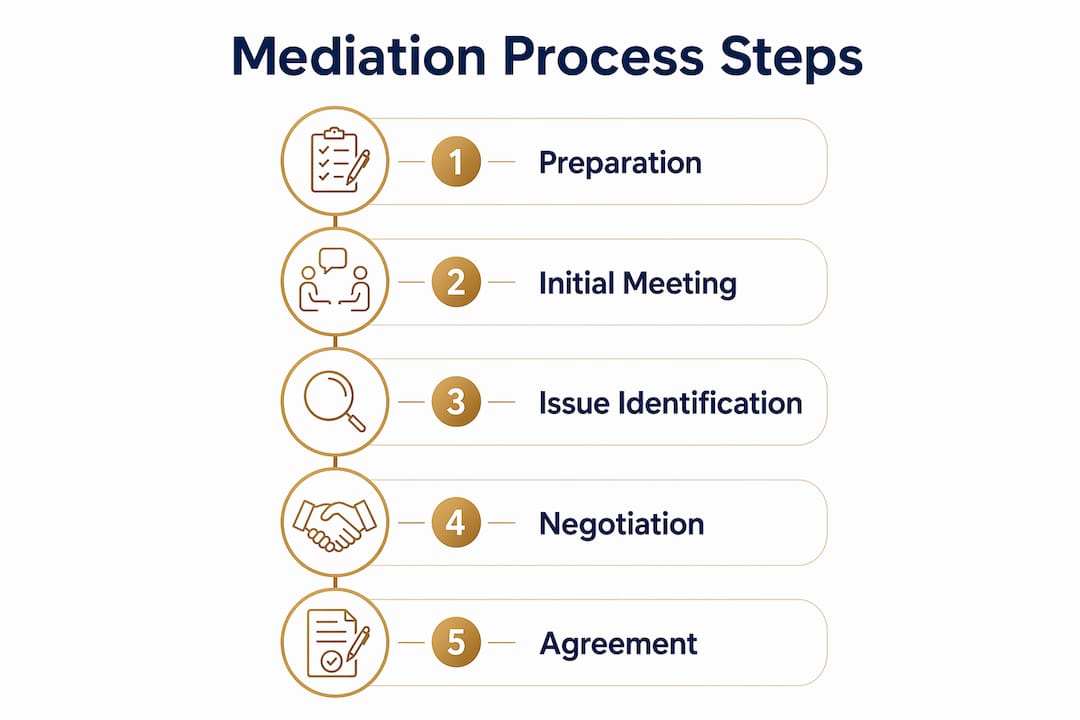
The Harvard Program on Negotiation outlines a structured yet flexible sequence that most commercial mediations follow. Understanding each stage helps you arrive prepared rather than reactive.
Most commercial mediations last between a few hours and a full working day. Some complex disputes require multiple sessions. The Ninth Circuit Mediation Program in the United States uses confidential telephone assessments before scheduling sessions to confirm suitability and set realistic expectations. UK commercial mediators often follow a similar pre-mediation consultation approach.
Pro Tip: Brief your mediator thoroughly before the session. Share your key documents, your real interests, and your settlement range. A well-briefed mediator can test the other side’s assumptions far more effectively during private caucuses.
The three main paths for resolving a commercial dispute are mediation, arbitration, and litigation. Each serves a different purpose, and choosing the wrong one costs time, money, and sometimes the business relationship itself.
| Factor | Mediation | Arbitration | Litigation |
|---|---|---|---|
| Confidentiality | Full | Usually yes | Public record |
| Decision maker | The parties | Arbitrator | Judge |
| Binding outcome | Only if agreed | Yes | Yes |
| Typical speed | Weeks | Months | Years |
| Cost | Lowest | Moderate to high | Highest |
| Relationship impact | Preserves | Neutral | Often damages |
| Flexibility | High | Moderate | Low |
Mediation is typically faster and less expensive than either arbitration or court proceedings. Sessions are often scheduled within weeks of instruction, and costs are shared between the parties. That efficiency matters when a dispute is tying up management time and straining a commercial relationship.
Arbitration produces a binding decision, which makes it appropriate when parties need certainty and cannot reach voluntary agreement. Litigation is the right choice when a legal precedent is needed, when enforcement through the courts is required, or when one party refuses to engage in any voluntary process. Many businesses settle rather than fight because the cost and reputational exposure of litigation outweighs the potential gain.
Mediation works best when both parties broadly agree on the facts but disagree on how to respond. It also works well when preserving the commercial relationship matters. Arbitration and litigation, by contrast, tend to produce winners and losers. That adversarial dynamic can permanently damage partnerships, supplier relationships, and joint ventures.
For a detailed comparison of litigation alternatives for businesses, the range of options is wider than most executives consider at the outset of a dispute.
Preparation is the single biggest determinant of mediation success. Research from ADR.org confirms that thorough risk assessment before the session matters more than performance during it. Executives who arrive having genuinely analysed their legal position, their costs, and their best alternative to a negotiated agreement are far better placed to reach settlement.
Before the session:
Choosing the right mediator:
Mediator selection has a direct impact on outcomes. Harvard’s Program on Negotiation notes that mediator style influences results, with more assertive approaches sometimes producing better outcomes in hard-nosed commercial disputes. A mediator with sector experience understands the commercial realities behind the legal claims. Ask for a mediator who has handled disputes of similar value and complexity.
During the session:
Pro Tip: Prepare a written settlement range before you walk in. Know your ideal outcome, your realistic target, and your absolute floor. Executives who have not done this work often make poor decisions under the pressure of a live negotiation.
For structured guidance on preparing for legal consultation, the preparation principles apply equally to mediation sessions.
Mediation is the only dispute resolution method specifically designed to preserve the relationship between the parties. Litigation and arbitration produce a verdict. Mediation produces an agreement. That distinction shapes everything about how the process unfolds.
The mediator’s role in de-escalating tension is central to this. Commercial disputes often carry personal grievances alongside legal claims. A skilled mediator separates the interpersonal breakdown from the business issues, addressing both without letting either derail the negotiation. This separation allows executives to focus on what a workable future relationship looks like rather than who was right in the past.
Mediation settlements can include terms that go beyond financial compensation. Parties can agree on future communication protocols, revised contract terms, apologies, or joint statements. Courts cannot order these outcomes. They are only available through negotiated agreement, which is why mediation consistently produces more durable resolutions in ongoing commercial relationships.
The practical benefits for relationship preservation include:
ADR.org’s research confirms that navigating interpersonal and business issues separately within mediation allows teams to achieve settlement while keeping future relations intact. That outcome is simply not available through adversarial proceedings.
The most common mistake I see business leaders make in mediation is treating it like a court hearing. They arrive with a barrister’s brief, a list of legal arguments, and a determination to prove they are right. That approach wastes the process entirely.
Mediation is not about winning the argument. It is about finding the settlement that costs you less than continuing the fight. The executives who succeed are the ones who have done honest risk analysis before they walk in. They know what a bad outcome looks like. They know what they are willing to accept. They are not there to perform. They are there to resolve.
Mediator selection matters more than most clients expect. An experienced commercial mediator who understands your sector will challenge both sides in ways that move the negotiation forward. A mediator who is too passive simply reflects positions back and forth without breaking the deadlock. Ask your solicitor for a specific recommendation, not just a name from a panel list.
The other lesson I would offer is this: bring your decision-maker, not a representative. I have seen mediations collapse because the person in the room could not actually agree to anything without calling their board. That is not mediation. That is a preliminary meeting dressed up as one. Genuine authority to settle is not optional. It is the foundation on which the whole process rests.
— Panagiotis
Reaching a mediated settlement is only part of the challenge. The legal preparation before the session and the enforcement of any agreement afterwards require experienced commercial solicitors who understand both the law and the negotiation dynamics.

Alilegal’s commercial litigation team works with business owners and executives at every stage of a commercial dispute, from initial risk assessment through mediation preparation to settlement enforcement. The team provides fixed-fee advice, clear strategic guidance, and direct access to senior solicitors who have handled disputes across contract, property, partnership, and international commercial law. If mediation does not resolve the matter, Alilegal is positioned to take the case forward through arbitration or litigation without losing momentum. Contact Alilegal to discuss your dispute and get a clear view of your options before your next session.
Business dispute mediation is a confidential, voluntary process where a neutral mediator helps disputing parties negotiate a settlement. The mediator facilitates communication but does not impose a decision; any agreement requires the consent of both parties.
Most commercial mediations last between a few hours and a full working day. Complex disputes may require multiple sessions, but mediation is consistently faster than arbitration or court proceedings.
A signed settlement agreement reached through mediation is legally enforceable. Courts can give effect to the terms if they are incorporated into ongoing proceedings, making the outcome as binding as any court order.
Mediation is the better choice when preserving the commercial relationship matters, when both parties want a confidential process, or when the cost and time of arbitration would outweigh the benefit. Arbitration is more appropriate when a binding decision is needed and voluntary agreement is unlikely.
Research from the Harvard Program on Negotiation confirms that mediator style directly influences commercial mediation results. A more assertive mediator can produce better outcomes in hard-nosed disputes, which is why choosing the right mediator for your specific context is a strategic decision, not an administrative one.


