
Menu
Get Expert Legal Support Today

Damages in a personal injury claim are the money awarded to compensate for two things: your pain, suffering and loss of amenity, known as general damages, and your quantifiable financial losses, known as special damages. General damages cover the injury itself, everything from a fractured wrist to long-term psychiatric harm. Special damages cover the money the injury has cost you: lost wages, medical bills, care, travel, and equipment.
Two actions matter more than anything else at this stage. First, get medical evidence on record early, even if that means a GP visit you’d otherwise skip. Second, start collecting receipts, payslips and bank statements immediately rather than trying to reconstruct them months later.
The general damages versus special damages split isn’t just a legal technicality. It decides what evidence you need and how your solicitor builds your case.
General damages compensate for pain, suffering and loss of amenity, often shortened to PSLA. This is the harder figure to pin down because there’s no invoice for a shoulder that no longer moves properly. Courts and solicitors rely on the Judicial College Guidelines to place an injury within a valuation bracket, cross-referenced against medical evidence. Common subheads within general damages include:
Special damages are past pecuniary losses, meaning financial costs that have already been incurred and can be calculated with precision. They must be pleaded with particulars and backed by vouching evidence such as receipts, invoices and payslips. Typical heads include loss of earnings, care costs (whether paid or provided by a family member), medical expenses, equipment such as mobility aids, and travel to appointments. Future pecuniary loss, covering ongoing or anticipated costs, sits alongside past loss but is calculated differently, which the next section covers.
Where a claimant suffers multiple injuries, courts sometimes apply an overlap discount to avoid double counting pain and suffering that stems from the same underlying trauma.
Pro Tip: Don’t assume a minor injury means minimal general damages. Chronic pain conditions and psychological injuries frequently attract higher brackets than claimants expect, provided the medical evidence properly documents ongoing impact.
Valuation isn’t guesswork, though it can feel that way from the outside. It follows a fairly consistent method, even if the final figure still depends on individual circumstances.
The multiplier effect surprises most claimants. A care need costing £15,000 a year doesn’t just multiply by remaining life expectancy; the Ogden tables adjust for discount rate and risk, which can still produce a lump sum running into hundreds of thousands of pounds for a younger claimant with a long life expectancy. In catastrophic injury cases, special damages routinely dwarf general damages precisely because lifetime care and lost earning capacity compound over decades.
Statistic callout: The size of an Ogden multiplier depends heavily on the discount rate set by the Lord Chancellor. A change of even half a percentage point in that rate can shift a lifetime care lump sum by tens of thousands of pounds, which is why claimants shouldn’t rely on rough annual-cost estimates when planning for long-term losses.
A claim is only as strong as its paperwork. Courts and defendant insurers expect vouched, itemised evidence, not estimates.
Start collecting the following as early as possible: medical records and expert reports, invoices and receipts for treatment or equipment, prescriptions, payslips covering the period before and after the injury, bank statements showing income disruption, receipts for travel to appointments, and a written statement from your employer confirming absence and any reduced duties.

The schedule of loss is the document that ties all of this together. It’s a running, itemised account of every past and anticipated future loss, and it needs updating as the claim develops, not written once and forgotten. The Pre-Action Protocol for Personal Injury Claims requires the Letter of Claim to include a clear summary of facts, injuries and a schedule of past and future losses, with an expectation that claimants keep defendants informed of ongoing financial loss.
Vouching standards apply strictly to special damages: a receipt or invoice for every claimed cost. Unpaid care provided by a family member, sometimes called gratuitous care, is valued differently, usually at a commercial care rate reduced by a discount, rather than left unclaimed simply because no money changed hands. For a fuller breakdown of what solicitors typically request, Scotland Claims Injury Lawyers set out a useful checklist of the evidence types insurers scrutinise most closely.
Pro Tip: If your losses are ongoing, ask your solicitor about an interim payment early. You don’t need to wait until settlement to recover money for costs you’re already incurring, provided liability has been reasonably established.
Time limits catch out more claimants than weak evidence does, so it’s worth knowing the framework before anything else slips.
A methodical process protects the value of a claim far more than any single clever argument. Early medical evidence, careful schedule drafting, timely expert instruction and, where liability looks clear, an early interim payment application all shape the eventual figure. This mirrors the approach set out in Ali Legal’s guide to personal injury compensation, which walks through joint expert instruction, contemporaneous care logging and commercial-rate valuation of gratuitous care.
Claimants who keep a running record from day one, rather than reconstructing costs from memory months later, consistently end up with stronger, better-evidenced schedules of loss.
Fixed-fee and transparent pricing structures remove one layer of uncertainty from an already stressful process, letting claimants focus on gathering evidence rather than worrying about legal costs escalating unpredictably.
Author: Panagiotis. [Qualifications and experience placeholder.] [Case studies placeholder.]
Punitive damages, called exemplary damages in England and Wales, are rare in personal injury claims and shouldn’t be confused with compensation for the injury itself. Where general and special damages exist to put the claimant back in the position they’d have been in without the injury, exemplary damages exist purely to punish the defendant for outrageous conduct.
They’re reserved for a narrow set of circumstances: where a defendant’s conduct was calculated to make a profit exceeding any compensation likely to be paid, where a government servant acted in an oppressive, arbitrary or unconstitutional way, or where a statute expressly authorises them. A drunk driver who caused an accident, however reckless, typically wouldn’t attract exemplary damages on those grounds alone. But a company that knowingly continued selling a dangerous product because the profit outweighed likely compensation claims might.
In practice, most personal injury claims never involve exemplary damages at all. The overwhelming majority of cases, from workplace accidents to road traffic collisions, are settled purely on compensatory principles: general damages for the injury, special damages for the financial loss. If you believe a defendant’s conduct was so deliberate or reckless that punishment feels warranted, raise it with your solicitor early, since it changes how the claim is pleaded and what evidence needs gathering from the outset.
Contributory negligence reduces your compensation when you’re found partly responsible for your own injury, even where the defendant is primarily at fault. Courts apportion blame as a percentage, and your total award, both general and special damages, is reduced by that percentage.
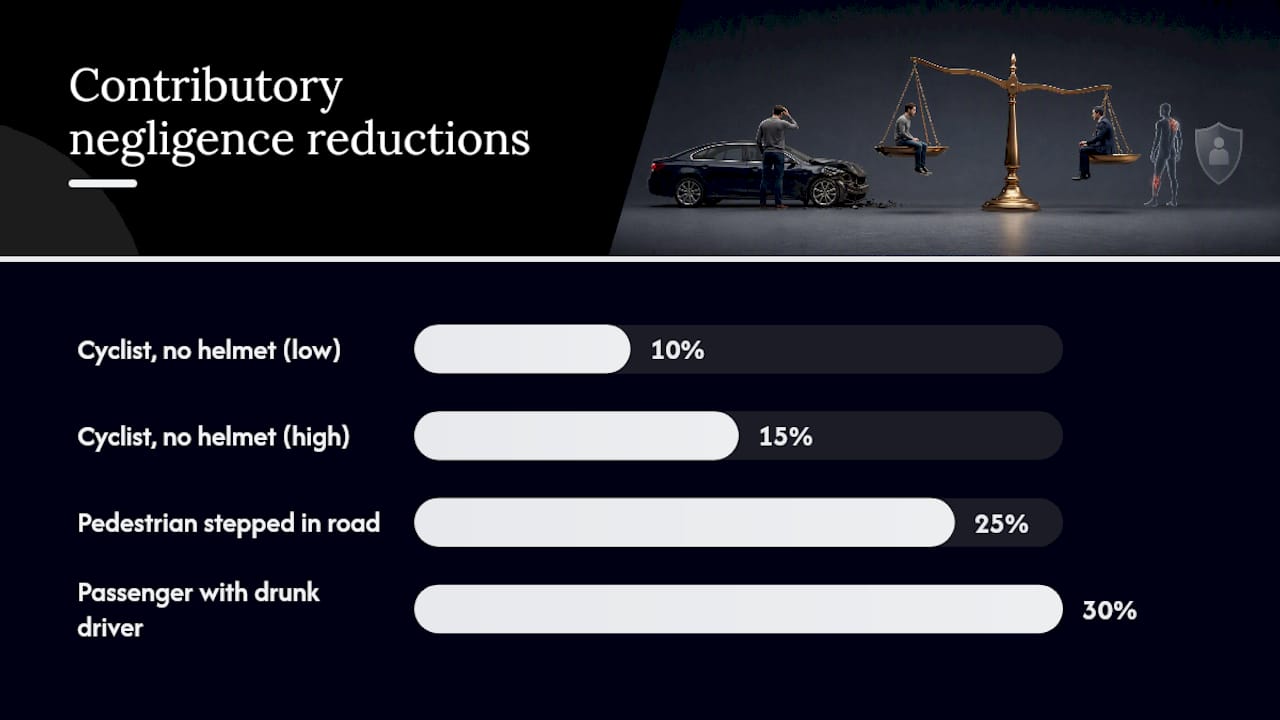
A cyclist injured by a careless driver but not wearing a helmet might see their award reduced by 10 to 15%, depending on how much the missing helmet contributed to the severity of the injury. A pedestrian who steps into the road without looking, hit by a speeding driver, might face a more substantial reduction, perhaps 25% or higher, because their own conduct materially contributed to the accident occurring at all. Passengers who knowingly travel with a drunk driver have historically faced meaningful reductions too.
The percentage isn’t fixed by any tariff. It comes from case-specific argument about causation and blameworthiness, which is exactly why insurers often push hard on contributory negligence early in negotiations.
This is where evidence quality becomes decisive again. Dashcam footage, witness statements and accident reconstruction reports can all shift the contributory negligence percentage substantially. If an insurer suggests you were partly at fault, don’t accept that framing without pushing back, since the difference between a 10% and 30% reduction on a serious injury claim can amount to tens of thousands of pounds.
Most personal injury claims settle long before they reach a courtroom. Negotiation typically begins once the defendant’s insurer has admitted liability, or at least accepted a reasonable prospect of it, and the claimant’s solicitor has produced a properly evidenced schedule of loss.

The process usually runs through rounds of offer and counter-offer. The insurer proposes a figure, often lower than the schedule suggests, and the claimant’s solicitor responds with supporting evidence for why the higher figure is justified, whether that’s a stronger medical prognosis, additional receipts, or updated care costs. Part 36 offers, a formal settlement mechanism under the Civil Procedure Rules, add cost consequences that push both sides toward realistic figures rather than opening positions.
Settling avoids the cost, delay and uncertainty of a trial, and the overwhelming majority of claims resolve this way. But settlement only works well when the schedule of loss is airtight. A poorly evidenced claim invites lowball offers, because the insurer knows a court might not award much more than what’s already vouched.
Court awards become necessary when liability is disputed, when the parties can’t agree on quantum despite strong evidence, or when the case involves complex future loss calculations that benefit from judicial scrutiny. A judge isn’t bound by either side’s opening position and will assess general damages against the Judicial College Guidelines and special damages against the evidence presented, which sometimes produces a figure higher, and sometimes lower, than either party expected.
Compensation for personal injury is not subject to income tax or capital gains tax in the vast majority of cases. Both general damages for pain and suffering and special damages for financial loss, including lost earnings, are paid to put you back in the position you’d have been in without the injury, and HMRC treats them as compensatory rather than as income.
This applies even to the loss of earnings element within special damages, which might seem counterintuitive since the wages themselves would have been taxed had you earned them normally. The compensation replaces a loss rather than generating new income, which is why it escapes tax.
There’s an important exception worth flagging. If damages are invested and generate interest or investment returns after they’re received, that subsequent income or gain can be taxable in the ordinary way. Periodical Payment Orders, used in the most serious long-term care cases, are also generally tax-free, reflecting their compensatory purpose even though they’re paid annually rather than as a lump sum.
If your award includes an interest element for the period between the incident and settlement, that interest can sometimes attract different tax treatment, so it’s worth raising with your solicitor or an accountant if your claim is substantial. For most claimants pursuing a straightforward injury claim, tax simply isn’t a factor that should affect how you approach negotiation or settlement.
Claimants consistently under-claim special damages by failing to log unpaid family care and small recurring costs like travel and prescriptions. A solicitor’s involvement tends to tighten evidence and protect the schedule’s credibility. Instruct one as soon as costs start accumulating, not once the claim feels complicated.
— Panagiotis
Building a strong schedule of loss under time pressure, while recovering from an injury, is exactly where most claims lose value. Ali Legal Ltd’s personal injury team handles the evidence-heavy groundwork directly: gathering medical reports, drafting and updating schedules of loss, instructing the right experts, and applying for interim payments once liability looks clear.

Fixed-fee options mean you know the cost of preparing your claim before you commit, rather than watching legal spend creep upward as the case develops. That transparency matters most in exactly the cases where special damages run highest, serious or long-term injuries where every receipt and care log genuinely affects the final figure. If you’re not sure whether your evidence is strong enough yet, or where to start with a schedule of loss, get in touch through Ali Legal’s contact page to arrange an initial conversation about your claim.
This article is general information, not a substitute for advice from a qualified lawyer. Consult a qualified legal professional about your own circumstances before acting on anything here.


