
Menu
Get Expert Legal Support Today

TL;DR:
- Choosing the right dispute resolution method is crucial for saving time, money, and protecting relationships.
- Arbitration produces a legally binding and enforceable decision, while mediation and negotiation aim for voluntary agreements.
Arbitration, negotiation, and mediation are the three principal methods of alternative dispute resolution (ADR), each offering a distinct path to settling disagreements without going to court. Businesses and individuals across the UK use these processes to resolve everything from commercial contract disputes to workplace grievances. Understanding the differences between them is not merely academic. Choosing the wrong method can cost you time, money, and the working relationship you are trying to protect. This guide sets out how each process works, what the UK’s ACAS protocols require, and how to select the right approach for your specific situation.
Arbitration, negotiation, and mediation each sit within the broader framework of alternative dispute resolution, but they operate very differently. Arbitration is a private, formal process in which an independent arbitrator hears both sides and issues a legally binding decision. Mediation involves a neutral third party who facilitates dialogue but cannot impose an outcome. Negotiation requires no third party at all: the disputing parties communicate directly to reach a voluntary agreement.
The binding nature of each method is the sharpest distinction. Arbitration is legally binding and enforceable upon the parties’ consent, whereas mediation and negotiation produce agreements only if both sides choose to accept them. That difference shapes everything: the cost, the formality, the speed, and the risk each party carries into the process.
ACAS (the Advisory, Conciliation and Arbitration Service) plays a central role in UK dispute resolution. It provides arbitration schemes for trade disputes, runs a mediation service for workplace conflicts, and operates a mandatory early conciliation process that prospective Employment Tribunal claimants must complete before filing a claim. Knowing where ACAS fits helps businesses and individuals plan their dispute resolution strategy from the outset.
Arbitration is a private adjudication process. The parties agree to submit their dispute to an arbitrator, whose decision (called an award) is final and legally binding. ACAS arranges arbitration for trade disputes when requested, acting as an authorised body that organises the process under agreed terms.
Arbitration suits disputes where the parties need a definitive outcome but want to avoid the expense and publicity of litigation. Common examples include:
The process can be informal or highly structured, depending on the arbitration scheme chosen. Submission to arbitration is usually voluntary, but once both parties agree to participate, the arbitrator’s award binds them. That point matters: you cannot simply walk away from an arbitration award because you dislike the outcome.
Arbitration is generally faster than court proceedings and keeps sensitive commercial information private. The trade-off is cost. Arbitrators charge professional fees, and the process can become expensive in complex disputes. For businesses with high-value or technically complex claims, that cost is usually justified by the certainty of a binding resolution.
Pro Tip: Before agreeing to any arbitration clause in a commercial contract, check whether it specifies the arbitration rules (such as those of the London Court of International Arbitration) and the seat of arbitration. These details determine the procedural framework and the enforceability of any award.
Negotiation is the most direct form of dispute resolution. Parties communicate directly to reach a mutually acceptable agreement without any third-party decision-maker. There is no formal procedure, no arbitrator, and no mediator. The outcome depends entirely on what both sides are willing to accept.
Effective negotiation techniques make the difference between a productive conversation and a deadlock. The most reliable approaches follow a clear sequence:
Effective negotiation techniques including preparation, active listening, and collaborative option-finding improve the chances of a voluntary agreement and protect the business relationship. That relationship benefit is negotiation’s greatest advantage over arbitration. A negotiated settlement leaves both parties feeling heard, which matters enormously when they need to work together afterwards.
Negotiation has clear limits, however. If one party refuses to engage in good faith, or if the power imbalance between the parties is significant, direct bargaining rarely produces a fair result. In those situations, bringing in a neutral third party through mediation or arbitration is the more appropriate step.

Mediation is a structured, non-binding process in which a neutral mediator helps disputing parties communicate and find their own solution. The mediator does not decide who is right. ACAS mediation includes separate meetings followed by joint sessions, with the mediator facilitating dialogue throughout. The process is voluntary and, unlike ACAS early conciliation, is usually charged.
The mediator’s role is facilitative, not adjudicative. A skilled mediator encourages parties to focus on future solutions rather than relitigating past grievances. That forward focus is what makes mediation particularly effective for workplace disputes, neighbour conflicts, and commercial relationships where the parties need to continue dealing with each other after the dispute is resolved.
Many people confuse mediation with ACAS conciliation. They are distinct services. ACAS conciliation is free and mandatory before Employment Tribunal claims, focuses on resolving the legal claim itself, and typically involves the conciliator speaking to each party separately rather than bringing them face to face. Mediation, by contrast, aims to repair the underlying relationship and usually involves joint sessions.
| Feature | Mediation | ACAS conciliation |
|---|---|---|
| Cost | Usually charged | Free |
| Mandatory | No | Yes (pre-tribunal) |
| Format | Joint and separate sessions | Separate communications |
| Outcome focus | Relationship repair | Legal claim resolution |
| Binding outcome | No | No |
Pro Tip: If you are facing an Employment Tribunal claim, ACAS early conciliation is a legal requirement before you can proceed. Use that period actively. Early conciliation reduces tribunal caseload and encourages faster resolution with real cost savings for both sides.
Selecting the right dispute resolution method depends on five factors: the binding authority you need, the cost you can absorb, the speed required, the formality appropriate to the relationship, and the nature of the dispute itself.
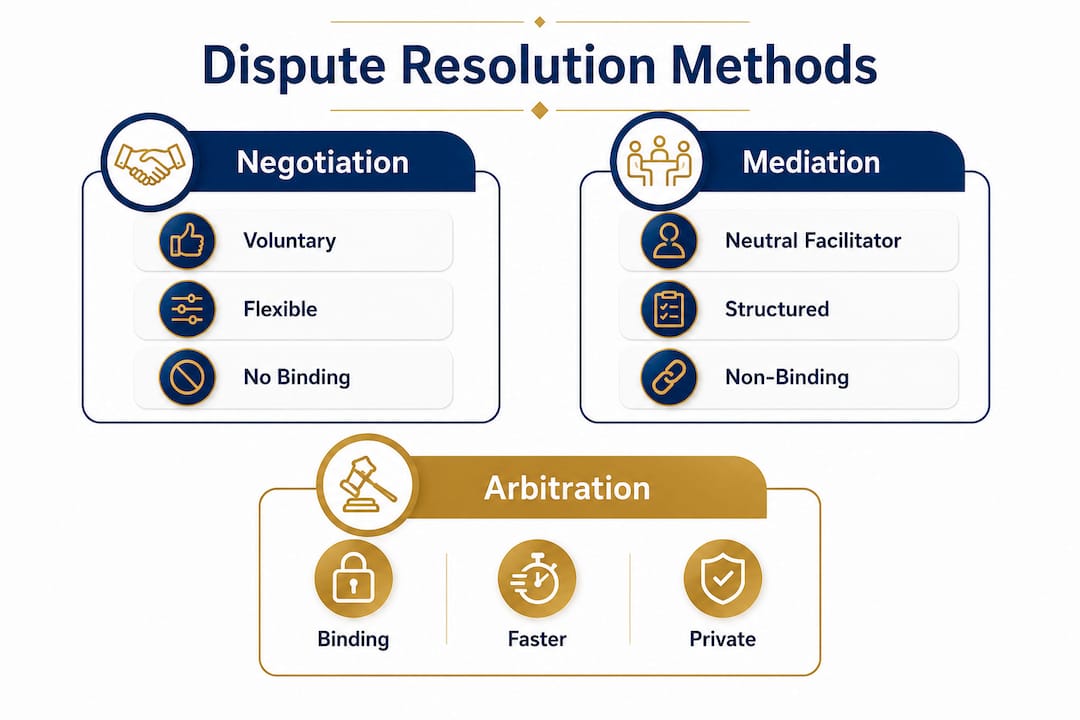
The table below summarises the key differences:
| Factor | Negotiation | Mediation | Arbitration |
|---|---|---|---|
| Binding outcome | No | No | Yes |
| Third-party involvement | None | Neutral facilitator | Arbitrator with authority |
| Cost | Lowest | Moderate | Higher |
| Speed | Fastest | Moderate | Slower than negotiation |
| Formality | Informal | Semi-formal | Formal |
| Best for | Ongoing relationships, low-stakes disputes | Workplace and commercial relationship repair | High-value, complex, or cross-border disputes |
Practical decision-making follows a straightforward logic. Start with negotiation. If direct dialogue fails or is not viable, move to mediation. If a binding outcome is required, or if the dispute is too complex or high-value for facilitated dialogue, arbitration is the appropriate choice.
ACAS early conciliation has a standard period of one calendar month, extendable by two weeks if both parties agree, giving a maximum of six weeks. That statutory timetable means employment disputes have a built-in window for resolution before tribunal proceedings begin. Businesses should treat that window as an opportunity, not a formality.
Key decision factors to weigh include:
For disputes involving resolving contract disagreements in a UK commercial context, the choice between these methods often comes down to whether the parties can still talk to each other. If they can, start with negotiation or mediation. If they cannot, arbitration provides the structure and authority to reach a definitive outcome. For international disputes, the advantages of international arbitration are particularly pronounced, given the cross-border enforceability of awards under the New York Convention.
For injury-related disputes, the dispute resolution options in serious claims follow a similar hierarchy, with negotiation and mediation preferred before formal proceedings.
After working across commercial, employment, and international disputes, the pattern I see most often is this: parties choose their dispute resolution method based on emotion rather than strategy. They go straight to arbitration because it feels decisive, or they avoid it entirely because it sounds expensive. Both instincts are usually wrong.
The most effective approach treats arbitration, negotiation, and mediation as a sequence rather than alternatives. Start with direct negotiation. If that fails, bring in a mediator. Reserve arbitration for situations where a binding outcome is genuinely necessary. That sequence is not just cheaper. It is more likely to produce a result both parties can live with.
The other mistake I see regularly is underestimating the ACAS early conciliation period. Businesses treat it as a procedural hurdle to clear on the way to tribunal. In practice, it is the most cost-effective six weeks available to resolve an employment dispute. The conciliator’s role is to facilitate a settlement, and the majority of cases that reach conciliation do settle. Ignoring that opportunity is a costly error.
Mediation, in particular, is underused in commercial disputes. The mediator’s role in legal disputes is often misunderstood as passive. A skilled mediator actively reframes positions, identifies hidden interests, and creates the conditions for agreement that neither party could reach alone. That is not a soft option. It is a sophisticated process that frequently resolves disputes that seemed intractable.
— Panagiotis
Dispute resolution works best when you have clear legal advice before you choose your method, not after the process has already gone wrong.
Ali Legal Ltd advises businesses and individuals across arbitration proceedings, negotiation strategy, and mediation preparation. Whether you are facing a commercial contract dispute, an employment claim, or a cross-border disagreement, Ali Legal Ltd provides fixed-fee, transparent guidance tailored to your situation. The team’s experience in international disputes and arbitration means you receive advice grounded in both UK procedural standards and international frameworks. If you are unsure which method suits your dispute, contact Ali Legal Ltd for a direct, no-obligation consultation.
Mediation is a non-binding process where a neutral facilitator helps parties reach their own agreement. Arbitration produces a legally binding award that the parties must comply with, regardless of whether they are satisfied with the outcome.
Yes. ACAS early conciliation is a legal requirement for prospective Employment Tribunal claimants, with a standard period of one calendar month that can be extended by two weeks if both parties agree.
Negotiation is best when the parties have an ongoing relationship they want to preserve, the dispute is relatively straightforward, and both sides are willing to engage in good faith dialogue without a third party.
A mediated settlement is not automatically binding. To become enforceable, the agreed terms must be recorded in a written contract signed by both parties, or in the case of employment disputes, in a COT3 agreement through ACAS.
Arbitration suits high-value commercial disputes, cross-border disagreements, construction and engineering claims, and situations where the parties need a definitive, enforceable outcome but want to avoid the publicity of court proceedings.


