
Menu
Get Expert Legal Support Today

TL;DR:
- Exequatur is a formal authorization allowing foreign consuls to perform official functions or enabling foreign court judgments to be enforced domestically. It involves granting legal recognition or permission in both diplomatic and judicial contexts, with procedures varying across jurisdictions. Proper preparation, understanding treaty frameworks, and legal counsel are essential for successful enforcement or authorization efforts.
Few legal terms carry as much weight across as many different contexts as exequatur. If you have encountered it in the context of international litigation, consular law, or the enforcement of a foreign court judgment, you may have found the existing explanations either too narrow or too technical to be genuinely useful. What is exequatur, exactly? The short answer is that it is a formal authorisation with dual purpose in international law: it either permits a foreign consul to perform official functions in a host country, or it allows a foreign court judgment to be enforced as if it were a domestic one. Both meanings matter, and confusing them leads to costly mistakes.
The word exequatur comes from Latin, meaning “let it be executed.” That etymology tells you almost everything about its function. Whether you are dealing with a diplomat seeking to open a consulate or a creditor trying to recover money under a foreign court order, the procedure is ultimately about granting official permission for something foreign to carry legal force on domestic soil.
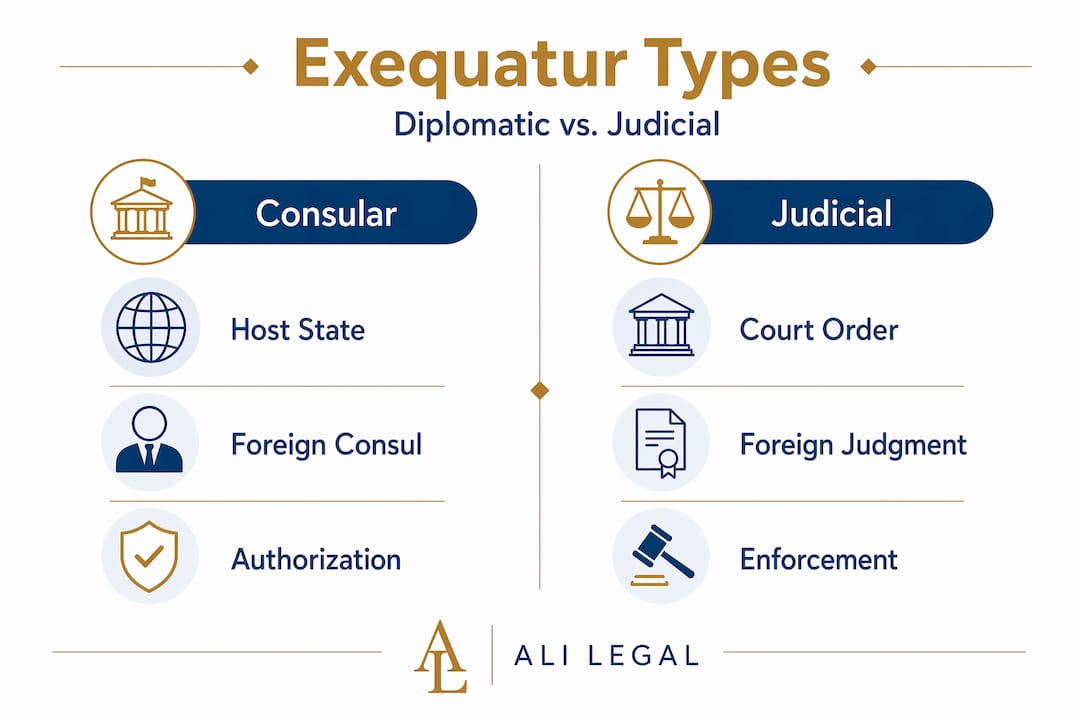
In diplomatic practice, exequatur is the document issued by a host state to authorise a foreign consul to begin exercising their functions. Without it, a consul appointed by their government has no formal standing in the receiving country. The Vienna Convention on Consular Relations, adopted in 1963, governs this process internationally. It sets out the conditions under which exequatur is granted, what happens when it is refused, and crucially, how it can be withdrawn.
Withdrawal is not a theoretical concern. If a receiving state decides that a consul has acted in a way incompatible with their role, it can revoke the exequatur, and the consul must cease functions and may be recalled entirely. This mechanism gives the host state real leverage in diplomatic relations without resorting to more dramatic measures.
The judicial meaning of exequatur is the one most relevant to individuals and legal professionals dealing with cross-border disputes. Here, it refers to a court procedure by which a domestic court examines a foreign judgment and, if satisfied that it meets the required conditions, declares it enforceable within its own jurisdiction.
Key features of this judicial meaning include:
Understanding this distinction between consular and judicial exequatur is the foundation for everything that follows.
For most individuals and legal professionals reading this, the judicial exequatur process is the practical priority. The question is not merely theoretical. It arises whenever someone has won a court case in one country and needs to enforce that judgment against assets or parties located in another.
The procedure varies by jurisdiction, but the general framework follows a recognisable pattern.
One misconception that causes real problems in practice is the assumption that ex parte foreign judgments cannot be enforced abroad. In 2026, the Telangana High Court confirmed that ex parte judgments are enforceable provided they were decided on the merits and proper procedural requirements were met. The court’s reasoning was clear: what matters is whether evidence was genuinely considered, not simply whether the defendant was present.
Pro Tip: If you are seeking to enforce a foreign judgment and the debtor argues it was obtained ex parte, do not assume enforcement is impossible. The substantive quality of the original proceedings, including evidence considered and merits assessed, is what courts will scrutinise.

The exequatur process is not uniform. It operates very differently depending on whether you are in a civil law country, a common law country, or a jurisdiction governed by a specific treaty framework. Understanding these differences is not an academic exercise. It directly affects strategy, timelines, and the likelihood of success.
| Jurisdiction | Exequatur mechanism | Key requirements | Treaty basis |
|---|---|---|---|
| France | Formal exequatur proceedings before the Tribunal judiciaire | International jurisdiction of foreign court; no conflict with French public policy; no pending domestic proceedings | Bilateral treaties where applicable |
| Spain | Exequatur before the Supreme Court (or lower courts under EU rules) | Proper service on defendant; reciprocity or treaty; no public policy violation | EU Regulation 1215/2012 within EU context |
| Brazil | Superior Tribunal de Justiça (STJ) issues exequatur | Certified translation; apostille; compliance with Brazilian public order | Bilateral treaties or reciprocity |
| Romania | Recognition proceedings before domestic courts | Foreign court jurisdiction; final judgment; procedural regularity | EU rules and bilateral agreements |
| Puerto Rico | Domestic exequatur for US civil court orders | US civil orders validated domestically; compliance with Puerto Rico procedural rules | Federal framework |
| United Kingdom | No formal exequatur; common law recognition or statutory regimes | Service of process; jurisdiction; public policy | Various treaties and reciprocal arrangements |
The United Kingdom’s position deserves a specific note. English law does not use the term exequatur in a formalised sense for judgment enforcement. Instead, foreign judgments may be enforced through the common law action on a judgment, or under specific statutory regimes. This makes it all the more important to take specialist advice on cross-border litigation rather than assuming the procedure you are familiar with from one jurisdiction applies elsewhere.
Reciprocity and treaty frameworks are also significant. Several jurisdictions require either a formal agreement or a reciprocal arrangement before they will recognise a foreign judgment at all. In the absence of such a framework, the applicant faces a considerably harder task.
Knowing the theory is one thing. Approaching an actual exequatur process without proper preparation is another matter entirely. Whether you are a business trying to enforce a commercial judgment abroad or an individual pursuing a family law order across borders, the following steps and considerations apply broadly.
The starting point is always the judgment itself. You will need:
Pro Tip: Before instructing local counsel in the enforcement jurisdiction, obtain a written assessment of the reciprocity position and any treaty framework that applies. This single step can save months of misdirected effort.
The role of legal representation cannot be overstated. Exequatur proceedings involve procedural requirements that differ not just between countries but sometimes between regions within the same country. Working with a solicitor who understands both the originating and receiving jurisdictions is not a luxury. It is a practical necessity for cases with meaningful sums at stake. For context on how conflict of laws principles affect enforcement strategy in the UK, the interaction between treaty regimes and domestic court discretion is genuinely complex.
For disputes requiring multi-jurisdictional resolution, understanding the procedural landscape early makes an enormous difference. A guide to resolving cross-border disputes with clarity can help frame the options before you commit to a course of action.
I have worked with clients on international enforcement matters where the word “exequatur” was either completely unknown to them or understood only in one of its two senses. That gap in understanding consistently causes the same problem: people either underestimate the complexity of what they are trying to do, or they give up prematurely because someone told them an ex parte judgment or a judgment from a particular jurisdiction could never be enforced.
What I have learned is that exequatur cases turn on preparation and jurisdiction-specific knowledge far more than on the underlying merits of the original judgment. A creditor with a technically sound foreign judgment can still fail if the procedural steps are mishandled. Equally, what looks like a hopeless enforcement situation can often be resolved once you properly map the treaty framework and identify which court has the most favourable approach.
The dual nature of the concept matters too. I have seen consular exequatur issues affect commercial arrangements in ways that clients did not anticipate. When a consul’s authorisation is revoked, the downstream effects on commercial and legal relationships in that jurisdiction can be significant and swift.
My honest view is that exequatur will become more, not less, significant as cross-border commerce and litigation grow. The legal world has not kept pace with the speed at which judgments, assets, and people now cross borders. Practitioners who understand exequatur in both its diplomatic and judicial dimensions will be considerably better placed to serve clients who face this increasingly common challenge.
— Panagiotis
Exequatur proceedings demand precise legal knowledge, and the consequences of procedural errors are expensive. Alilegal’s team has extensive experience in civil and commercial litigation with an international dimension, advising businesses and individuals who need to enforce foreign judgments or defend against enforcement actions brought against them.

Whether you are dealing with a commercial debt judgment issued abroad, a consular authorisation matter, or a complex multi-jurisdictional dispute, Alilegal offers fixed-fee consultations and straightforward advice from solicitors who understand both the domestic and international dimensions. Our civil litigation service covers enforcement proceedings from initial assessment through to execution, and our commercial litigation practice handles high-stakes international disputes where speed and strategy both matter. Contact Alilegal today for a clear assessment of your enforcement options.
Exequatur is a formal legal authorisation that either permits a foreign consul to carry out official functions in a host state, or allows a foreign court judgment to be enforced within another country’s domestic legal system.
The UK does not operate a formal exequatur regime. Instead, foreign judgments are enforced through common law actions or specific statutory mechanisms, depending on the country of origin and any applicable treaty.
Yes. Courts in several jurisdictions, including India’s Telangana High Court in 2026, have confirmed that ex parte judgments can be enforced provided they were decided on the merits and proper procedural standards were met.
Requirements commonly include a certified copy of the final judgment, an official translation, proof of proper service on the defendant, absence of a public policy conflict, and in many jurisdictions, a treaty or reciprocal arrangement between the two countries.
Timelines vary considerably by jurisdiction. In some civil law countries with established procedures, the process can take several months. In jurisdictions without a formal exequatur regime or where public policy objections arise, proceedings can extend significantly longer.


