
Menu
Get Expert Legal Support Today

TL;DR:
- An injunction is a court order that prevents or compels actions before or during harm, acting as an equitable remedy.
- Obtaining an injunction requires satisfying criteria like likelihood of success, irreparable harm, and public interest, and involves strict procedural steps.
If you are facing a dispute and need urgent legal protection, understanding what is an injunction could make the difference between preserving your rights and suffering irreversible harm. An injunction is a court order that either compels someone to do something or, more commonly, stops them from doing it. Unlike monetary damages, which compensate you after harm has already occurred, injunctions act before or during harm to prevent it. This guide explains how injunctions work, the different types available, and what you need to do to obtain one.
At its most fundamental level, an injunction is an equitable remedy granted by a court when monetary compensation would be inadequate to address the harm caused. The term “equitable” simply means the court is applying principles of fairness rather than following a rigid formula. This distinction matters enormously in practice. If your neighbour is about to demolish a protected building on your boundary, no amount of money after the fact restores what has been lost. An injunction stops the act before it happens.
Courts do not grant injunctions automatically. Courts exercise significant discretion, weighing the good faith of the parties, their prior conduct, and the overall balance of harms before making any order. This is quite different from a damages claim, where the court’s role is largely to calculate a figure.
Understanding the legal injunction meaning also requires knowing the consequences of ignoring one. Violating an injunction can result in contempt of court, which carries the possibility of fines or even imprisonment. This is what gives injunctions their teeth. They are not suggestions; they are binding court orders with real penalties attached.
A few key points help clarify the scope of injunctions:
Understanding the types of injunctions available is where many people get confused, so it helps to look at each category clearly.
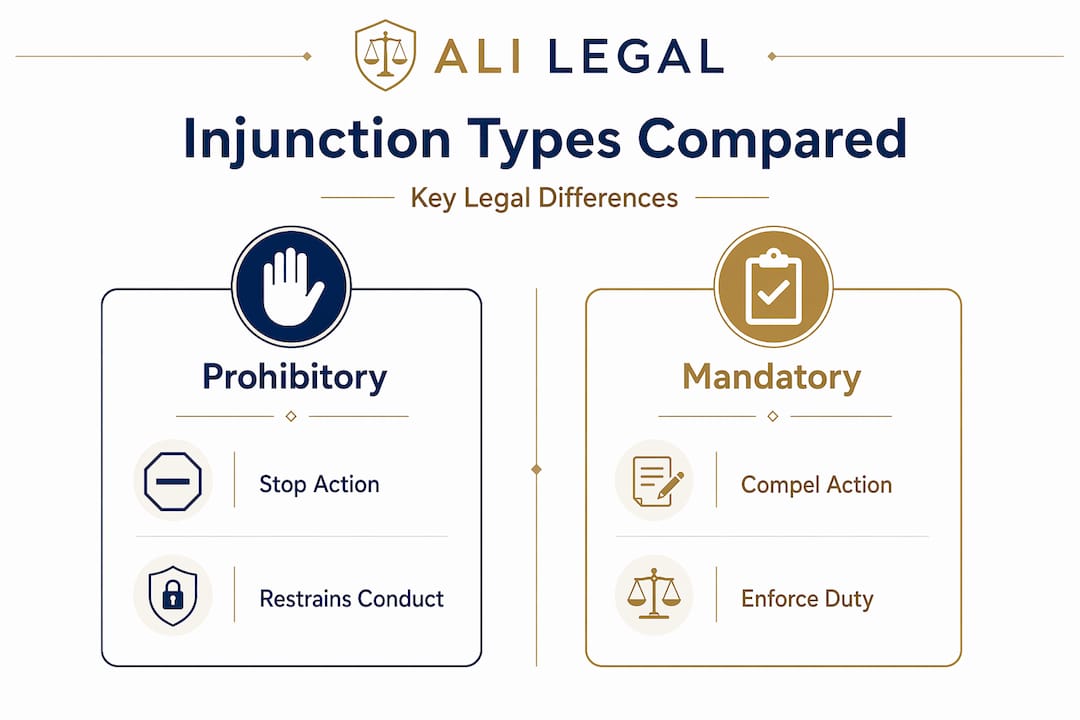
An injunction may require a party to do something or stop doing something, and many orders contain both components. The two broadest categories are prohibitory injunctions, which restrain a party from acting, and mandatory injunctions, which compel a party to take a specific action. Mandatory injunctions tend to be harder to obtain because courts are cautious about ordering positive acts.
Beyond these broad categories, injunctions are also classified by duration and urgency:
| Type | Duration | Key feature | Common example |
|---|---|---|---|
| Temporary restraining order (TRO) | Days to weeks | Issued without notice in emergencies | Stopping imminent asset disposal |
| Preliminary injunction | Pending full trial | Requires notice to the other side | Freezing business activities during litigation |
| Permanent injunction | Indefinite | Granted after full trial | Prohibiting ongoing trade secret misuse |
Temporary restraining orders are short-term injunctions that can be issued without the other party being present, making them the fastest form of emergency relief available. However, they are typically subject to an early review hearing and are often not immediately appealable. A preliminary injunction lasts throughout the litigation process, while a permanent injunction is the final outcome of a successful trial.
Pro Tip: If you believe you need emergency legal protection, ask your solicitor specifically about a TRO or interim injunction application. Waiting until a full hearing could mean the harm you are trying to prevent has already occurred.
Obtaining an injunction is not straightforward, and courts do not award them lightly. To succeed in a preliminary injunction application, you must satisfy a four-factor test. Each factor carries real weight, and weakness in any one area can defeat your application.
The four factors are:
The process for seeking an injunction broadly follows these steps:
On that last point: courts may require applicants to post a monetary bond as security to compensate the defendant if the injunction later turns out to have been wrongfully obtained. The amount depends on the likely financial impact on the defendant. This is a strategic consideration many applicants overlook entirely.
Pro Tip: Never approach an injunction application without legal representation. The procedural requirements are strict, and a poorly drafted application can be refused even if your underlying case is strong. Engaging a solicitor who understands the civil litigation process will significantly improve your prospects.
Once an injunction is in place, the question becomes how it is enforced and what happens if circumstances change.
Enforcement is the responsibility of the party who holds the order. If the respondent breaches it, you must return to court and apply to have them held in contempt. Courts often modify or dissolve injunctions if evidence shows that circumstances have materially changed since the original order was made. For example, if a business injunction was based on an ongoing contract that has since expired, the rationale for the order may no longer exist.
Key points about enforcement and breach include:
The dynamic nature of equitable remedies means injunctions are rarely “set and forget” orders. Active monitoring and willingness to return to court are part of effective injunction management.
Injunctions appear across a remarkably broad range of disputes. Injunctions cover business disputes, family law matters, and property issues, and the variety of situations where they apply is wider than most people realise.

In family law, injunctions are frequently used to protect individuals from harassment or domestic abuse. These are sometimes called non-molestation orders or occupation orders in England and Wales, and they function as a form of injunction tailored to the family context. The injunction vs restraining order distinction is worth noting here: in England and Wales, a restraining order is typically a criminal court order imposed on a convicted defendant, while an injunction is a civil remedy sought by the affected party.
In business disputes, injunctions are used to prevent a departing employee from joining a competitor in breach of restrictive covenants, to stop the misuse of trade secrets, or to restrain a party from terminating a contract unlawfully. Franchise legal disputes are one specific area where injunctions frequently arise, particularly around territory rights and brand compliance obligations.
In property disputes, injunctions are used to stop illegal building works, prevent trespass, or compel a party to remove an unlawful structure from land.
There are also broader controversies worth knowing about. Nationwide injunctions have generated significant constitutional debate, particularly in US federal courts, where critics argue they represent judicial overreach. While less common in the UK context, the debate illustrates how powerful and contested injunctions can become when applied at scale.
I have seen many clients arrive convinced that obtaining an injunction is simply a matter of filing the right paperwork. It rarely is. Courts treat injunction applications seriously, and they scrutinise the applicant’s conduct just as closely as the respondent’s. Judges are alert to cases where the real purpose of the application is commercial pressure rather than genuine protection from harm.
What I find most misunderstood is the irreversible harm threshold. Many clients believe that any ongoing wrong qualifies. In practice, courts ask a tougher question: could compensation put you back where you were? If the honest answer is yes, the injunction application faces an uphill battle.
My advice is always to engage a solicitor the moment you suspect injunctive relief may be needed. The earlier you act, the stronger the urgency argument tends to be. Delay is frequently used by respondents to argue that the harm cannot have been that serious. Speed and preparation, combined with a realistic assessment of your case’s strengths, are the foundations of a successful injunction application.
— Panagiotis
When the stakes are high and time is short, having the right legal team matters. Alilegal’s civil litigation team works with individuals and businesses at every stage of the injunction process, from urgent emergency applications to full contested hearings. For business-critical disputes, the commercial litigation team brings focused strategic thinking to injunction cases where the outcome can define the future of your company.

Alilegal operates with fixed fees, clear timelines, and direct communication. If you are considering an injunction or facing one brought against you, contact the team today for a no-obligation consultation.
An injunction is a court order requiring a person or organisation to either do something or stop doing something. Courts grant them as equitable remedies when monetary compensation would not adequately address the harm.
A temporary restraining order is a short-term emergency measure issued quickly, sometimes without notifying the other party, while a preliminary injunction lasts throughout litigation and requires a fuller court hearing with both sides present.
You can generally appeal a preliminary or permanent injunction, though temporary restraining orders are often not immediately appealable due to their short duration and emergency nature.
Breaching an injunction is treated as contempt of court, which can result in fines or imprisonment depending on the severity and persistence of the breach.
In England and Wales, an injunction is a civil remedy that a claimant applies for through civil proceedings, while a restraining order is typically imposed by a criminal court upon conviction of an offence such as harassment.


