
Menu
Get Expert Legal Support Today

TL;DR:
- Poor contract management costs businesses up to 9.2% of annual revenue annually.
- Effective contracts protect cash flow, reduce disputes by up to 65%, and safeguard assets.
- Managing the full contract lifecycle and fostering a collaborative, responsible culture is crucial.
Poor contract management costs businesses 9.2% of annual revenue each year, globally. That is not a rounding error; it is a structural leak hiding in plain sight. Many business owners and corporate managers still treat contracts as a legal formality, something to sign and file away. That misconception is expensive. Contracts are, in truth, one of the most powerful tools you have for protecting your cash flow, managing risk, and keeping operations running smoothly. This guide walks through the legal foundations of contracts, how they reduce disputes, how to manage them across their full lifecycle, and what practical steps you can take right now.
| Point | Details |
|---|---|
| Contracts cut disputes | Robust contracts can reduce business disputes by up to 65% through clear expectations. |
| Six elements for validity | Every business contract needs offer, acceptance, consideration, capacity, legality, and mutual intent. |
| Prevent revenue loss | Ineffective contract management can cost you over 9% of annual revenue but is recoverable with best practices. |
| Lifecycle stages matter | Managing each contract stage carefully and using technology boosts compliance and cuts admin costs. |
| Integrated approach is key | Bridging legal and commercial goals maximises contract value, not just compliance. |
Contracts are not just documents that lawyers insist upon. They are the backbone of every reliable business relationship you build. When you agree terms in writing, you create a shared reference point that both parties can return to if things go wrong. That clarity alone changes how people behave.
Businesses that invest in robust contract practices see measurable results. Research shows that disputes fall by up to 65% for companies with well-structured contracts in place. That figure is significant because disputes are not just stressful; they consume management time, legal budget, and commercial goodwill.
Beyond dispute reduction, contracts protect several critical business assets:
Informal agreements carry real risk. A verbal understanding between directors may feel sufficient in the moment, but memory is unreliable and intentions shift. When a supplier delivers late, a client refuses to pay, or a partner walks away, the absence of a written contract leaves you with very little to stand on.
“Contracts safeguard business interests by clarifying expectations, reducing disputes, protecting cash flow and intellectual property, and providing legal recourse for breaches.” This is not a legal nicety; it is a commercial necessity.
Understanding what commercial contracts actually are is the first step towards using them as the strategic tools they are designed to be.
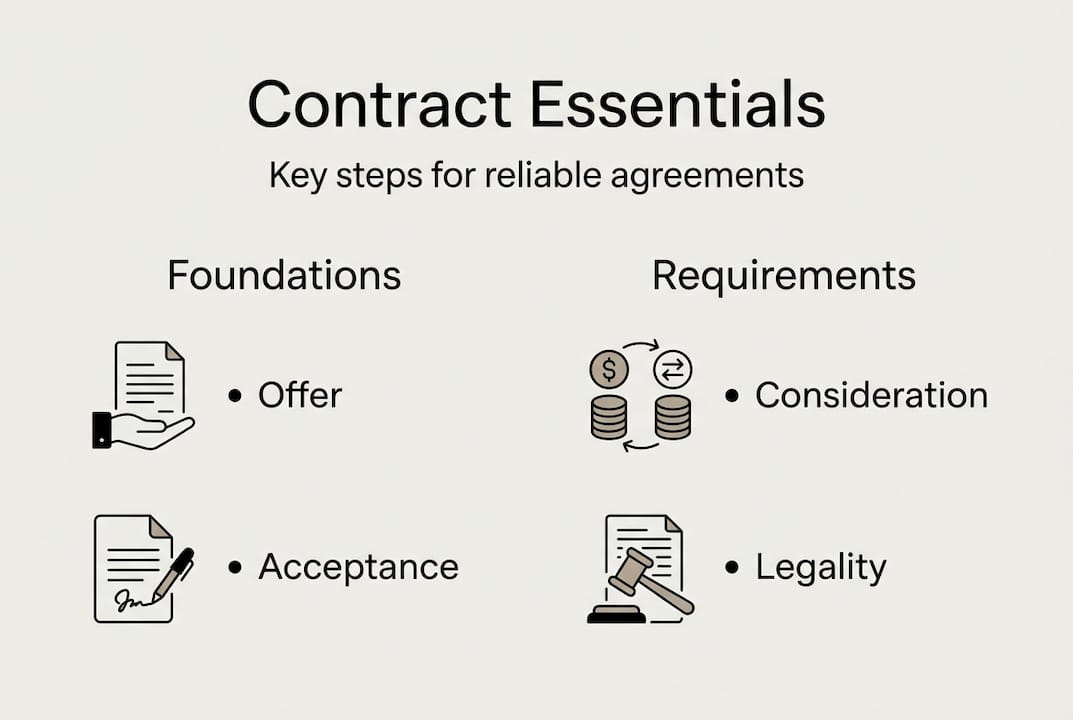
Not every written agreement is legally enforceable. A contract must satisfy six essential elements to hold up in court. Miss even one, and the entire agreement may be void or unenforceable when you need it most.
Legally binding contracts require the following six components:
Here is how these elements can break down in practice:
| Element | Common weakness in real contracts |
|---|---|
| Offer | Vague scope of work or ambiguous deliverables |
| Acceptance | Counter-offers made verbally without written confirmation |
| Consideration | No stated payment terms or unclear value exchange |
| Capacity | Signing authority not verified for corporate entities |
| Legality | Clauses that inadvertently breach competition law |
| Mutual intent | Informal emails treated as binding without clear intent |
The essentials of sound business contracts go beyond ticking boxes. Each element must be clearly evidenced in the document itself. Courts do not fill in gaps generously; they interpret what is written.
Pro Tip: Always use written contracts with a consistent template across your business. Standardised templates reduce the chance of missing a core element and make it far easier to train staff on contract expectations. Review your templates against UK contract law principles at least once a year.
The financial case for good contract management is compelling. Organisations worldwide lose 9.2% of annual revenue through poor contract practices. Of that, up to 5.4% is recoverable with better processes. For a business turning over £5 million, that is potentially £270,000 sitting in poorly managed agreements.

The same research reveals that 80% of businesses lack clear accountability for contract performance. Nobody owns the obligation to check whether milestones are met, payments are received, or renewal dates are approaching. That gap is where value quietly disappears.
Compare the outcomes of good and poor contract management:
| Practice area | Good contract management | Poor contract management |
|---|---|---|
| Cost control | Predictable spend, fixed fee structures | Budget overruns, unclaimed penalties |
| Compliance | Regular reviews, audit trails | Missed obligations, regulatory risk |
| Dispute rate | Low, with clear resolution pathways | High, with costly litigation exposure |
| Renewal management | Proactive, value-optimised | Auto-renewals on unfavourable terms |
Businesses that treat contracts as live commercial tools rather than archived paperwork benefit in several concrete ways:
Understanding how contractual liability affects your business is essential before signing any significant agreement. The risk is not always obvious at the drafting stage, but it becomes very obvious when something goes wrong.
A contract does not end when it is signed. That is actually when the real work begins. Contract lifecycle management (CLM) covers six distinct stages, and each one carries its own risks and opportunities.
CLM software can reduce administrative costs by 25 to 30% and boost compliance by up to 55%. That is a meaningful operational gain, particularly for businesses managing large volumes of supplier or client contracts.
Special clauses deserve particular attention. Force majeure provisions, which excuse a party from performance due to extraordinary events, require precise drafting because courts interpret them strictly and narrowly. A broadly worded clause may offer no protection at all when tested. Similarly, boilerplate clauses such as entire agreement, severability, and governing law should never be copied without review; they carry real legal weight.
Knowing how to handle a contract breach when one arises, and whether your contract includes an arbitration clause for resolving disputes outside court, can save significant time and cost.
Pro Tip: Assign a named individual within your business to own each significant contract. That person should be responsible for monitoring obligations, flagging renewal dates, and escalating performance issues. Financial oversight embedded from day one prevents the silent revenue leakage that affects so many organisations.
Here is something most contract guides will not tell you: the problem is rarely the contract itself. It is the way leadership treats contracts after they are signed.
Legal teams focus on risk avoidance. Finance teams focus on value capture and revenue recovery. These two priorities rarely sit in the same room. The result is a governance gap where contracts are filed, forgotten, and quietly haemorrhage value.
Digital CLM tools are helpful, but they are not a solution on their own. We have seen businesses invest heavily in contract software while maintaining the same siloed behaviours that caused the problem in the first place. Technology surfaces the data; leadership must act on it.
The businesses that genuinely recover lost contract value are those that treat contracts as a cross-functional responsibility. Legal, finance, and operations must share accountability for what is agreed and whether it is being delivered. Exploring effective contract negotiation strategies is part of this, but the bigger shift is cultural. Contracts are not compliance documents. They are revenue instruments. Treat them accordingly.
If reading this has prompted you to question whether your current contracts are doing enough to protect your business, that instinct is worth acting on. Many businesses operate on outdated templates, informal arrangements, or agreements that have never been reviewed by a qualified solicitor.

At Ali Legal, we work with business owners and corporate managers to review, draft, and strengthen commercial contracts across a wide range of sectors. Whether you need support with commercial litigation following a contract dispute or want to understand civil litigation best practices before a matter escalates, our team offers straightforward, fixed-fee advice. Contact us today to arrange a consultation and start turning your contracts into genuine business assets.
A business contract must contain an offer, acceptance, consideration, capacity, legality, and mutual intent to be legally enforceable. If any one of these elements is absent, the agreement may not hold up in court.
Well-crafted contracts set out obligations clearly, and businesses using them see disputes fall by up to 65%. Clarity on expectations removes the ambiguity that most disputes feed on.
CLM covers every stage of a contract’s life from preparation through to renewal or termination, and CLM software reduces administrative costs by up to 30%. It ensures obligations are tracked and value is not lost after signing.
Oral agreements are difficult to prove in court because there is no written record of what was actually agreed. Without documented terms, resolving a dispute fairly becomes a matter of one person’s word against another’s.
Yes, but only if they are drafted precisely. Courts interpret these clauses strictly, so vague wording can render them useless when you need them most.


