
Menu
Get Expert Legal Support Today

Cross-border contracts often lead to tough questions about whose legal rules will apply when a dispute arises. For UK-based corporate legal teams, choosing between English law or a foreign system can affect everything from cost control to the ability to enforce judgments abroad. In this context, conflict of laws is more than a technical term. It sets the framework for how jurisdiction, applicable law, and enforcement are resolved when your agreements span multiple countries, giving your company valuable strategic clarity.
Conflict of laws sounds like a legal term designed to confuse, but it actually addresses a straightforward problem: when contracts cross borders, whose laws apply? A dispute between a London-based company and a German supplier raises an immediate question. Should English law govern the agreement, German law, or some combination? That question sits at the heart of conflict of laws. In the UK context, conflict of laws refers to the set of principles and rules that determine which country’s legal system will apply to disputes involving cross-border transactions, and where those disputes can be resolved. It is not about contradictory rules within a single jurisdiction, but rather about choosing between different national legal systems when contracts involve multiple countries.
The UK legal framework for conflict of laws rests on specific statutory foundations and long-established common law principles. The Civil Jurisdiction and Judgments Act 1982 provides the primary statutory framework governing how UK courts determine their jurisdiction in cross-border disputes and recognise foreign judgments. Beyond this legislation, UK courts rely on foundational principles documented in authoritative sources like Dicey, Morris and Collins on the conflict of laws, which comprehensively addresses jurisdiction, applicable law, and enforcement in cross-border cases. These sources combine statutory law, international conventions, and common law doctrine to create a coherent system for managing legal conflicts that arise when your contract involves parties or assets in different countries.
For UK-based corporate legal teams, understanding conflict of laws is not academic curiosity. It directly affects your ability to enforce contracts, manage disputes, and control litigation costs. When you sign a contract with an international supplier, the choice of law clause determines whether disputes will be governed by English law, foreign law, or some hybrid approach. The choice of jurisdiction clause determines where any dispute will be heard—in English courts, foreign courts, or through arbitration. These decisions have tangible consequences. A contract governed by English law and subject to English courts gives your team home advantage: familiarity with judges, established procedural rules, and enforcement mechanisms. A contract governed by foreign law requires you to hire specialists in that jurisdiction, understand unfamiliar legal principles, and navigate different court systems. The stakes extend beyond legal fees. Different legal systems produce different outcomes. A contractual indemnity clause might be enforceable under English law but unenforceable under the law of another country. A damages claim worth £500,000 under English law might be worth significantly more or less under another system.
Conflict of laws also determines whether a judgment from an English court will be enforceable abroad. Obtain a judgment in the High Court in London, but if your debtor’s assets sit in France, you need the French courts to recognise that English judgment. The framework governing recognition and enforcement differs depending on whether the debtor is in a European Union member state, a signatory to international conventions, or in a jurisdiction with no formal enforcement arrangements with the UK. This is where understanding conflict of laws principles becomes essential. Your corporate legal team needs to grasp how courts determine jurisdiction, which law applies, and how judgments are enforced across borders. These principles shape every cross-border contract your company enters.
Pro tip: When negotiating a contract with an international party, always agree explicitly on the governing law and dispute resolution mechanism before signing, as this prevents costly disputes about which legal system applies when conflicts arise.
Three fundamental principles underpin conflict of laws in the UK: jurisdiction, applicable law, and enforcement. These are not abstract concepts. They determine which court will hear your dispute, which country’s rules will govern the contract’s interpretation, and whether you can actually collect money if you win. Understanding how they work together is critical for any corporate legal team managing international contracts.
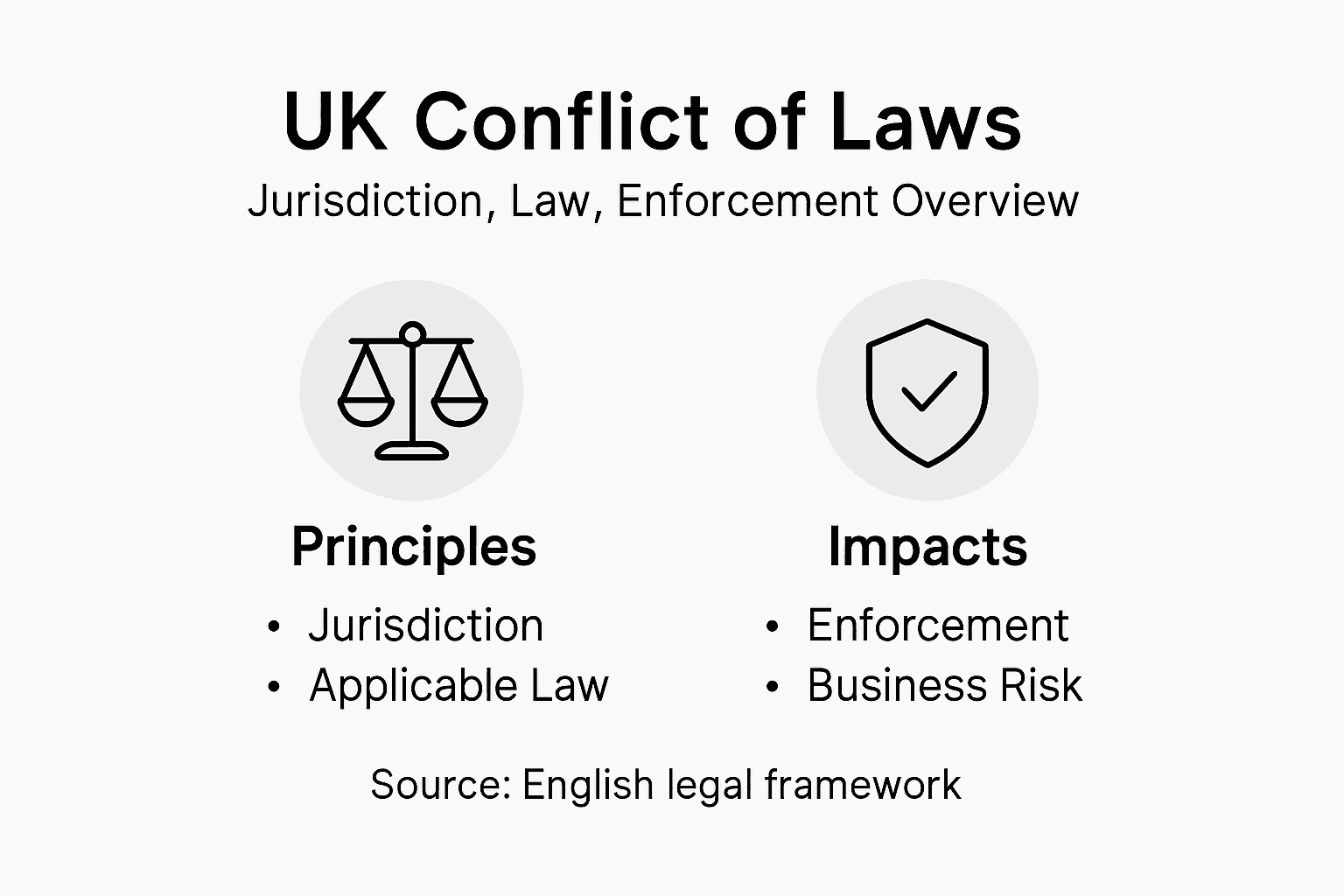
Jurisdiction answers the first procedural question: which court has the right to hear the dispute? This is not the same as applicable law. A dispute might be heard in an English court but governed by German law, or vice versa. UK courts determine jurisdiction based on where the defendant is located, where the contract was performed, where the damage occurred, or where the parties agreed disputes would be resolved. The common law framework, supplemented by statutory provisions, guides these determinations. When you include a jurisdiction clause in your contract stating that disputes will be heard in England and Wales, you are exercising control over this principle. Without such a clause, a foreign party could potentially sue you in their home court, forcing you to defend yourself in an unfamiliar legal system with unfamiliar procedural rules. Jurisdiction determinations in England and Wales rest on established principles concerning where substantial elements of a dispute occur and how extraterritorial reach applies in certain circumstances.
Applicable law determines which country’s substantive legal rules will govern the contract’s interpretation and enforcement. This is where choice of law clauses matter most. If your contract states it is governed by English law, English courts will apply English contract law principles to interpret what the parties meant, whether either party breached, what remedies apply, and whether certain clauses are enforceable. If the contract is governed by French law, French contract law principles apply instead. The differences can be significant. Some legal systems recognise concepts English law does not. Some restrict what parties can agree to. A limitation of liability clause permissible under English law might be unenforceable under another country’s mandatory consumer protection rules. The parties are generally free to choose the governing law, but that choice is only effective if it is explicit and legally valid under the laws of the relevant jurisdictions.
Enforcement is where many companies discover their hard-won legal victories mean little. You win a judgment in the High Court in London, but your debtor’s assets sit in Belgium. You need the Belgian courts to recognise and enforce that English judgment. The enforcement framework depends on whether the debtor is in a European Union country (different rules apply post-Brexit), a country signatory to international conventions, or a jurisdiction with no formal enforcement arrangements with the UK. The Civil Procedure Rules Part 74 governs the procedures for registering and enforcing foreign judgments within England and Wales, setting out specific registration requirements and enforcement mechanisms for cross-border commercial disputes. Without understanding these enforcement rules, you might secure a judgment that proves impossible to execute against foreign assets. This is why choice of jurisdiction clauses are sometimes more important than choice of law clauses. A judgment obtained in a jurisdiction where the defendant has assets, or where enforcement arrangements are strong, is worth far more than a judgment obtained in a distant court with no enforcement infrastructure.
These three principles interact constantly. You might litigate in an English court (jurisdiction) applying German law (applicable law) and then enforce the judgment in Germany (enforcement). Each step involves different rules, different procedures, and different strategic considerations. Corporate legal teams must think through all three when negotiating cross-border contracts.
The following table compares the core principles of conflict of laws in the UK and highlights their strategic importance:
| Principle | Main Focus | Key Business Impact |
|---|---|---|
| Jurisdiction | Which court will hear case | Influences legal costs and predictability |
| Applicable Law | Which country’s law applies | Affects interpretation and remedies |
| Enforcement | Making judgment effective | Determines ability to collect damages |
Pro tip: Always include both a choice of law clause naming English law and a choice of jurisdiction clause naming English courts in your international contracts, as this gives you maximum control over disputes and ensures enforcement in a jurisdiction where you can identify assets.
Conflict of laws does not operate uniformly across all legal disputes. The rules that determine which country’s law applies to a contractual dispute differ fundamentally from the rules governing tortious claims, property disputes, or employment matters. Your corporate legal team needs to recognise these distinctions because they directly affect strategy, costs, and outcomes. A contractual claim and a tortious claim arising from the same incident may be governed by entirely different legal systems.
Contractual conflicts occur when parties dispute the meaning, performance, or enforceability of a contract involving cross-border elements. These are the disputes most corporate teams encounter regularly. The legal framework governing contractual conflicts is codified in the Law Applicable to Contractual Obligations Regulations 2009, which establishes clear principles for determining which country’s law applies to contractual obligations in cross-border disputes. The primary rule is straightforward: the parties can choose the law governing their contract. If your contract includes a choice of law clause selecting English law, English law will apply regardless of where the parties are located or where the contract was performed. If the parties did not explicitly choose a governing law, the regulations establish default rules. The law of the country with which the contract has its closest connection typically applies. This might be the country where the party performing the characteristic obligation is located. For a supply contract, this is usually the seller’s location. The regulations provide detailed guidance on these connecting factors, and they significantly reduce uncertainty compared to older common law approaches.

Tortious conflicts involve claims for damages based on wrongful conduct rather than breach of contract. These include negligence claims, defamation, product liability, and professional negligence. A manufacturer in Germany sells a defective product to a UK customer, causing injury. The customer sues for negligence. Which law applies? The legal framework for tortious conflicts is set out in the Law Applicable to Non-Contractual Obligations Regulations 2008, which establish rules for cross-border tortious claims and other non-contractual disputes including unjust enrichment and restitution. The default principle is that the law of the country where the damage occurred applies. In the scenario above, the UK law would apply because the injury occurred in the UK. However, the regulations permit parties to agree on applicable law in writing after the damage has occurred, and they contain exceptions for unfair competition, restrictive practices, and environmental damage. The regulations do not permit parties to choose the law before the harm occurs, unlike contractual disputes. This fundamental difference reflects the policy that tort law should apply where the harm materialises, protecting victims rather than accommodating party autonomy.
Other conflict types extend beyond contracts and torts. Property disputes involving foreign land are governed by the law of the country where the property is located. Employment disputes are governed by the law with which the employment has its closest connection, often the employee’s habitual workplace. Family law matters follow separate rules altogether. Intellectual property disputes may be governed by the law of each country where intellectual property rights are claimed. Probate and succession matters are governed by the law of the deceased’s domicile. Each category operates under distinct conflict of laws principles, creating complexity when disputes span multiple categories. A claim arising from a cross-border business relationship might involve contractual elements (breach of contract), tortious elements (negligent misrepresentation), and perhaps even property elements (disputes over title to goods). Your legal team must analyse which elements predominate because this determines which conflict of laws regime applies and therefore which country’s substantive law governs.
Pro tip: When drafting cross-border contracts, include explicit choice of law and choice of jurisdiction clauses that specify English law and English courts, as this ensures contractual claims follow predictable rules rather than defaulting to less favourable connecting factors.
International commercial contracts operate within a legal framework shaped by statutory rules, trade agreements, and common law principles. Understanding the key rules governing these contracts is essential because they determine how disputes are resolved, which laws apply, and how enforceable your agreement truly is across borders. The framework has evolved significantly, particularly since the UK’s exit from the European Union, creating both challenges and opportunities for corporate legal teams managing cross-border transactions.
The Contracts (Applicable Law) Act 1990 provides the statutory foundation for determining the proper law of contracts in cases involving conflicting legal systems. This Act incorporates Rome Convention principles, enabling UK courts to apply uniform rules for contractual obligations across borders. The framework operates on a clear hierarchy. First, the parties can explicitly choose which country’s law will govern their contract. This choice must be expressed clearly in writing or be reliably established by the parties’ conduct. An English court will respect this choice almost invariably, even if the chosen law has minimal connection to the contract. This principle of party autonomy is central to international commercial contracting because it provides certainty. Both parties know in advance which legal system will interpret their obligations, what remedies are available, and how disputes will be resolved. Second, if the parties have not chosen a governing law, the courts will determine the law with which the contract has its closest connection. This might be the place of performance, the place where the contract was concluded, the habitual residence of the party responsible for the characteristic performance, or other connecting factors. The statutory framework provides detailed guidance on these connecting factors, reducing the unpredictability of common law approaches.
Beyond statutory rules, international commercial contracts are shaped by trade agreements the UK has entered into with external countries and regions. These UK trade agreements include provisions affecting commercial contracts, such as rules on tariffs, trade facilitation, and dispute resolution mechanisms. Some agreements establish preferential treatment for goods and services originating from signatory countries. Others create frameworks for resolving commercial disputes between parties from different signatory nations. Understanding which trade agreements apply to your contract can significantly affect costs and dispute resolution outcomes. A contract involving goods imported from a country with which the UK has a comprehensive free trade agreement might benefit from preferential tariff treatment, reducing costs and affecting contract pricing. A dispute involving a party from a country with which the UK has an investment protection agreement might be subject to international arbitration rather than domestic court proceedings.
Practical implementation of these rules requires three critical steps. First, always include an explicit choice of law clause naming English law. Do not rely on connecting factors to determine governing law, as this creates uncertainty and potential disputes about which law applies. Second, include a choice of jurisdiction clause specifying either English courts or international arbitration seated in England, as this gives you control over dispute resolution and ensures enforcement mechanisms are available. Third, review whether any relevant trade agreements apply to your contract, as these may create mandatory dispute resolution mechanisms or impose specific contractual requirements you must satisfy. Corporate teams often overlook trade agreement obligations when drafting international contracts, resulting in agreements that fail to satisfy treaty requirements or miss opportunities for preferential treatment.
Pro tip: Always insert both a governing law clause selecting English law and a jurisdiction clause naming English courts or London arbitration in your international commercial contracts, as this prevents disputes over which legal system applies and ensures you can enforce judgements in familiar forums.
Cross-border contracts introduce risks that domestic contracts simply do not present. These risks span legal uncertainty, enforcement challenges, cultural misunderstandings, currency fluctuations, and regulatory compliance across multiple jurisdictions. Your corporate legal team cannot eliminate these risks entirely, but you can identify them early and allocate them strategically through careful contract drafting and dispute resolution planning. The difference between a contract that survives a dispute and one that collapses often comes down to how risks were distributed between the parties before any problem arose.
The primary risks in cross-border contracts fall into distinct categories. Legal uncertainty occurs when the parties have not clearly specified which country’s law applies or where disputes will be resolved. This creates expensive disputes about jurisdiction and applicable law before you can even address the substantive merits. Enforcement risks arise when you win a judgment but cannot collect because the debtor’s assets sit in a country with no formal enforcement arrangements with the UK. Regulatory risks emerge when regulations in the debtor’s country prevent payment or restrict enforcement. A contract with a German supplier might be governed by English law, but if the German courts refuse to recognise the English judgment, your legal victory is worthless. Currency risks occur when exchange rates move significantly between the contract date and payment date, affecting the real value exchanged. Performance risks arise from different commercial expectations and cultural approaches to contract performance. What constitutes timely performance in one culture might be considered tardy in another. Risk allocation and pricing approaches should assign each commercial risk to the party best positioned to manage it, preventing situations where inappropriate risk sharing leads to poor value and contract failures.
Here is a summary of primary risk types in cross-border contracts and common mitigation strategies:
| Risk Category | Description | Mitigation Strategy |
|---|---|---|
| Legal Uncertainty | Ambiguity over applicable law or courts | Explicit contract clauses |
| Enforcement Risk | Difficulty collecting judgement overseas | Research and secure guarantees |
| Currency Fluctuation | Value changes due to exchange rates | Indexing or fixing contract currency |
| Regulatory Compliance | Foreign rules hinder payment or performance | Due diligence and local advice |
Mitigation strategies must address these risks systematically. Start with contract drafting that leaves no ambiguity about governing law, jurisdiction, and dispute resolution mechanisms. Specify English law and English courts or London arbitration. Include detailed force majeure clauses that define what events excuse performance and what notice procedures apply. Create escalation procedures that require senior executives to attempt resolution before litigation commences. Build in interim remedies such as injunctions or specific performance clauses that allow you to obtain urgent court orders if disputes arise. Consider requiring dispute resolution through staged processes: first negotiation between senior executives, then mediation, then arbitration. This staged approach often resolves disputes faster and cheaper than immediate litigation. Preparing for cross-border disputes requires careful contract drafting, choice of law clauses, and pre-dispute planning that anticipates potential conflicts.
Second, address enforcement risks by researching the debtor’s jurisdiction before signing. Which courts would enforce your judgment? Which international conventions apply? Does the debtor’s country recognise UK judgments? If enforcement looks problematic, consider requiring security upfront, such as letters of credit or guarantees from parent companies. Third, allocate currency risks explicitly. Specify which party bears exchange rate fluctuations or agree to currency indexing mechanisms. Fourth, conduct regulatory due diligence in the debtor’s jurisdiction. Are there restrictions on payments abroad? Export controls? Sanctions that might prevent performance? Fifth, allocate performance risks clearly. Define what constitutes timely performance, what quality standards apply, and what remedies apply if standards are not met.
Your responsibilities as a corporate legal team extend beyond drafting. You must communicate these risks to business stakeholders who negotiate the commercial terms. Often, commercial teams overlook legal risks when pursuing attractive pricing or terms. Your responsibility is to quantify what happens if disputes arise and the debtor cannot be enforced against. You must also stay informed about the debtor’s jurisdiction. Legal frameworks change. Trade agreements shift. Political instability can suddenly make enforcement impossible. Regular review of active contracts, particularly those with significant exposure, allows you to identify emerging risks and adjust your strategies.
Pro tip: Before signing any cross-border contract, conduct enforcement due diligence by researching the debtor’s jurisdiction, identifying which courts would enforce your judgment, and confirming that enforcement mechanisms exist in the debtor’s country.
Cross-border contracts introduce complex issues around conflict of laws, including jurisdiction, applicable law, and enforcement risks. When disputes arise involving multiple countries, uncertainty around which courts and legal systems apply can jeopardise your business outcomes. Whether you need clarity on governing law clauses, help with enforcement strategies, or guidance on mitigating international legal risks, Ali Legal offers strategic legal solutions tailored for UK-based companies operating globally.

Do not leave your international contracts to chance. Benefit from straightforward advice, fixed fees, and a client-focused approach that puts your business first. Explore our full range of legal services at All | Ali Legal and secure your legal certainty today. To discuss how to protect your interests and navigate cross-border disputes effectively, contact our expert solicitors now at Ali Legal Contact. Act promptly to gain the home advantage in your international agreements.
Conflict of laws refers to principles that determine which country’s legal system applies to disputes involving contracts across borders. It addresses issues such as jurisdiction, applicable law, and enforcement when parties from different countries are involved in legal agreements.
A choice of law clause is crucial as it specifies which country’s laws will govern the contract. This clause provides certainty to the parties, reduces potential disputes about applicable laws, and can significantly impact the remedies and interpretations if disputes arise.
Jurisdiction determines which court has the authority to hear a dispute. A clear jurisdiction clause helps control where disputes will be resolved, thus preventing foreign parties from suing in unfamiliar or less favourable legal systems.
Corporate legal teams should ensure explicit contract clauses about governing law and jurisdiction, conduct thorough due diligence on enforcement mechanisms in the debtor’s jurisdiction, and address potential risks such as currency fluctuation and regulatory compliance to enhance successful contract execution.


