
Menu
Get Expert Legal Support Today

More than one in three british SMEs face legal challenges every year, yet many struggle to find support that actually prevents future problems. With shifting rules in the United Kingdom and unpredictable commercial contract risks, small business owners need more than one-off advice. Ongoing legal support gives british companies constant, proactive protection, helping owners stay ahead of compliance issues and avoid costly mistakes before they arise.
Ongoing legal support represents a strategic partnership designed to provide UK small and medium enterprises with continuous protection and proactive guidance across their business operations. Unlike traditional legal services that respond only when problems emerge, this approach focuses on preventing potential risks before they escalate. Small businesses face complex legal challenges that require consistent monitoring and expert intervention.
The landscape of SME legal support typically encompasses two primary categories: reactive support and proactive management. Many SMEs find legal support costly and time-consuming, often uncertain about when professional legal guidance becomes necessary. Reactive support addresses immediate issues like contract disputes, debt recovery, and urgent compliance matters. Proactive management, however, involves routine document review, ongoing regulatory compliance checks, and strategic legal planning to mitigate potential future risks.
Effective ongoing legal support for UK SMEs should include comprehensive services such as regular contract reviews, data protection assessments, employment law guidance, intellectual property monitoring, and compliance health checks. The Information Commissioner’s Office offers tailored advice for SMEs on critical areas like information security and personal data management, highlighting the importance of continuous legal oversight.
The following table highlights the practical differences between reactive and proactive legal support for UK SMEs:
| Aspect | Reactive Legal Support | Proactive Legal Support |
|---|---|---|
| Timing | Addresses issues after they arise | Prevents issues before they escalate |
| Typical Activities | Contract dispute resolution, debt recovery | Regular contract reviews, compliance checks |
| Resource Allocation | Short-term, urgent response | Ongoing, scheduled engagement |
| Business Impact | Reduces immediate risk, may be costly long-term | Minimises risk, supports business continuity |
Pro tip: Schedule quarterly legal health checks to identify potential risks and ensure your business remains compliant with current regulations.
Legal support services for UK small and medium enterprises encompass a diverse range of offerings designed to address different business needs and legal challenges. These services are strategically structured to provide comprehensive protection and guidance across various operational aspects. Many SMEs require flexible legal solutions that balance cost-effectiveness with professional expertise, making the selection of appropriate legal support critical for sustainable business growth.
The primary categories of legal support services typically include reactive legal assistance and proactive legal management. Reactive services focus on immediate problem resolution such as contract disputes, debt recovery, employment conflicts, and urgent compliance issues. Proactive services, by contrast, involve routine legal health checks, preventative document reviews, ongoing regulatory compliance monitoring, and strategic legal planning. Modern legal support increasingly integrates technological solutions, with lawtech platforms offering digital tools that streamline legal processes and reduce traditional consultation costs.
Citizens Advice highlights several support channels available to SMEs, ranging from free professional advice to specialised legal insurance coverage. These support options include legal aid for serious problems, pro bono services from volunteer lawyers, trade union legal assistance, and reduced-cost consultations through community law centres. Additionally, many professional legal firms now offer scalable service packages tailored specifically for small and medium enterprises, allowing businesses to access high-quality legal support without committing to expensive long-term retainers.
Pro tip: Research and compare multiple legal support service providers, focusing on those offering flexible, technology-integrated solutions that can adapt to your specific business needs.
Ongoing legal support for UK small and medium enterprises operates through a sophisticated, multi-layered approach that combines proactive monitoring, strategic guidance, and responsive intervention. Legal support mechanisms enable SMEs to manage regulatory compliance through practical tools and tailored advice, ensuring businesses remain protected and legally aligned with current statutory requirements.

The operational framework typically involves a hybrid model integrating digital technologies and human expertise. Lawtech solutions automate routine legal tasks such as document management, compliance tracking, and risk assessment, while professional legal experts provide nuanced guidance for complex scenarios. Research demonstrates that SMEs benefit from an integrated approach balancing technological efficiency with professional human intervention, allowing businesses to control legal costs while maintaining comprehensive protection.
Key operational components of ongoing legal support include continuous regulatory monitoring, periodic legal health checks, preventative risk assessments, and rapid response mechanisms for emerging legal challenges. These services often encompass specialised areas such as data protection, employment law, contract management, intellectual property safeguarding, and regulatory compliance. Modern legal support platforms offer scalable solutions that can be customised to match the specific complexity and requirements of individual businesses, providing flexible access to professional legal resources without requiring full-time in-house legal teams.
Pro tip: Develop a comprehensive legal support strategy that integrates both technological tools and professional legal expertise to create a robust, adaptive protection framework for your business.
Legal compliance represents a fundamental cornerstone for UK small and medium enterprises, establishing a comprehensive framework that governs business conduct and mitigates potential regulatory risks. The Information Commissioner’s Office emphasises continuous adherence to data protection principles through ongoing education and tailored regulatory guidance, ensuring businesses maintain transparent and accountable operational practices.
The governing principles of legal compliance extend beyond mere regulatory adherence, encompassing broader strategic considerations that balance business innovation with statutory requirements. Regulatory frameworks such as the UK GDPR, employment legislation, and sector-specific guidelines create a structured environment where businesses must demonstrate active commitment to legal standards. The Financial Conduct Authority establishes principles of good regulation that prioritise proportionality, senior management responsibility, and market integrity, providing a nuanced approach to compliance that recognises the unique challenges faced by SMEs.
Effective legal compliance requires a proactive, multi-dimensional approach involving continuous monitoring, regular risk assessments, staff training, and adaptive policy development. Key compliance domains include data protection, financial reporting, health and safety regulations, employment law, and industry-specific statutory requirements. Businesses must develop robust internal mechanisms that not only meet current legal standards but also anticipate potential regulatory changes, creating a dynamic compliance culture that protects both organisational interests and stakeholder rights.
Pro tip: Implement a comprehensive compliance management system that combines technological tools, regular staff training, and periodic external audits to maintain a proactive and adaptive legal governance approach.
Managing contractual and regulatory risks represents a critical strategic imperative for UK small and medium enterprises, requiring a comprehensive and proactive approach to legal governance. SMEs must implement robust data protection policies and systematic compliance monitoring to minimise potential legal exposures, ensuring they remain protected against evolving regulatory landscapes.
Contractual risk management involves multiple strategic dimensions, including comprehensive contract drafting, thorough legal review processes, and systematic risk assessment protocols. Modern businesses must develop sophisticated mechanisms that anticipate potential legal vulnerabilities, addressing issues such as liability limitations, performance expectations, confidentiality provisions, and dispute resolution frameworks. Precise contract language becomes instrumental in defining clear operational boundaries and protecting organisational interests, preventing potential misunderstandings that could escalate into costly legal disputes.
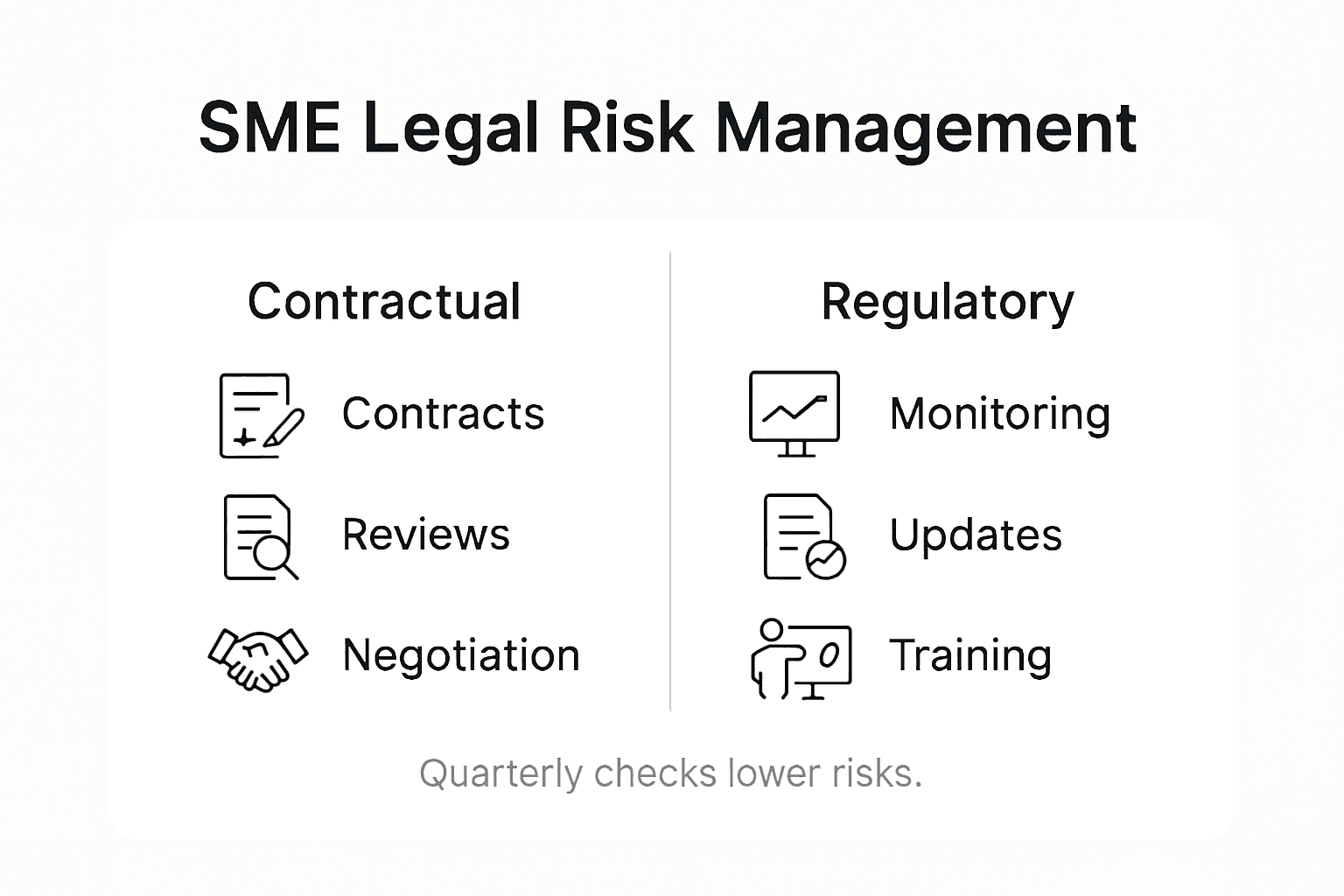
The regulatory risk management framework requires organisations to maintain continuous vigilance across multiple compliance domains. Key focus areas include data protection regulations, employment legislation, sector-specific statutory requirements, financial reporting standards, and health and safety protocols. Successful risk management demands a holistic approach that integrates technological solutions, regular staff training, periodic external audits, and adaptive policy development. Businesses must cultivate a proactive compliance culture that views regulatory adherence not as a bureaucratic burden but as a strategic opportunity to build organisational resilience and stakeholder trust.
Pro tip: Develop a dynamic risk register that systematically tracks, evaluates, and updates potential legal and regulatory risks, enabling your organisation to respond swiftly and strategically to emerging challenges.
Navigating legal support costs represents a significant challenge for UK small and medium enterprises seeking comprehensive protection without financial strain. Solicitors are legally obligated to provide transparent, upfront cost information to help businesses make informed decisions, ensuring SMEs understand potential financial implications before committing to legal services.
Common legal support mistakes often stem from inadequate understanding of available alternatives and cost-management strategies. Cost-effective legal solutions range from fixed-fee consultations to technology-enabled platforms that reduce traditional legal expenses. Citizens Advice recommends exploring multiple support channels, including legal aid, trade union assistance, and innovative lawtech solutions, which can significantly mitigate financial burdens for resource-constrained businesses.
Alternative legal support options have expanded dramatically, offering SMEs increasingly flexible and affordable approaches to managing legal risks. These alternatives include legal insurance packages, fixed-price service bundles, online legal document preparation tools, and hybrid models combining digital platforms with professional human expertise. Businesses must critically evaluate these options, considering factors such as service comprehensiveness, cost-effectiveness, response time, and alignment with specific organisational needs. The emerging legal support marketplace provides unprecedented opportunities for SMEs to access high-quality legal guidance without traditional prohibitive costs.
Here is a summary of popular alternative legal support options and their key benefits for SMEs:
| Option | Main Advantage | Cost Level |
|---|---|---|
| Legal insurance packages | Predictable legal expense coverage | Moderate to high |
| Fixed-fee service bundles | Clear, upfront pricing structure | Low to moderate |
| Lawtech platforms | Fast, automated legal support | Low |
| Pro bono or legal aid | Potentially no cost for eligible cases | Very low to none |
Pro tip: Conduct a comprehensive audit of your legal support needs and budget, comparing multiple service models to identify the most cost-efficient solution for your specific business requirements.
Small and Medium Enterprises in The United Kingdom face constant legal risks that demand proactive management and clear, expert guidance. Challenges like managing contractual complexities, meeting evolving regulatory compliance, and preventing costly disputes leave many SMEs vulnerable. This article highlights the crucial difference between reactive responses and continuous legal oversight that can protect your business from these risks while fostering growth and resilience.
At Ali Legal, we understand these pain points intimately and offer tailored solutions designed for UK SMEs. With transparent fixed fees and straightforward advice, our legal professionals blend technology and expertise to deliver fast, strategic support. Whether you require routine contract review, regulatory compliance checks, or risk assessment, our services provide the ongoing legal health checks your business needs. Explore our broad range of offerings in Uncategorized | Ali Legal and comprehensive insights in All | Ali Legal to see how we address common SME challenges.
Take the decisive step to safeguard your SME with a trusted partner who prioritizes your long-term success. Contact us today at Ali Legal for a personalised consultation that can transform your legal risk into confident opportunity.
Ongoing legal support for SMEs refers to a continuous partnership that provides proactive guidance and protection, focusing on preventing legal issues before they arise, rather than reacting only when problems occur.
Proactive legal management involves regular reviews, compliance checks, and risk assessments to prevent issues, while reactive assistance focuses on resolving immediate legal problems like disputes or compliance failures.
SMEs should consider a mix of reactive services such as contract disputes and debt recovery, and proactive services like routine legal health checks and regulatory compliance monitoring to minimise risks and ensure legal alignment.
SMEs can manage legal support costs by exploring alternatives like legal insurance, fixed-fee service bundles, and lawtech platforms, which offer more affordable options compared to traditional legal services.


