
Menu
Get Expert Legal Support Today

Legal costs in british courts can quickly reach tens of thousands of pounds, leaving many individuals and businesses unsure how to proceed. Litigation funding has become a practical solution, giving people the means to seek justice without draining their finances up front. By uncovering how this system operates and what protections are in place, you will discover what every british claimant needs to know before starting a legal dispute.
Litigation funding provides a strategic financial mechanism enabling individuals and businesses to pursue legal claims without bearing the entire upfront cost. In the United Kingdom, this specialised financing approach has emerged as a critical tool for accessing justice, particularly in commercial litigation scenarios where legal expenses might otherwise be prohibitively expensive.
The concept of third-party litigation funding represents a nuanced financial arrangement where an independent investor provides capital to support legal proceedings in exchange for a predetermined return. Research from the University of Oxford highlights the importance of establishing robust regulatory frameworks to ensure transparency and maintain client control throughout the litigation process. These investors typically assess the potential merits of a case, evaluating its likelihood of success before committing financial resources.
Under current UK legal frameworks, litigation funding operates within carefully defined parameters. The Ministry of Justice has been instrumental in developing guidelines that protect both claimants and funders, ensuring fair and ethical financing practices. These regulations aim to balance access to justice with responsible financial management, preventing potential conflicts of interest and maintaining the integrity of legal proceedings. By providing an alternative to traditional litigation financing methods, third-party funding enables plaintiffs with legitimate claims to seek legal recourse without being constrained by immediate financial limitations.
Key considerations for potential litigation funding recipients include understanding the specific terms of funding agreements, assessing the potential financial implications, and carefully evaluating the credibility of potential funding partners. While litigation funding can offer significant advantages, it is not a universal solution and requires careful, strategic consideration based on the unique circumstances of each legal dispute.
Litigation funding encompasses several distinct arrangements designed to provide financial support for legal proceedings. Commercial litigation solicitors frequently encounter these diverse funding models, each tailored to address specific legal and financial requirements of claimants seeking justice.
Research from the University of Oxford reveals three primary litigation funding approaches: third-party funding, conditional fee agreements, and damages-based agreements. Third-party funding involves independent investors providing capital in exchange for a percentage of potential damages. Conditional fee agreements, often called ‘no win, no fee’ arrangements, allow legal representation where lawyers only receive payment if the case succeeds. Damages-based agreements permit lawyers to claim a proportion of recovered damages as their fee.
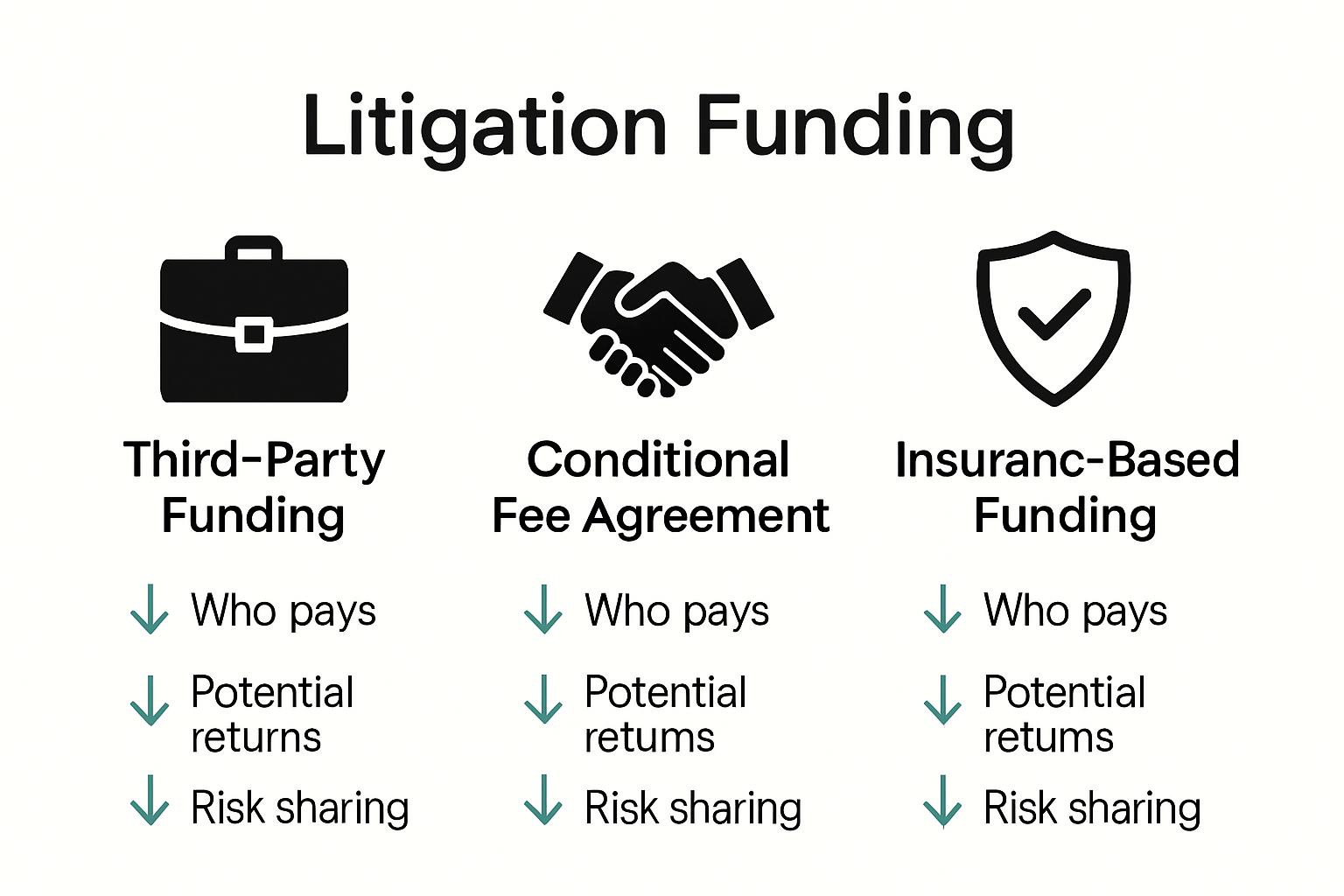
Moreover, the litigation funding landscape includes specialised insurance-based models. European legal research highlights two significant categories: Before-the-Event (BTE) and After-the-Event (ATE) insurance. BTE insurance is typically purchased proactively before any potential legal dispute, providing pre-emptive coverage for potential legal expenses. ATE insurance, conversely, is acquired after a legal issue has emerged, offering retrospective financial protection and mitigating the claimant’s potential financial risk.
Each funding arrangement presents unique advantages and considerations. Businesses and individuals must carefully evaluate their specific circumstances, potential case merits, and financial capabilities when selecting an appropriate litigation funding strategy. Factors such as case complexity, estimated legal costs, potential damages, and risk tolerance play crucial roles in determining the most suitable funding approach.
Litigation funding involves a sophisticated, multi-stage evaluation process where potential funders meticulously assess the viability and potential of legal claims. Civil litigation specialists understand that each funding application undergoes rigorous scrutiny to mitigate financial risks and ensure strategic investment.

Research from the University of Oxford outlines a comprehensive framework for litigation funding assessment. The process typically comprises several critical stages: initial case review, detailed legal merit evaluation, financial risk analysis, and structural agreement negotiations. Funders conduct extensive due diligence, examining the legal merits, potential damages, defendant’s financial capacity, and estimated legal costs. They assess factors such as case strength, probability of success, potential recovery amounts, and the complexity of legal arguments.
The UK government’s litigation funding guidelines emphasise the importance of transparent and enforceable funding agreements. These agreements meticulously define the financial terms, including the funder’s potential return, risk-sharing mechanisms, and conditions for funding withdrawal. Typically, litigation funders will only commit resources to cases with a demonstrated high probability of success, usually requiring a minimum estimated success rate of 60% and potential damages significantly exceeding the anticipated legal expenses.
Key considerations in the litigation funding process include comprehensive case evaluation, risk assessment, and mutual agreement on financial terms. Potential claimants must provide detailed documentation, including case briefs, expert legal opinions, evidence substantiating claims, and comprehensive financial projections. Successful litigation funding requires a collaborative approach, with clear communication between the claimant, legal representatives, and the funding entity to ensure alignment of objectives and expectations.
The legal landscape of litigation funding in the United Kingdom is characterised by a complex and evolving regulatory environment designed to protect claimants and ensure fair judicial processes. Regulatory and compliance experts recognise the intricate balance required to maintain transparency and accountability within third-party litigation financing.
The UK government’s recent legislative efforts demonstrate a commitment to enhancing access to justice through sophisticated legal frameworks. The Litigation Funding Agreements (Enforceability) Bill 2024 represents a pivotal development, addressing critical regulatory principles that govern third-party litigation funding. This legislation aims to establish clear guidelines for funding agreements, ensuring they meet rigorous standards of fairness, transparency, and legal compliance.
Key regulatory principles governing litigation funding include stringent due diligence requirements, mandatory disclosure of funding arrangements, and explicit protections against potential conflicts of interest. Funders must demonstrate their financial capacity, maintain independence from case management, and adhere to strict ethical standards. The regulatory framework mandates comprehensive risk assessments, requiring detailed documentation that proves the funder’s neutrality and the potential merit of the legal claim.
The evolving legal landscape demands continuous adaptation. Litigation funding providers must navigate complex legal requirements, balancing commercial interests with ethical considerations. This includes maintaining robust internal governance structures, implementing transparent decision-making processes, and ensuring that funded litigation serves the broader principles of justice and legal accountability. Successful litigation funding depends not just on financial potential, but on a profound commitment to upholding the fundamental integrity of the legal system.
Litigation funding involves a sophisticated interplay of financial risks, legal obligations, and potential cost implications that demand meticulous strategic assessment. Corporate law specialists understand that each funding arrangement carries inherent complexities requiring comprehensive risk management and financial planning.
Recent competition policy research reveals critical insights into the multifaceted nature of litigation funding risks. Funders bear significant financial exposure, potentially facing scenarios where legal proceedings may not yield anticipated returns. Key financial obligations include initial case assessment costs, ongoing legal expenses, potential adverse costs orders, and the requirement to maintain sufficient capital reserves to support prolonged litigation processes.
The UK government’s comprehensive review highlights several crucial risk mitigation strategies. Litigation funders must implement robust due diligence processes, including detailed case merit evaluations, thorough defendant financial capacity assessments, and sophisticated risk calculation models. These strategies involve creating comprehensive contingency frameworks that account for potential adverse outcomes, unexpected legal complexities, and potential regulatory changes.
Ultimately, successful litigation funding requires a delicate balance between financial risk tolerance and strategic legal investment. Claimants and funders must collaborate transparently, establishing clear contractual frameworks that delineate risk-sharing mechanisms, potential returns, and comprehensive exit strategies. This approach ensures that litigation funding remains a dynamic, responsible mechanism for accessing judicial remedies while maintaining the highest standards of financial and legal accountability.
Navigating the complexities of litigation funding is crucial for ensuring your legal claim does not stall due to financial barriers. This article highlights the essential challenges around third-party funding, risk management, and legal compliance. Readers seeking transparent, strategic solutions can benefit from Ali Legal’s client-centric approach which focuses on clear communication, fixed fees, and fast resolution. Whether you face commercial disputes or civil claims, understanding funding options and potential risks empowers you to make informed choices.
Key advantages at Ali Legal include:
Be confident in your legal journey by exploring our broad range of services in Uncategorized | Ali Legal and comprehensive support available at our website homepage.

Take control of your legal funding today. Visit Ali Legal to schedule a consultation and harness effective litigation funding solutions designed to secure your rightful claims without undue financial strain.
Litigation funding is a financial mechanism that allows individuals or businesses to pursue legal claims without upfront costs. Third-party investors provide capital for legal proceedings in exchange for a share of the potential damages.
The litigation funding process involves a multi-stage evaluation, including initial case review, legal merit assessment, financial risk analysis, and agreement negotiations. Funders conduct due diligence to determine the viability and potential of a claim.
The main types of litigation funding arrangements include third-party funding, conditional fee agreements (no win, no fee), damages-based agreements, and insurance-based models like Before-the-Event (BTE) and After-the-Event (ATE) insurance.
Litigation funding involves financial risks, such as the possibility that legal proceedings may not yield anticipated returns. Funders have obligations for due diligence, risk management, and maintaining financial reserves while also ensuring that the funded litigation aligns with ethical and regulatory standards.


