
Menu
Get Expert Legal Support Today

A legal dispute is a formal disagreement between two or more parties where at least one side asserts a legal right, claim, or obligation that the other contests. The disagreement must have legal consequences — meaning it involves rights or remedies that can be enforced through the courts or another recognised process. Not every argument qualifies. A neighbour complaining about noise is a grievance; a neighbour seeking damages for a statutory nuisance is a legal dispute.
Civil justice spans a wide range, from simple debt recovery to complex multinational litigation, and most disputes are resolved outside court through negotiation or mediation. The parties involved can be individuals, businesses, public bodies, or any combination of these. What binds them together is that one party believes the other has breached a legal duty, violated a right, or caused a harm for which the law provides a remedy.
The basic elements that constitute a legal dispute are:
Legal disputes in the UK fall into several broad categories, each governed by distinct rules, courts, and remedies. Understanding which category a dispute belongs to shapes every decision that follows, from where to file a claim to what evidence you need.
Civil disputes involve private parties, whether individuals or organisations, seeking redress from one another. Civil cases aim primarily for compensation or specific performance rather than punishment, and are decided on the balance of probabilities. Personal injury claims, debt recovery, and property boundary disagreements all fall here.
Criminal disputes are initiated by the state against an individual or organisation accused of conduct harmful to society. The Crown Prosecution Service brings the case, and the standard of proof is much higher: guilt must be established beyond reasonable doubt. Outcomes include fines, community service, or imprisonment.
Commercial disputes arise between businesses over contracts, partnerships, intellectual property, or financial arrangements. These tend to involve higher sums and greater complexity, often landing in the High Court’s Business and Property Courts.
Employment disputes cover disagreements between employers and employees over dismissal, discrimination, unpaid wages, or breach of contract. The Employment Tribunal is the primary forum, with its own procedural rules and time limits.
Family disputes involve matters such as divorce, financial settlements on separation, child arrangements, and inheritance. These proceedings are heard in the Family Court and often carry a strong emphasis on mediation before any hearing.
Property disputes concern ownership, boundaries, landlord and tenant obligations, and conveyancing failures. They can be civil in nature but are sometimes governed by specialist legislation such as the Landlord and Tenant Act 1985.
Tort claims arise from civil wrongs that cause harm, including negligence, defamation, and nuisance. These sit within civil law but have their own body of case law and limitation periods.
Each category carries different triggers. Commercial disputes often stem from ambiguous contract terms or non-payment. Employment disputes frequently arise from procedural failures during redundancy or disciplinary processes. Family disputes are driven by relationship breakdown and disagreements over assets or children.

Litigation is one specific method of resolving a legal dispute, not a synonym for it. A dispute is the underlying disagreement; litigation is the formal court procedure used to adjudicate it. Many disputes are resolved long before a claim is ever issued.
The distinction matters practically. Litigation involves issuing court proceedings, usually in the High Court Business and Property Courts or County Court, and leads to a binding judgment. It is the most comprehensive mechanism available, but also the most costly and time-consuming. A dispute, by contrast, may be resolved through a letter before action, a negotiated settlement, or a mediation session, none of which require a court to be involved at all.
Key differences between a dispute and litigation:
One further complexity: the same factual situation can give rise to both civil and criminal proceedings simultaneously. A fraud case, for example, may result in criminal prosecution by the state and a separate civil claim for damages by the individuals affected. The two tracks run independently, with different courts, different standards of proof, and different outcomes.
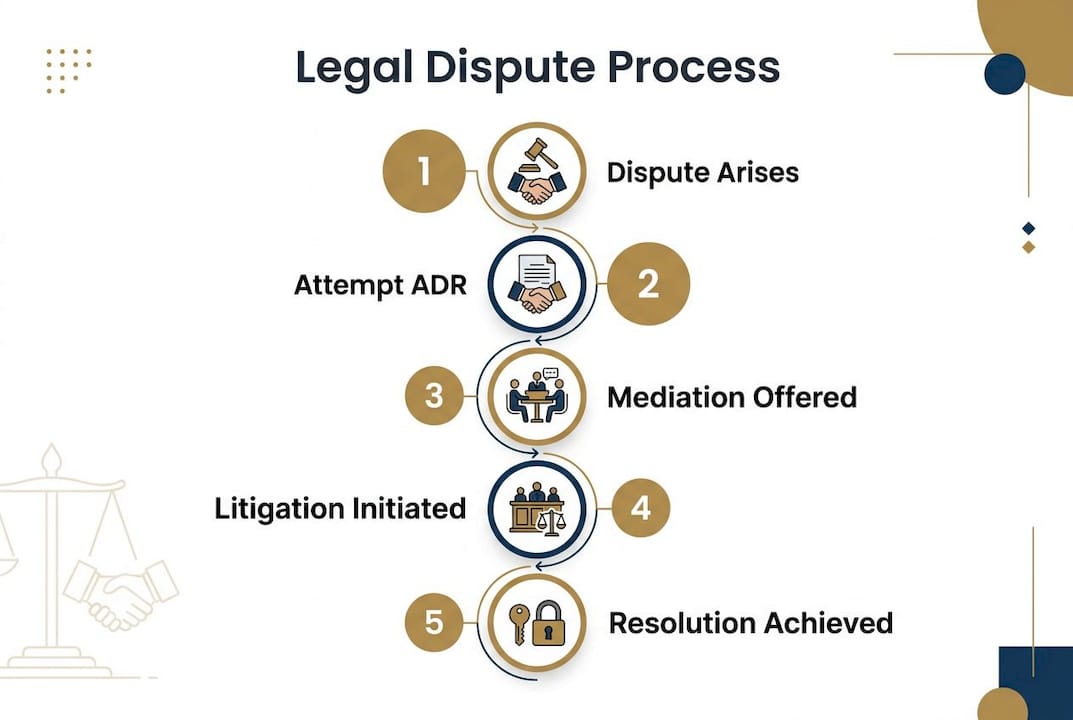
The legal dispute resolution process in the UK offers several routes, and the right choice depends on the nature of the dispute, the relationship between the parties, and the urgency of the outcome.
Litigation remains the default for disputes that cannot be settled. It produces a binding judgment and is backed by the full enforcement machinery of the courts. The downside is cost and delay; complex High Court cases can take years to resolve.
Mediation is the most widely used form of alternative dispute resolution in England and Wales. A neutral mediator helps the parties reach a voluntary agreement. The process is confidential, flexible, and can be used at any stage of a dispute, including after proceedings have been issued.
Arbitration is a binding private process where an arbitrator decides the outcome. It is particularly common in international commercial contracts and construction disputes, where privacy and enforceability across jurisdictions matter.
Expert determination suits highly technical disputes, such as rent reviews or construction valuations. An independent expert delivers a binding decision, often without the extensive legal reasoning required in arbitration or litigation. This makes it faster and cheaper for the right type of dispute.
Ombudsman schemes apply in specific sectors, including financial services, energy, and housing. Ombudsmen investigate complaints and can recommend remedies, though their decisions are generally not legally binding, leaving parties free to pursue other routes if dissatisfied.
Negotiation is the simplest form of resolution: direct exchanges between the parties or their solicitors, either openly or on a without-prejudice basis. Most disputes that settle do so through negotiation, often prompted by the prospect of litigation rather than by litigation itself.
Courts now expect parties to have attempted ADR before issuing proceedings. Failing to do so can result in adverse costs orders, even against a party that ultimately wins the case. ADR is no longer a soft recommendation; it carries real procedural weight.
Pro Tip: Before instructing solicitors to issue a claim, consider whether a without-prejudice letter proposing mediation might resolve the dispute faster and at a fraction of the cost. Courts look favourably on parties who make genuine efforts to settle.
For a detailed comparison of these options, Ali Legal’s ADR guide covers costs, enforceability, and practical considerations for UK businesses and individuals.
Concrete examples make the abstract definition of a legal dispute far easier to grasp, and they also illustrate why evidence gathering is so critical from the outset.
Contract disputes arise when one party fails to perform their obligations under an agreement, whether by non-payment, late delivery, or defective work. Evidence required includes the written contract, correspondence, invoices, delivery records, and any communications acknowledging the breach. For guidance on resolving contract disputes in the UK, the key is establishing what was agreed and what was not delivered.
Employment claims cover unfair dismissal, discrimination, and unpaid wages. Relevant evidence includes employment contracts, payslips, disciplinary records, HR correspondence, and witness statements from colleagues.
Tort claims, particularly personal injury and negligence, require medical records, accident reports, photographs of the scene, expert medical opinion, and evidence of financial loss such as lost earnings.
Property disputes often turn on title documents, Land Registry records, planning permissions, surveyor reports, and correspondence between the parties or their solicitors.
Debt recovery is among the most straightforward civil disputes. Evidence is typically a signed agreement, invoices, and proof that payment was demanded and not made.
The standard of proof differs between civil and criminal proceedings, and this shapes what evidence is sufficient. Civil disputes require proof on the balance of probabilities: it is more likely than not that the events occurred as alleged. Criminal proceedings demand proof beyond reasonable doubt, a considerably higher bar. Evidence that is compelling in a civil claim may fall short in a criminal prosecution of the same facts.
Admissibility matters too. Evidence obtained improperly, or disclosed too late in proceedings, can be excluded or attract cost penalties. Gathering appropriate evidence early, and preserving it carefully, is one of the most consequential decisions in any dispute.
The UK operates a structured court system that routes disputes according to their value and complexity. The County Court handles lower-value and less complex civil claims, including the small claims track for straightforward matters up to £10,000. The High Court’s Business and Property Courts handle high-value and complex commercial disputes, with specialist lists for areas such as technology, construction, and financial services.
Civil procedure in England and Wales is governed by the Civil Procedure Rules 1998, updated regularly to reflect evolving practice. Pre-action protocols are a central feature: they require parties to exchange information, set out their positions clearly, and attempt resolution before issuing proceedings. Failure to follow a protocol does not automatically invalidate a claim, but courts take non-compliance seriously when awarding costs.
The 2026 picture: Courts in England and Wales have strengthened their expectation that parties attempt mediation or another form of ADR before litigation. A party that refuses ADR without good reason risks a costs penalty regardless of the outcome on the merits.
The cultural shift is real. Legal professionals increasingly treat ADR as the first step rather than a last resort, reflecting both the procedural expectations of the courts and the practical reality that litigation costs can quickly outweigh the value of the dispute itself.
The impact of a legal dispute extends well beyond the legal costs. For individuals, a dispute can mean months or years of stress, uncertainty, and financial pressure, particularly where the matter involves employment, family breakdown, or a property transaction gone wrong. The time spent gathering documents, attending hearings, and instructing solicitors is time taken from work and personal life.

For businesses, the consequences are often more acute. A commercial dispute can disrupt cash flow, damage supplier or customer relationships, and consume management time that would otherwise go towards running the company. Reputational damage is harder to quantify but can outlast the dispute itself, particularly where proceedings become public record. Smaller businesses are especially vulnerable: a protracted High Court claim can cost more than the amount in dispute.
There are less obvious effects too. Employees caught up in employment tribunal proceedings, even as witnesses rather than parties, face disruption and anxiety. Directors involved in shareholder disputes may find their authority within the business undermined while the matter remains unresolved. For individuals facing criminal proceedings alongside civil claims, the dual pressure of two separate legal processes running concurrently can be overwhelming.
Early resolution, whether through negotiation or mediation, limits these wider costs. A dispute settled in weeks rather than years preserves relationships, protects cash flow, and allows both parties to move forward.
Every legal dispute is, at its core, a contest about rights and obligations. Without a clear legal basis, a grievance remains just that: a grievance. The law gives certain rights enforceable status, and it is that enforceability that transforms a disagreement into a dispute capable of resolution through legal process.
Understanding your rights before a dispute escalates changes the decisions you make. A tenant who knows their rights under the Landlord and Tenant Act 1985 is better placed to respond to an unlawful eviction than one who does not. A business that understands its contractual obligations is less likely to inadvertently breach them, and better prepared to defend a claim if one arises. Rights also carry corresponding obligations: the right to enforce a contract comes with the obligation to have performed your own side of it.
Legal obligations shape the dispute resolution process itself. Pre-action protocols impose obligations on both claimants and defendants. The duty of disclosure in civil proceedings requires parties to produce relevant documents even when those documents are unhelpful to their own case. Breaching these obligations carries costs consequences and can undermine an otherwise strong position.
Knowing your legal position early, ideally before a dispute crystallises, is the single most effective way to protect your interests. A solicitor can identify whether you have a viable claim or a credible defence, advise on the strength of your evidence, and help you avoid the procedural missteps that can turn a winnable case into an expensive lesson.
Most articles on this subject treat legal disputes as a linear process: disagreement arises, parties attempt resolution, court decides. The reality is messier, and the gap between theory and practice is where disputes become expensive.
The biggest mistake individuals and businesses make is treating a legal dispute as something to manage reactively. By the time a claim is issued, the window for the most cost-effective decisions has often already closed. Evidence has been lost, without-prejudice communications have been mishandled, and pre-action protocol obligations have been ignored. Courts notice all of this, and they factor it into costs decisions.
ADR is genuinely underused, not because parties are unaware of it, but because they underestimate how seriously courts take a refusal to engage with it. Winning on the merits but losing on costs because you declined a reasonable mediation offer is a scenario that plays out regularly in the County Court and High Court alike. The procedural shift in 2026 makes this risk more pronounced, not less.
The other underappreciated reality is that legal rights are only as useful as your ability to evidence them. A clear contractual right means little if you cannot produce the contract, the correspondence that preceded it, or the records that demonstrate the breach. Early legal advice, before a dispute becomes entrenched, is where the real value of a solicitor lies. Not in the courtroom, but in the weeks before anyone considers going there.
If you are facing a legal dispute or want to understand your position before one arises, Ali Legal Ltd offers clear, fixed-fee advice across civil litigation, commercial disputes, employment claims, and property matters. Whether you need guidance on corporate litigation or a practical overview of your rights and obligations, the team at Ali Legal Ltd provides straightforward advice without unnecessary delay.

Contact Ali Legal Ltd to speak with a solicitor about your dispute today.


