
Menu
Get Expert Legal Support Today

TL;DR:
- Litigation, arbitration, and mediation are the main dispute resolution methods used by individuals and organizations facing legal conflicts. Litigation involves a public court process with a binding verdict, while arbitration is a private, enforceable decision made by neutral arbitrators, often used for international disputes. Mediation is a confidential way for parties to negotiate and reach their own agreement, often suitable for preserving relationships and reducing costs.
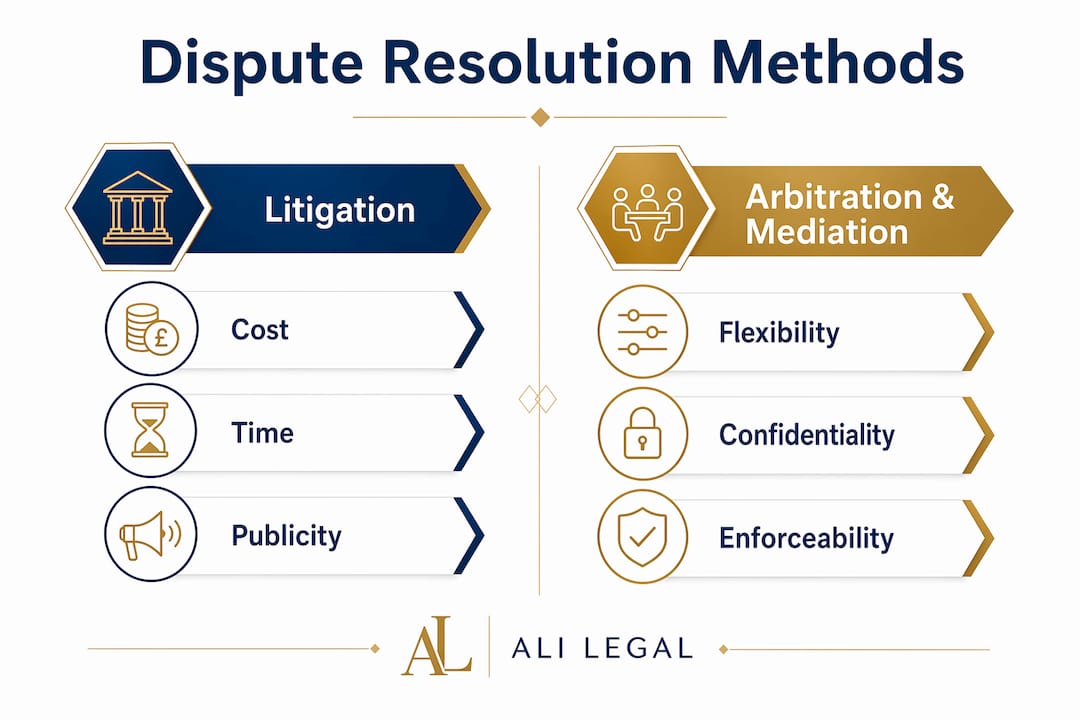
Litigation, arbitration, and mediation are the three primary dispute resolution methods available to individuals and organisations facing legal conflict. Litigation is the formal court process in which a judge or jury delivers a binding verdict. Arbitration is private adjudication by a neutral arbitrator, typically mandated by contract, with awards enforceable in over 170 countries under the 1958 New York Convention. Mediation is a voluntary, confidential process in which a neutral facilitator helps parties reach their own agreement. Choosing correctly between these three paths determines cost, speed, confidentiality, and the durability of the outcome.

Litigation is a formal, public court process in which a judge or jury resolves a dispute by applying the law. The outcome is a binding court judgement, enforceable by state power. Litigation records are public, which means the facts of your dispute, the evidence, and the final decision can all be accessed by third parties.
The typical litigation process follows these stages:
Litigation’s strengths are significant. Broad discovery rights mean you can compel the other side to produce documents they would prefer to hide. Appeal rights provide a safety net if the first decision is wrong. Courts can also grant injunctions and other interim remedies that private forums cannot always match.
The drawbacks are equally real. Litigation is expensive, slow, and public. A contested commercial dispute in the English courts can take two to four years from issue to trial. The public record creates reputational risk for businesses. For disputes where confidentiality or speed matters, litigation is often the least suitable option.
Arbitration is private adjudication by one or more neutral arbitrators, usually triggered by a clause in a commercial contract. The process is adversarial and legally sophisticated, not a simplified version of litigation. The arbitrator’s decision, called an award, is binding and final, with very limited grounds for appeal.
The key advantages of arbitration include:
Pro Tip: Parties in arbitration can tailor procedural rules to reduce costs and focus on the core issues. Most parties never use this right. Agreeing tight document production rules and a single arbitrator rather than a panel can cut costs substantially.
Arbitration has real limitations. The enforceability of the arbitration agreement itself can be contested, requiring a preliminary legal battle before the merits are even heard. More critically, complex arbitrations can exceed litigation costs, particularly when professional arbitrators charge daily rates and institutional fees are added. Limited appeal rights, while efficient, also mean a wrong decision is very difficult to correct. Alilegal’s guide to arbitration clauses in UK contracts explains how to draft these provisions to avoid common pitfalls.
Mediation is a voluntary, confidential process in which a neutral mediator facilitates negotiation between disputing parties. The mediator does not decide the outcome. The parties decide it themselves, with the mediator guiding communication, identifying common ground, and proposing options. This makes mediation fundamentally different from both litigation and arbitration.
The process typically works as follows:
Pro Tip: Mediation suits disputes where parties need to express emotions or reach creative trade-offs. A commercial landlord and tenant dispute, for example, might resolve through a rent deferral arrangement that no court could impose. Bring a decision-maker with full settlement authority to the mediation, not just a lawyer.
Mediation is preferred when preserving a long-term relationship is important. Business partners, joint venture parties, and family members in commercial disputes often find that an adversarial process destroys the relationship permanently. Mediation allows both sides to reach a solution they can live with. For a detailed breakdown of how mediators work in practice, Alilegal’s guide to the role of a mediator is a useful starting point.
The limitation is clear: mediation produces no outcome unless both parties agree. If one party refuses to engage genuinely, the process fails. The mediation session itself is non-binding until a written agreement is signed.
The table below summarises the key differences across five practical factors.
| Factor | Litigation | Arbitration | Mediation |
|---|---|---|---|
| Cost | High; court fees, lawyers, and potential appeals | Variable; can exceed litigation in complex cases | Generally lowest; mediator fees and one day’s preparation |
| Speed | Slow; years in contested cases | Moderate; faster than litigation but not always quick | Fast; often resolved in one to two days |
| Confidentiality | Public record | Private proceedings and award | Fully confidential |
| Enforceability | Court judgement; enforceable domestically | New York Convention; 170+ countries | Binding contract once signed; court order if registered |
| Finality | Appealable | Very limited appeal rights | No outcome unless parties agree |
| Formality | High; strict procedural rules | Moderate; rules can be adapted | Low; party-led process |
Confidentiality is the factor most organisations underestimate. Litigation records are public, which means a competitor, journalist, or regulator can read the details of your dispute. Arbitration and mediation both protect that information. For businesses in regulated sectors, this distinction alone can determine the choice of forum.
Cost comparisons require care. Mediation is almost always the cheapest option when it succeeds. Arbitration is often cheaper than litigation for straightforward disputes, but costs can surpass litigation in highly complex cases with multiple arbitrators and institutional administration fees. Litigation’s costs are high but predictable in structure, with court fee scales set by statute.
The right method depends on four factors: the nature of the dispute, the relationship between the parties, the need for enforceability, and the cost you can justify.
Choose mediation when preserving the relationship matters, when the dispute involves multiple issues that could be traded off creatively, or when speed and cost are the primary constraints. Mediation is also the right first step before committing to a more expensive process. Alilegal’s guide to business dispute mediation sets out a practical framework for executives.
Choose arbitration when the dispute arises from a contract with an arbitration clause, when cross-border enforcement is needed, or when confidentiality is non-negotiable. Arbitration is also appropriate when the parties want a legally binding decision but prefer a private forum to court.
Choose litigation when you need broad discovery rights, when you require a public ruling to set a precedent, when interim remedies such as injunctions are needed urgently, or when the other party has no arbitration agreement and refuses mediation.
Consider a hybrid approach. Many contracts now include tiered dispute resolution clauses: negotiation first, then mediation, then arbitration or litigation. This sequence gives parties the chance to resolve matters cheaply before escalating. Alilegal’s overview of alternatives to litigation covers this approach in detail for smaller organisations.
Pro Tip: Review your contracts now, before a dispute arises. If your commercial agreements contain arbitration clauses, understand what rules apply and which institution administers them. Discovering that you are bound by an unfamiliar set of procedural rules mid-dispute is a costly surprise.
Legal advice at the outset is not optional. The choice of forum affects your rights, your costs, and the enforceability of any outcome. A solicitor can assess the specific facts and recommend the most effective path.
The most persistent misconception I encounter is that arbitration is simply a quieter, friendlier version of going to court. It is not. Arbitration is a sophisticated, adversarial process that requires the same quality of legal preparation as litigation, sometimes more. Parties who enter arbitration expecting informality are consistently surprised by the cost and rigour involved.
The second misconception is that mediation is a soft option for disputes that are not serious enough for court. The opposite is true. Mediation produces durable outcomes precisely because the parties own the solution. A court judgement tells you who won. A mediated settlement tells you what both sides can actually live with. In commercial relationships that need to continue after the dispute, that distinction is decisive.
My practical advice is this: use mediation earlier than feels comfortable. Most parties wait until litigation or arbitration is already underway, at which point costs and entrenched positions make settlement harder. A well-timed mediation, before proceedings are issued, resolves disputes faster and at a fraction of the cost. The mediation process stages are worth understanding before you need them, not after.
— Panagiotis
Choosing the wrong dispute resolution method costs time, money, and sometimes the outcome itself. Alilegal works with individuals and businesses to assess each dispute on its facts and recommend the most effective path forward.

Alilegal’s team has deep experience in civil litigation, commercial disputes, arbitration, and mediation across domestic and international matters. Whether you are facing a contract dispute, a cross-border commercial claim, or a relationship-sensitive business conflict, Alilegal provides clear advice on your options from the outset. Fixed fees and transparent communication mean you know what you are committing to before proceedings begin. Contact Alilegal to discuss your dispute and identify the resolution method that fits your situation.
Arbitration produces a binding decision made by a neutral arbitrator, similar to a court judgement. Mediation is a facilitated negotiation in which the parties themselves reach a voluntary agreement, which becomes binding only once signed.
Yes. A settlement agreement from mediation is a binding contract once signed by both parties, and in many jurisdictions it can be registered as a court order for direct enforcement.
Arbitration awards are enforceable in 170+ countries under the 1958 New York Convention, making arbitration the preferred method for cross-border commercial disputes where enforcement across jurisdictions is required.
Not always. While arbitration is often faster than litigation, complex arbitrations can exceed litigation costs when multiple professional arbitrators, institutional fees, and extensive procedural steps are involved.
Litigation is the right choice when you need broad discovery rights, urgent interim remedies such as injunctions, a public ruling, or when the other party has no arbitration agreement and refuses to engage in mediation.


