
Menu
Get Expert Legal Support Today

Legal counsel in a UK business sits at the intersection of law and commercial decision-making. The role covers far more than reviewing contracts: it spans regulatory compliance, risk identification, corporate governance, dispute management, and acting as a trusted adviser to senior leadership. Whether the title is General Counsel, Legal Director, or simply Legal Counsel, the core responsibilities follow a consistent pattern across sectors.
The primary legal counsel duties in a UK corporate context include:
The SRA guidance on in-house solicitors makes clear that these duties carry personal accountability: a solicitor employed in-house remains bound by the SRA’s Code of Conduct regardless of their employer’s instructions.
Legal counsel must translate complex regulatory requirements into practical guidance the business can act on. This means monitoring obligations under the Companies Act 2006, FCA rules, the UK GDPR, and sector-specific legislation, then communicating what those obligations mean for day-to-day operations. The role of legal representation here is not passive: counsel is expected to flag risks proactively, before a problem reaches the board.

Contract work sits at the heart of most in-house legal roles. Counsel drafts, reviews, and negotiates agreements ranging from supplier terms and licensing arrangements to joint ventures and service contracts. The goal is not just legal accuracy but commercial clarity. A well-drafted contract reduces the likelihood of disputes and protects the organisation’s position if one arises. For guidance on structuring these documents effectively, drafting commercial contracts requires both technical precision and an understanding of what the business actually needs from the deal.
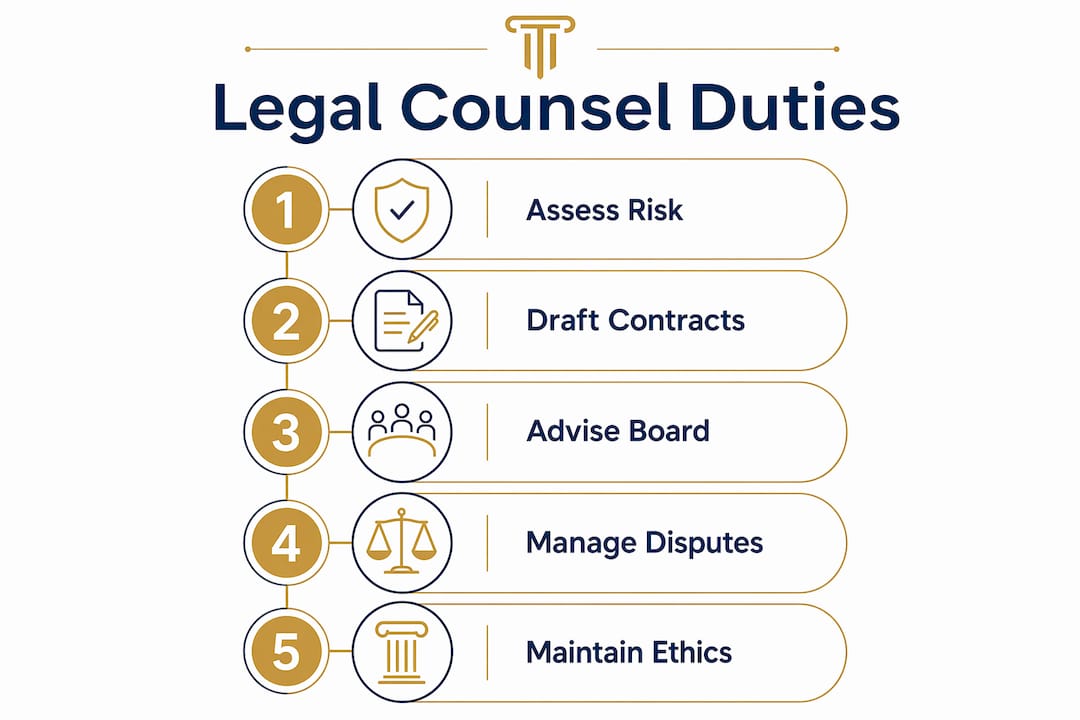
General Counsel and senior legal counsel often sit on, or report directly to, the board. Their function is to help leadership make decisions that are legally sound and ethically defensible. This goes beyond answering specific legal questions: it involves shaping governance frameworks, advising on director duties under the Companies Act, and contributing to risk appetite discussions. The Law Society’s in-house ethics framework describes this as requiring “influence and independence” in equal measure.

In-house solicitors must recognise the limits of their own expertise and instruct external counsel for complex or specialist matters. When litigation arises, the in-house team typically manages the relationship with external solicitors, coordinates disclosure, and ensures the organisation’s position is properly presented. For matters reaching the High Court or Court of Appeal, a barrister acting as counsel will usually be instructed to advocate.
Solicitors’ professional obligations to act with integrity take precedence over employer instructions where the two conflict. Counsel must maintain legal professional privilege, avoid misleading courts or regulators, and refuse to participate in dishonest or unlawful activity even under commercial pressure. These are not aspirational standards: breaching them can result in the solicitor being struck off the roll.
Pro Tip: Maintain a clear paper trail when giving formal legal advice internally. Document the basis and limitations of your advice explicitly. This protects both the organisation and your own professional standing if the matter is later scrutinised.
Not every person carrying a legal counsel job title is a qualified solicitor. Some roles, such as contracts manager or legal adviser, may be filled by individuals without formal legal qualification, provided they do not mislead anyone about their status. However, the most senior and regulated roles, including General Counsel, typically require full solicitor qualification via the Solicitors Qualifying Examination (SQE), which replaced the Legal Practice Course (LPC) as the primary route and will be the sole pathway by 2032.
To qualify as a solicitor, candidates must pass SQE1 and SQE2, complete two years of Qualifying Work Experience, and be admitted to the roll of solicitors regulated by the Solicitors Regulation Authority (SRA).
Common in-house roles range from junior legal counsel through to General Counsel, with several distinct levels in between. The table below sets out the typical progression alongside approximate salary ranges.
| Role | Typical seniority | Approximate UK salary range |
|---|---|---|
| Junior Legal Counsel / Legal Adviser | Entry level | A typical salary for entry-level legal advisers |
| Legal Counsel | Mid-level | A typical salary for mid-level legal counsel |
| Senior Legal Counsel | Senior | A typical salary for senior legal counsel |
| Deputy General Counsel / Head of Legal | Senior leadership | A typical salary for senior leadership legal roles |
| General Counsel / Legal Director | Board or near-board | A typical salary for board-level legal leadership |
London roles attract a significant premium. Salary data from Glassdoor places the average annual salary for legal counsel in London at around £91,848, with wide variation depending on sector, seniority, and the size of the employing organisation. Financial services and technology firms tend to pay at the upper end; public sector and charity roles typically sit lower.
The Legal Contracts Manager role deserves a specific mention. It focuses on high-volume contract management and is often, though not always, performed by a qualified lawyer. It sits outside the traditional General Counsel hierarchy but forms a critical part of many large organisations’ legal functions.
The tension between being an employee and being an officer of the court is the defining challenge of in-house practice. In-house solicitors balance employment as company staff with regulatory duties that cannot be overridden by a line manager or a commercial deadline. The SRA is explicit: solicitors must act with integrity and independence, and those duties safeguard the wider public interest above any individual employer’s interests.
This is not abstract. A solicitor asked to backdate a document, suppress relevant evidence, or change legal advice to achieve a preferred commercial outcome must refuse. Doing otherwise risks enforcement action and, in serious cases, removal from the roll.
The Law Society and SRA advise that the most effective in-house legal teams are those empowered as trusted advisers who can raise concerns without fear of reprisal. This means having direct access to the board, clear reporting lines, and an organisational culture that treats legal challenge as an asset rather than an obstacle. Counsel who can say “no” credibly, and explain why, adds more value than one who simply validates decisions already made.
Legal counsel must alert the organisation if asked to act in a way that creates a conflict between their professional obligations and their employment duties. The SRA’s Code of Conduct requires solicitors to refrain from acting where such a conflict exists or is likely to arise. Practically, this means counsel should not simultaneously hold a commercial role, such as directing a subsidiary or leading a sales initiative, where incentives would pull against their professional judgement.
Pro Tip: Set mutual expectations about professional obligations at the start of the employment relationship, not after a conflict has arisen. Including relevant terms in the employment contract gives both parties a clear framework and reduces the risk of misunderstanding under pressure.
Solicitors working in-house in unregulated entities may not require Professional Indemnity Insurance, but they remain personally accountable to the SRA for their conduct. The regulatory obligation travels with the individual, not the employer.
The responsibilities of legal advisors extend well beyond legal knowledge. Emotional intelligence, the ability to deliver unwelcome advice diplomatically, and the courage to maintain independence under commercial pressure are what separate effective in-house counsel from technically competent ones.
The legal counsel role does not exist in a static regulatory environment. Several developments in UK law are directly reshaping what in-house teams are expected to manage.
The Economic Crime and Corporate Transparency Act 2023 introduced new corporate criminal liability provisions, including a “failure to prevent fraud” offence for large organisations. Legal counsel now carries responsibility for advising on the adequate procedures defence and ensuring compliance frameworks are fit for purpose before the offence is triggered.
The UK GDPR and Data Protection Act 2018 continue to generate significant in-house workload, particularly around data sharing agreements, subject access requests, and breach notification obligations to the Information Commissioner’s Office. Counsel working in technology, financial services, or healthcare sectors will spend a disproportionate share of their time here.
The Companies Act 2006 remains the backbone of corporate governance obligations. Directors’ duties under sections 171 to 177, including the duty to promote the success of the company and avoid conflicts of interest, require ongoing legal input. Counsel advising boards on governance matters must keep these provisions current in their practice. For a broader view of how these duties interact with corporate structure, corporate law in the UK covers the key frameworks in detail.
The FCA’s Consumer Duty, which came into full force in July 2023 for open products and extended to closed products in July 2024, has added a new layer of compliance obligation for financial services firms. In-house counsel at regulated firms must understand how the Duty applies to their products and services and advise on whether customer outcomes meet the required standard.
Employment law is also in flux. The Employment Rights Bill, progressing through Parliament in 2025 and 2026, proposes significant changes to unfair dismissal rights, flexible working entitlements, and trade union recognition. Legal counsel with employment responsibilities will need to track these changes and update internal policies accordingly.
The conventional picture of in-house legal counsel is someone who makes life easier for the business by keeping it out of trouble. That framing undersells both the difficulty and the importance of the role.
The real pressure is not legal complexity. Most experienced solicitors can handle the technical side. The pressure is relational: delivering advice that the business does not want to hear, to people who have the authority to ignore it, without losing the credibility needed to be heard next time. That requires a combination of legal judgement, political awareness, and genuine courage that no qualification exam tests for.
There is also a structural tension that organisations rarely acknowledge openly. An in-house solicitor is simultaneously an employee subject to performance reviews, salary decisions, and organisational hierarchy, and a regulated professional whose obligations to the public interest override their employer’s instructions. Those two positions are compatible most of the time. When they are not, the solicitor’s professional obligations win. Understanding this from the outset, rather than discovering it mid-crisis, is what separates organisations that get real value from their legal teams from those that end up with expensive compliance failures.
The types of legal professionals involved in any given matter vary considerably, and knowing when to bring in external expertise, whether a specialist solicitor or a barrister acting as counsel, is itself a core skill of effective in-house practice.
The organisations that handle this best are not necessarily those with the largest legal teams. They are the ones where the General Counsel has a direct line to the board, where raising a concern is treated as professional diligence rather than obstruction, and where the legal function is involved in decisions early enough to shape them rather than just review them after the fact.


