
Menu
Get Expert Legal Support Today

If another party’s negligence caused your injury, get medical attention first, then seek legal advice without delay. Most personal injury claims must start within three years of the accident, so acting quickly protects your position even if you’re not yet sure you want to proceed. Whether you go it alone through the Official Injury Claim service or instruct a solicitor depends on how serious the injury is and how complicated the circumstances are.
Do this now:
Every claim, regardless of size, moves through broadly the same stages. Understanding them removes most of the anxiety, because you know what’s meant to happen next and roughly when.
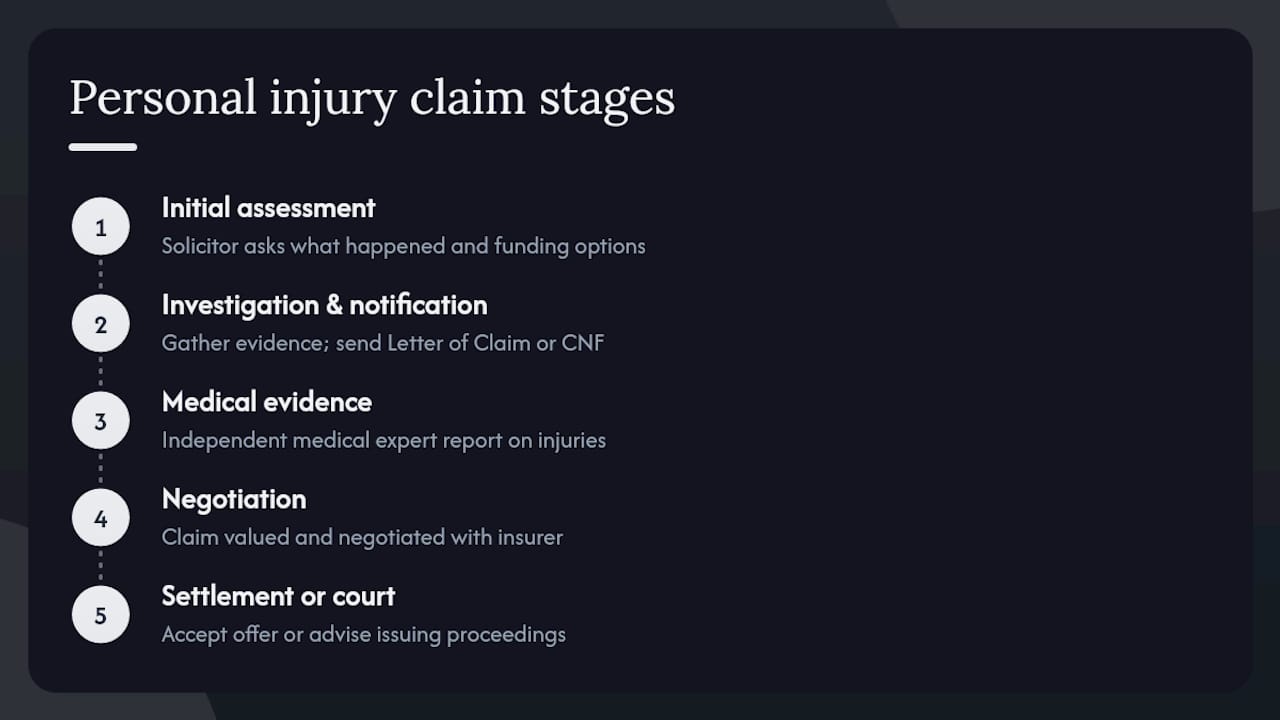
1. Initial assessment. A solicitor will ask what happened, when, and whether there’s a clear case of fault. This conversation usually happens free of charge and covers funding options at the same time, so you know the cost picture before committing to anything.
2. Investigation and notification. Your solicitor gathers evidence and sends a Letter of Claim, or in road traffic cases a Claim Notification Form (CNF), to the party you’re claiming against. That party (or their insurer) typically has a fixed window, often 21 days to acknowledge and longer to respond in full, to admit or deny liability.
3. Medical evidence. Once liability is accepted, or sometimes in parallel, an independent medical expert is instructed to assess your injuries and produce a report covering diagnosis, treatment, and prognosis. This report underpins the eventual valuation of your claim.
4. Negotiation. With medical evidence and financial losses documented, your solicitor puts a value on the claim and negotiates with the other side’s insurer. Most cases settle at this stage without ever reaching a courtroom, according to guidance on the typical personal injury claim process.
5. Settlement or court. If negotiation succeeds, you receive an offer to accept. If it doesn’t, your solicitor will advise on issuing court proceedings, though this remains a last resort rather than the norm.
Pro Tip: Ask your solicitor for a rough timeline at the outset and check in every few months rather than waiting for updates to arrive. Claims stall when nobody chases the medical report or the other side’s insurer.
For a fuller breakdown of how each stage affects your eventual compensation, Ali Legal Ltd’s personal injury claims guide sets out valuation and negotiation tactics in more depth.
The Limitation Act 1980 gives you three years from the date of the accident, or from the date you first realised you’d been injured, to issue court proceedings. Miss that date without a valid exception and your claim is almost certainly dead in the water.
Common exceptions include:
Roughly one in three years feels like a long runway until evidence starts disappearing, memories fade, and CCTV footage gets overwritten within weeks. Solicitors typically issue protective proceedings well before the deadline where a case is complex, precisely to avoid a last minute scramble.
Evidence wins or loses cases, and the strongest evidence is almost always the earliest evidence. Start collecting the moment you’re able to.
Once instructed, your solicitor takes over the heavier lifting: obtaining CCTV before it’s deleted, requesting employer records or HSE reports, and instructing the independent medical expert who produces the report both sides rely on for valuation, as outlined by Timms Solicitors on evidence preservation. Medical reports usually take a few weeks to a couple of months to prepare, and the cost is typically recovered from the defendant if the claim succeeds.
Pro Tip: Keep a simple diary of pain levels, missed work, and appointments from day one. It sounds tedious, but it becomes the backbone of your special damages claim later.
For a broader view of what solicitors ask for and why, Scotland Claims Injury Lawyers sets out the categories of evidence that carry the most weight in disputed cases.
Most personal injury solicitors work on a “no win, no fee” basis, formally called a conditional fee agreement. You pay nothing if the claim fails, and if it succeeds, the solicitor takes a success fee, capped by law, deducted from your compensation.
Before instructing anyone, ask:
Gov is worth reading before you sign anything, particularly because legal aid is rarely available for this type of claim.
Not every solicitor handles personal injury work well, so look for genuine specialism rather than a general practice that “also does” injury claims.
At first contact, ask these questions:
Red flags include vague answers on fees, reluctance to put funding terms in writing, and pressure to sign before you’ve had time to read anything. Citizens Advice also flags the distinction between claims management companies, which can introduce you to a solicitor but generally can’t represent you in court, and an actual solicitor who can see the case through end to end. Ali Legal Ltd’s guide on what personal injury lawyers do breaks down that distinction further.
Court proceedings are issued only when negotiation stalls, and trials remain rare. If issued, both sides exchange witness statements and expert evidence ahead of a hearing.
Ali Legal Ltd applies the same fixed-fee, client-centred model to personal injury work that underpins its wider practice: clear costs agreed upfront, no jargon, and a named solicitor managing your file from first contact to settlement.
Practical case examples and outcomes are set out in Ali Legal Ltd’s personal injury cases summaries, giving a sense of how different injury types have resolved in practice.
The three mistakes seen most often: delaying medical treatment because the injury “isn’t that bad”, losing evidence by not writing anything down for weeks, and signing a funding agreement without asking what happens if the claim loses. Each is avoidable. See a doctor the same day if you can, write down what happened before you sleep on it, and get funding terms in writing before you sign.
— Panagiotis
If you’re weighing up whether to handle a small whiplash claim yourself through Official Injury Claim or bring in a solicitor for something more serious, the safest move is a short conversation before you decide either way. Ali Legal Ltd offers fixed-fee initial advice, so you know exactly what a consultation costs before you book it, and there’s no obligation to proceed afterwards.

The firm’s personal injury team handles everything from evidence gathering and medical report instruction through to insurer negotiation and, where needed, court proceedings, always with a named solicitor running your file rather than a call centre. If property damage sits alongside your injury claim, Ali Legal Ltd’s property law guidance covers the related legal angles too. Get in touch through Ali Legal Ltd’s contact page to arrange your initial consultation and find out where you stand before the three-year clock becomes a concern.
This article is general information, not a substitute for advice from a qualified lawyer. Consult a qualified legal professional about your own circumstances before acting on anything here.


