
Menu
Get Expert Legal Support Today

TL;DR:
- Business continuity planning (BCP) is a comprehensive, organization-wide strategy aimed at ensuring ongoing operations during disruptions beyond just IT systems. Proper BCP involves analyzing critical processes, setting clear recovery metrics, and regularly testing plans, leadership, and dependencies to maintain resilience. Effective BCP integrates legal compliance, stakeholder communication, and adaptability to evolving threats like cyber attacks and supply chain failures.
Most business owners assume business continuity planning (BCP) is a concern for the IT department. A server goes down, and the recovery team steps in. But BCP is far broader than that. It is the process of creating prevention and recovery systems so that your organisation can keep delivering products and services at acceptable levels through any disruptive incident, whether that is a flood, a key supplier collapse, a pandemic, or a cyber attack. This guide walks you through what BCP really involves, how to structure an effective plan, and what separates businesses that survive disruptions from those that do not.
| Point | Details |
|---|---|
| BCP is holistic | It safeguards all critical operations, not just IT, keeping your business running in any crisis. |
| Start with BIA | A business impact analysis helps prioritise what matters most and sets clear recovery targets. |
| Ongoing testing is vital | Plans quickly become outdated; maintain relevance with regular reviews and updates. |
| Adapt for new threats | Prepare for cyber attacks, operational compromises, and align BCP directly with disaster recovery. |
| Ownership ensures success | Leadership buy-in and clear responsibility turn theory into real continuity and resilience. |
Business continuity planning is not simply an IT policy or an emergency contact list. It is a strategic, organisation-wide framework that prepares every function of your business to keep operating when something goes wrong. Think of it as the difference between patching a leak and building a waterproof structure from the start.
Many decision-makers conflate BCP with disaster recovery, but they serve distinct purposes. BCP is broader than IT disaster recovery: it plans for continuity of the entire business process and includes non-IT resources such as workspaces, communications, and other operational resources. Disaster recovery is typically focused on restoring systems after a failure. BCP asks the bigger question: how does the whole business keep functioning during and after a disruption?
| Feature | Business continuity planning | Disaster recovery |
|---|---|---|
| Focus | All business operations | IT systems and data |
| Scope | Organisation-wide | Technical infrastructure |
| Ownership | Senior leadership | IT department |
| Outcome | Operational resilience | System restoration |
A well-designed BCP covers the following key areas:
“Operational continuity is not about having the perfect plan. It is about having thought through the right questions before the crisis begins, so that your people know what to do even when the situation does not match the script.”
Understanding BCP as a legal and operational matter also means recognising how it intersects with legal risk management for your business. Contractual obligations, data protection duties, and regulatory requirements do not pause during a disruption. Your BCP must account for them.
With the definition clear, it is time to unpack what actually composes an effective BCP. The structure is not arbitrary. Each component serves a specific purpose, and gaps between them are where plans fail in real-world situations.
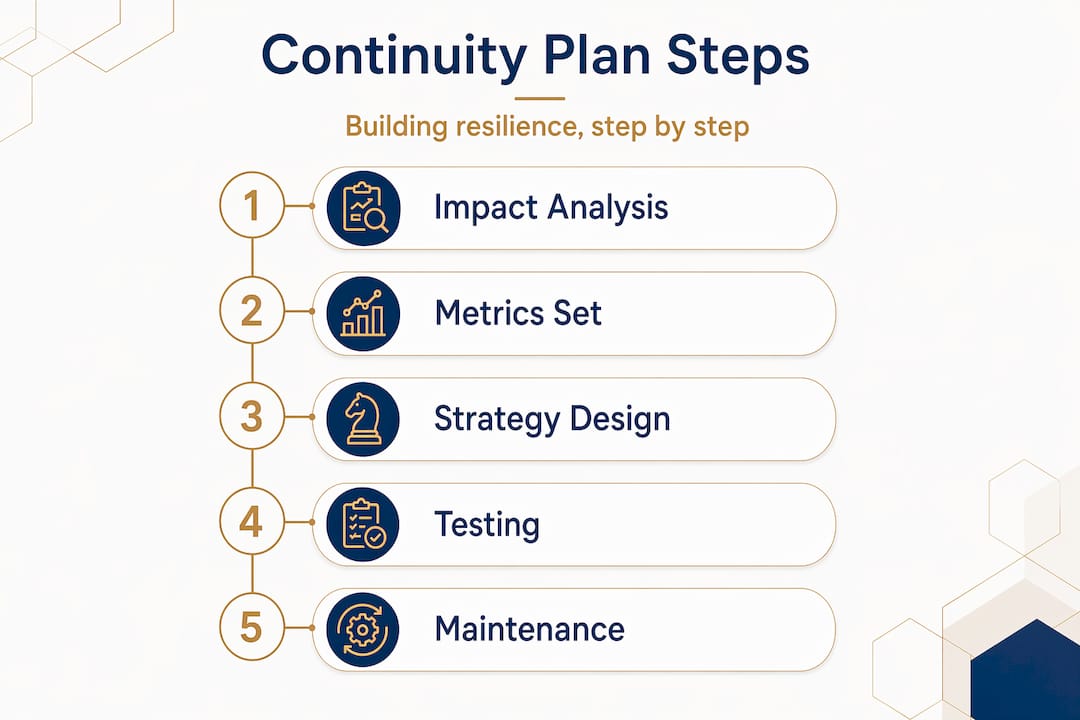
A common methodology is to start with a business impact analysis (BIA), use it to set continuity and recovery metrics such as RTO and MTD, and then design strategies that align people, process, technology, and supply-chain dependencies to keep operating through disruption.
| Component | What it does |
|---|---|
| Business impact analysis (BIA) | Identifies critical processes and quantifies the cost of downtime |
| Recovery time objective (RTO) | Defines the maximum acceptable time to restore a process |
| Maximum tolerable downtime (MTD) | Sets the absolute limit before the disruption causes irreparable harm |
| Roles and responsibilities | Assigns ownership of each recovery action to a named individual |
| Supply chain mapping | Identifies dependencies and alternative sourcing options |
| Communication plan | Outlines how internal teams, clients, and stakeholders are informed |
Without defined RTOs and MTDs, your plan is a collection of good intentions. These metrics force clarity. They compel you to answer the question: how long can we actually survive without this process? For most businesses, that answer is shorter than they expect.
Here is what your BCP should address in practical terms:
Pro Tip: When conducting your BIA, do not just ask department heads what they do. Ask what would break first if their team disappeared for a week. That conversation often surfaces dependencies that never appear on an organisational chart.
Aligning your BCP with recognised frameworks such as ISO 22301 standards gives your plan structural credibility and is increasingly expected by insurers, investors, and enterprise clients. The compliance officer’s role within BCP is significant here, as they can ensure that the plan meets legal and regulatory requirements from the outset. Understanding business liability essentials is also critical, since a failure to maintain continuity can expose your organisation to contractual claims and regulatory sanctions.
Building your plan is only half the job. Ensuring it works and stays relevant demands ongoing action. A plan that sits in a drawer and is never tested is not a plan. It is a liability.

Testing and maintaining BCPs is essential because plans can go stale and become unusable when needed. Business leadership ownership and ongoing review and testing are what separate organisations with genuine resilience from those with the appearance of it.
Here are the key maintenance activities every organisation should build into its annual calendar:
Pro Tip: Assign a named individual, not just a job title, as BCP owner. When ownership is tied to a role rather than a person, accountability evaporates during staff changes.
“Plans that belong to everyone belong to no one. Genuine resilience requires a named senior leader who is accountable for the plan, its testing, and its outcomes.”
Maintaining robust law and compliance for business standards should be woven into your maintenance cycle. A BCP that was compliant when written can quickly fall out of alignment with evolving regulation. Review your website security checklist as part of your technology continuity review, particularly if your business handles client data online.
Even with good plans, rapidly evolving threats create new continuity challenges. The threat landscape has changed significantly. A decade ago, BCP focused primarily on physical disruptions. Today, the picture is considerably more complex.
Severe cyber threats require operational continuity planning even when IT and operational technology systems are degraded. Organisations must make difficult trade-offs between security controls and operational continuity. For example, isolating compromised systems may disrupt core services, but leaving them connected may worsen the breach. Your BCP must anticipate these scenarios and give leaders a framework for making those calls quickly.
Consider the following risks and trade-offs for critical processes during severe disruptions:
BCP defines what must continue and at what level, while disaster recovery focuses on restoring supporting systems and data. If either is misaligned, operational resilience can fail in real incidents. Many businesses treat these as separate workstreams owned by different teams. That approach creates gaps. The team responsible for keeping the business running and the team responsible for restoring its systems must operate from the same playbook, with shared assumptions about recovery timelines and minimum service levels.
Pro Tip: Use your BIA to define the minimum essential processes your business must maintain even under severe degradation. That list should drive both your BCP strategy and your disaster recovery priorities simultaneously, not independently.
Business advocacy in continuity matters more than many leaders realise. When disruptions affect contractual performance, having legal counsel involved in your BCP ensures you understand your obligations and your options before the crisis hits, not during it. Review your approach to website security as part of your cyber continuity planning, particularly if client-facing digital services form part of your core offering.
From working with businesses navigating operational crises and legal disputes, one pattern emerges repeatedly. The organisations that struggle most during disruptions are not the ones without a plan. They are the ones with a plan that nobody truly owns or believes in.
The document exists. The policy is signed. The folder is filed. And then a real disruption occurs, and the plan is found to be two years out of date, referencing staff who have left, suppliers who no longer exist, and systems that have since been replaced.
The first overlooked reality is that a checklist is not the same as readiness. Many businesses complete their BCP as a compliance exercise, ticking boxes to satisfy an insurer or a client due diligence request. The intent is correct, but the execution stops too soon. Real readiness comes from rehearsal, from genuinely testing whether your people can execute the plan under pressure, not just whether the plan looks thorough on paper.
The second reality is that complacency grows fastest after a period of stability. The longer a business operates without a serious disruption, the more likely the BCP is to decay quietly. Key staff change. Processes evolve. Technology changes. But the plan remains static because “nothing has gone wrong yet.” By the time something does go wrong, the gap between the plan and reality can be significant.
The third and perhaps most important lesson is this: real crises rarely match the scenarios you planned for. A flood is not just a flood. It may also coincide with a key member of staff being on leave, a supplier struggling with their own disruption, and a regulatory deadline that cannot be moved. Agility and a culture of clear-headed decision-making matter as much as the written plan itself.
Embedding continuity thinking into your executive culture means treating BCP as a living conversation, not a periodic document review. Leaders who understand legal risk management from a strategic perspective are better positioned to recognise emerging threats and respond in ways that protect both operations and legal standing.
The businesses that come through disruptions best are those where leaders have genuinely thought through the hard questions in advance, understand the trade-offs, and have empowered their teams to act decisively without waiting for instructions that may never come.
Understanding BCP is one thing. Embedding it into your legal and commercial strategy is another, and that is where experienced legal support makes a measurable difference.

At Ali Legal, we work with businesses to identify legal vulnerabilities that sit inside continuity risk, from contractual exposure during supply chain disruption to regulatory obligations that persist through an operational crisis. Our commercial litigation help is available when disruptions lead to disputes, and our broader risk management insights help you take a proactive approach before a crisis demands it. Fixed fees, straightforward advice, and long-term relationships mean you get genuine support without surprises. If you are ready to build a more resilient business, speak to our experts today.
Business continuity planning keeps critical business processes running during disruptions, whereas disaster recovery focuses on restoring IT systems and data after an incident. BCP covers far more than IT, including workspaces, communications, and non-technical operations.
A BIA identifies the key processes and dependencies your business cannot afford to lose, setting recovery priorities and metrics. It is the foundation of effective BCP because it forces you to quantify the actual cost of downtime before a disruption occurs.
Your BCP should be reviewed, tested, and updated at least annually or whenever significant changes occur in your organisation. Plans that go untested quickly become unreliable because business conditions, staff, and systems change continuously.
Senior leadership must own the BCP process, with clear delegated responsibility for creation, testing, and maintenance assigned to named individuals. Leadership ownership is essential because without executive accountability, plans are rarely kept current or properly tested.
No. All organisations benefit from BCP because disruptions can affect businesses of any size or sector. BCP creates prevention and recovery systems that allow any organisation to continue delivering products and services at acceptable levels when something goes wrong.


