
Menu
Get Expert Legal Support Today

TL;DR:
- Effective contract drafting hinges on clear design that reflects business goals and precise language, avoiding reliance on generic templates.
- Thorough clause-by-clause checklists and critical analysis of boilerplate provisions are essential to prevent costly legal errors and disputes.
- Integrating technology can assist efficiency, but human judgment and tailored review remain vital to ensure contracts are enforceable and aligned with current law.
Every contract you sign or issue carries assumptions baked into its language, and those assumptions can either protect your position or quietly undermine it. Poor drafting is not simply an inconvenience; it generates disputes, triggers compliance failures, and leaves your business exposed to risks you never anticipated. A robust contract-drafting methodology starts with deliberately translating your business deal into clear legal structure, not just assembling borrowed clauses. This guide walks you through the best practices that experienced practitioners rely on to produce contracts that are precise, enforceable, and genuinely fit for purpose.
| Point | Details |
|---|---|
| Prioritise contract design | Begin with a clear mapping of your business deal into contract structure rather than relying on off-the-shelf templates. |
| Use a structured checklist | A clause-by-clause checklist helps ensure nothing is missed and every term is clear and effective. |
| Tailor all boilerplate | Never treat boilerplate as harmless—customise every standard clause to fit your agreement. |
| Regularly update templates | Continually update forms and precedents to reflect new laws and real-world experience. |
| Balance AI with legal judgement | Use technology for efficiency but rely on human expertise to safeguard against errors and misinterpretations. |
Before a single clause is written, you need to understand what the contract is actually trying to achieve. Contract design means capturing the commercial goals, obligations, and risk allocation of a deal in both structure and plain language. It is the foundation on which everything else rests, and skipping it is the single most common reason contracts fail to protect the parties involved.
Many businesses reach for a template the moment they need a contract. Templates are not inherently bad, but treating them as a finished product is a dangerous shortcut. Every transaction has unique commercial terms, bespoke risk profiles, and regulatory considerations that a generic form simply cannot address. The design process should happen before you even open a template, not after.
Here is a practical order for approaching contract design:
“A robust contract-drafting methodology starts with contract ‘design’ fundamentals: systematically translate the business deal into contract structure and language, not just assemble boilerplate.” — Contract Design: Principles and Practice, Stanford Law
When drafting commercial contracts, this design-first approach ensures that the legal document is a genuine reflection of the business deal rather than a patchwork of borrowed provisions. Well-designed contracts for business protection create a roadmap that both parties can follow and a safety net when things go wrong.
Pro Tip: Hold a short “deal design” meeting with all stakeholders before drafting begins. Even 30 minutes spent mapping obligations and risks will save hours of revision later and significantly reduce the chance of disputes.
With a clear design blueprint in place, the next step is turning that planning into disciplined, organised drafting. A clause-by-clause checklist is not a bureaucratic exercise. It is the mechanism that prevents important provisions from being omitted, ensures consistency throughout the document, and forces the drafter to think carefully about every element of the agreement.
Drafting best practices should include an explicit, clause-by-clause checklist for planning and organising the drafting process, selecting the proper form, allocating and mitigating risk, and drafting provisions concisely, precisely, and consistently. This is not optional advice for large transactions. It applies equally to a straightforward services agreement or a complex joint venture.
A practical clause-by-clause checklist should address the following:
| Checklist area | Common omission | Risk if overlooked |
|---|---|---|
| Definitions | Undefined key terms | Ambiguity leading to dispute |
| Payment terms | No interest on late payment | Financial loss |
| IP ownership | Vague assignment language | Loss of created assets |
| Termination | Missing notice period | Contractual breach |
| Governing law | No jurisdiction clause | Costly jurisdictional disputes |
When navigating commercial contracts, this checklist approach breaks a potentially overwhelming document into manageable, reviewable pieces. It also highlights interdependencies, for instance, where a termination clause references a definitions clause that has since been amended.
Pro Tip: Build your checklist into your firm’s standard workflow for commercial contract essentials. Review it at drafting stage, after negotiation, and immediately before signing. Treat it as a living document, not a one-time exercise.
Boilerplate clauses are the standard provisions that appear almost automatically in commercial contracts. Governing law, jurisdiction, entire agreement, severability, notices, force majeure and survival clauses are among the most common. The danger is that many drafters and their clients treat these as formalities, inserting them without genuine analysis.
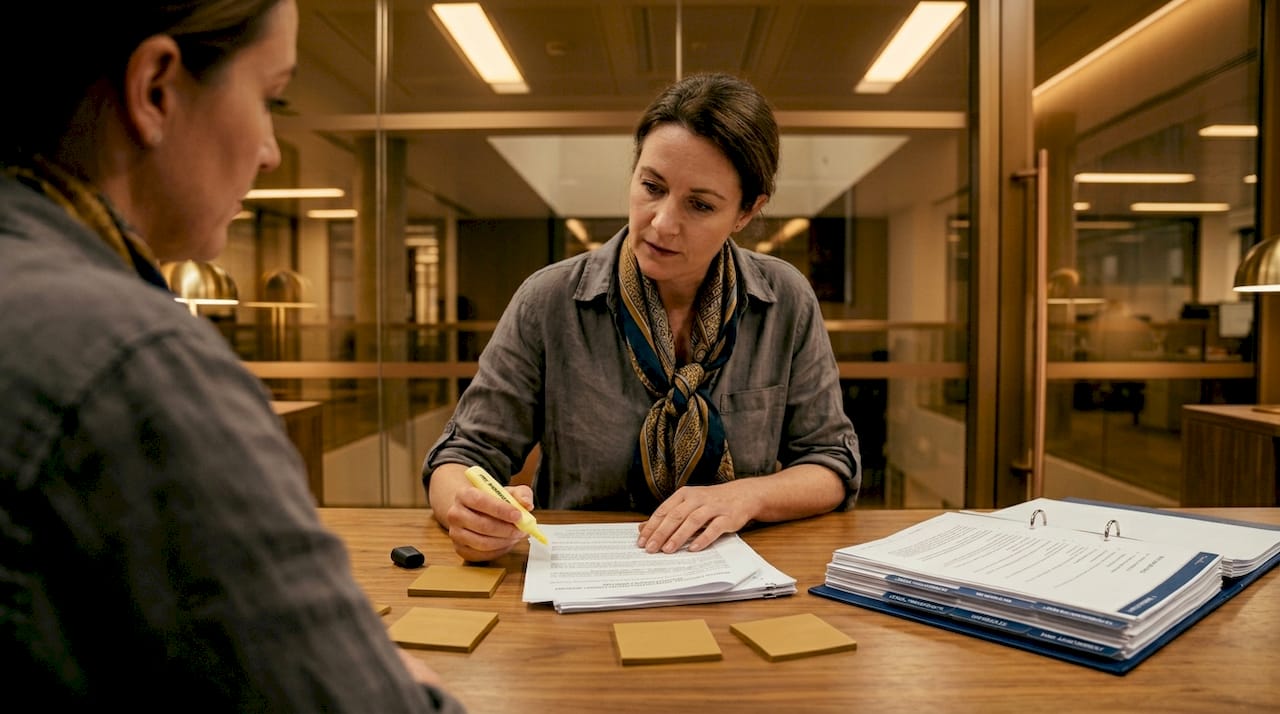
This is a costly mistake. Standardised boilerplate clauses can be outcome-determinative, and best practice requires critically analysing and harmonising boilerplate with the rest of the agreement, particularly cross-clauses such as survival, notice, governing law, forum and waiver, and interpretation. In plain terms: these clauses can decide who wins a dispute.
Consider a few real-world examples of boilerplate going wrong:
Best practice is to critically analyse and harmonise boilerplate with the rest of the agreement, especially cross-clauses that are often assumed to be standard but are, in fact, highly transaction-specific.
When assessing certainty in contract drafting, the boilerplate section should receive the same forensic attention as the commercial terms. Never assume that a clause is harmless simply because it appears in every contract you have seen.
Templates and precedent documents serve a genuinely useful purpose. They reduce drafting time, provide structural guidance, and capture lessons from previous transactions. Used responsibly, they are valuable tools. Used carelessly, they are landmines waiting to detonate.
Edge-case best practices include proactively evaluating precedent and templates for legal and practical fit in the specific transaction and updating them to comply with current law and practice. This is particularly relevant in the UK, where legislation changes regularly and judicial decisions can shift the interpretation of familiar contractual language.
Here is how to manage templates responsibly:
For growing businesses, investing in bespoke startup contract packs rather than relying on downloaded templates is frequently the more cost-effective option in the long run. The cost of a poorly drafted agreement, when it generates a dispute or a compliance failure, almost always exceeds the cost of getting it right from the outset.
Pro Tip: Set a calendar reminder to review your most-used contract templates every six months. Legislation, industry regulations, and commercial practice all evolve. Your standard documents should evolve with them.
Every experienced contracts solicitor has a story about a seemingly minor drafting error that caused major damage. A missing word. A cross-reference to the wrong clause. A defined term used inconsistently. These are not hypothetical risks; there is empirical support for treating contract drafting mistakes as genuine “landmines” rather than harmless variations.
The most common sources of contractual landmines include:
Even a single word change in a standard clause can shift millions of pounds of risk from one party to another. This is not an exaggeration. Courts have decided cases on the presence or absence of the word “reasonable.”
Robust contract review processes are the most effective defence against landmines. This means independent review by a qualified solicitor, not just a re-read by the person who drafted it. For businesses handling high volumes of contracts, document review support provides structured oversight that scales with your needs.
Pro Tip: After any significant negotiation or revision, run a definitions audit: extract every defined term, locate every use of that term in the document, and confirm that the usage is consistent. This single check catches a surprising proportion of drafting errors.
Legal technology, including AI-assisted drafting and review tools, has become a genuine feature of modern contract practice. These tools can accelerate first-draft production, flag missing standard clauses, and identify inconsistencies that a tired human eye might miss. Used well, they add real value.
However, performance evaluation of legal AI in contract review reveals important limitations. Measuring “ground truth match” may not capture legal adequacy, and expert interpretation can be heterogeneous, meaning automated checks need human and legal judgement boundaries. In plain terms: AI tools can tell you whether a clause exists, but they often cannot tell you whether it is adequate for your specific transaction.
Practical principles for integrating legal AI responsibly:
The essential contract review practices that protect your business are still rooted in qualified human judgement. Technology is a powerful assistant, not a replacement.
Pro Tip: If you use AI drafting tools, always run the output through a structured checklist review conducted by a solicitor. The AI handles speed; the solicitor handles accuracy and legal adequacy.
There is a persistent misconception that contracts are administrative formalities, something to be processed quickly so the “real work” can begin. In our experience, this attitude is precisely where businesses get into serious trouble.
The contract is the deal. It defines what each party is actually agreeing to, what happens when things go wrong, and who bears the financial consequences of every foreseeable (and some unforeseeable) risk. Treating it as a formality means accepting that somebody else, quite possibly a court, will define those terms for you later.
What we have found, working across commercial, corporate, and international matters, is that the businesses which suffer the fewest contractual disputes are not necessarily the ones with the most complex agreements. They are the ones whose contracts are clear, specific, and genuinely reflective of the deal that was actually struck. Plain language, precise obligations, and tailored provisions consistently outperform dense legal boilerplate that nobody actually reads until something goes wrong.
The uncomfortable truth is that most contractual disputes are entirely avoidable. They arise not from bad faith but from ambiguity, from drafting that allowed two parties to read the same clause and reach different conclusions. Investing properly in contract design and review at the outset is not a legal expense. It is a business protection strategy with a demonstrably positive return.
Getting your contracts right from the start is one of the most cost-effective investments a business can make. At Ali Legal, we work with businesses and individuals to produce commercial agreements that genuinely reflect the deal, allocate risk appropriately, and stand up to scrutiny.
Whether you need support with a single high-value agreement or a suite of contracts for a growing operation, our team provides clear, fixed-fee advice without unnecessary complexity. We review, draft, and advise on contracts across commercial, corporate, property, and international matters. Our approach is straightforward: we understand your objectives, identify the risks, and produce documentation that protects your position. Contact Ali Legal today to discuss how we can support your contracting needs.
Neglecting to customise boilerplate clauses and failing to check cross-references often leads to confusion and costly legal disputes that could have been avoided with careful drafting.
Templates are useful as starting points but must always be tailored and updated for each transaction. Evaluating templates for legal and practical fit in the specific deal is considered essential best practice.
AI tools can support drafting but cannot fully replace expert human judgement. Legal AI evaluation shows that automated checks have real limitations, particularly around legal adequacy and contextual interpretation.
Follow a structured clause-by-clause checklist), critically analyse every provision including boilerplate, and ensure the final agreement aligns with current law and your specific commercial objectives.


