
Menu
Get Expert Legal Support Today

TL;DR:
- Mediation is a voluntary, confidential process where an impartial third party helps parties negotiate their own settlement without imposing a decision.
- It is suitable for disputes where both sides can negotiate freely and the relationship, cost, and time favor resolution outside court.
Mediation is a voluntary, confidential process in which an independent, neutral third party helps two or more parties negotiate their own settlement. The mediator cannot impose a decision. That single fact separates mediation from arbitration and from court, and it is the reason many people prefer it.
Key things to know before you read further:
Ali Legal Ltd supports clients through every stage of this process, from pre-mediation legal advice to drafting enforceable settlement documents. The Family Mediation Council maintains a register of accredited family mediators across the UK.
Alternative dispute resolution (ADR) covers several distinct methods. Choosing the right one depends on how much control you want over the outcome and how quickly you need a decision.
| Method | Who decides | Binding? | Typical use |
|---|---|---|---|
| Mediation | The parties themselves | Only if agreed and documented | Family, commercial, neighbour, workplace |
| Arbitration | The arbitrator | Yes, by agreement | Commercial contracts, international disputes |
| Conciliation | The conciliator (more active than a mediator) | Depends on scheme | Employment, consumer complaints |
| Ombudsman | The ombudsman | Binding on the business if accepted | Financial services, energy, telecoms |
The critical distinction between mediation and arbitration is authority. A mediator or conciliator has no power to impose a decision; an arbitrator issues a binding award where the parties have agreed to arbitration in advance. For a deeper comparison of all three routes, Ali Legal Ltd’s guide to arbitration, negotiation, and mediation sets out the procedural trade-offs clearly.
Conciliation deserves a specific mention. It is closely related to mediation but the conciliator takes a more active role in proposing solutions. ACAS provides free early conciliation for employment tribunal claims, and most claimants must go through that process before lodging a tribunal claim. Consumer ADR has also changed recently: the Digital Markets, Competition and Consumers Act 2024 replaced the voluntary ADR accreditation framework with a mandatory one for consumer contract disputes, raising the baseline quality of schemes available to ordinary consumers.
“You can use mediation or conciliation to ask an impartial professional to help you reach an agreement. They’ll help you and the other side consider different options to resolve the dispute.” — GOV.UK, Solve problems out of court
Civil mediation is flexible, confidential, and often quicker and cheaper than court proceedings. Most civil mediations settle on the day or shortly after. That speed matters when a commercial relationship is at stake and a six-month litigation timetable would cause more damage than the original dispute.

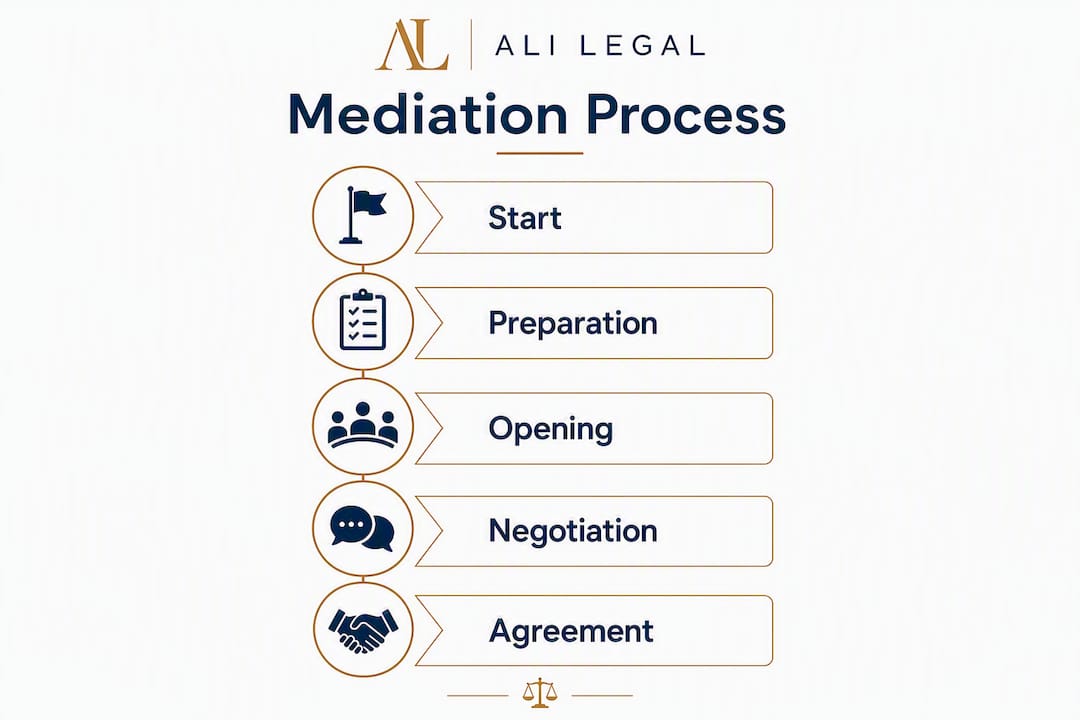
The core sequence is: preparation, MIAM or pre-mediation meeting, joint opening session, private caucuses, options generation, and either a written agreement or a clear next step. Here is how each stage works in practice.
Virtual mediation follows the same structure, with private caucuses conducted in separate video breakout rooms. Platforms such as Zoom or Microsoft Teams work well for straightforward disputes; more complex matters benefit from a dedicated virtual mediation platform where the mediator can move between rooms without either party seeing the other’s screen.
Pro Tip: Before the session, write down your three most important outcomes and your realistic bottom line. Mediators consistently report that parties who arrive with clear priorities settle faster and with less regret than those who come hoping the mediator will “sort it out.”
Mediation works well where both parties can negotiate freely and where the relationship, cost, or time involved in litigation makes a negotiated outcome preferable. Common suitable scenarios include:
There are situations where mediation is usually the wrong choice. Proceeding in those circumstances can cause real harm.
Safety and power imbalance: where there is substantiated domestic abuse, a significant power imbalance, or an urgent need for a court injunction, mediation is generally inappropriate. The Family Procedure Rules Part 3 recognise this: MIAM exemptions exist precisely for these cases. Cafcass, the Children and Family Court Advisory and Support Service, can provide guidance where a child’s welfare is at risk.
Other situations where mediation is typically unsuitable:
The risks of mediation are real even in suitable cases. There is no guaranteed outcome. Costs are incurred whether or not settlement is reached. And confidentiality, while protective, means a party cannot later use a concession made in mediation as evidence of liability if the case proceeds to court. That protection cuts both ways.
For family disputes, understanding the court procedure for child arrangement orders is useful background before deciding whether mediation or a court application is the right first step.
Many civil mediations conclude in a single day. Family mediations involving MIAMs, financial disclosure, and multiple sessions can take several weeks from start to finish, though the actual mediation time is usually measured in hours rather than months.
Typical cost structures:
The Family Mediation Voucher Scheme provides eligible families with a contribution of up to £500 towards the cost of family mediation where child arrangements are in dispute. The scheme is administered through accredited mediators registered with the Family Mediation Council. Not every family dispute qualifies, so check eligibility with your chosen mediator before booking.
A straightforward civil mediation timeline might look like this: instruction of mediator (week 1), exchange of position statements (week 2), mediation day (week 3), settlement agreement drafted and signed (week 3 or 4). A family mediation involving a MIAM, financial disclosure, and two joint sessions might run over six to eight weeks, though this varies considerably.
Pro Tip: Ask your mediator at the outset whether their fee includes preparation time, travel, and any post-mediation drafting. Some charge separately for each element; others bundle them. Knowing this upfront prevents disputes about the mediator’s own invoice.
Use an accredited register and verify credentials before instructing anyone. The two main registers for England and Wales are the Family Mediation Council (family disputes) and the Civil Mediation Council (civil and commercial disputes). Both maintain searchable directories.
A practical checklist before instructing a mediator:
Questions worth asking a prospective mediator before you instruct them: What is your fee structure and what does it include? How do you handle a situation where one party discloses something in a private caucus that the other party needs to know? What happens if we reach agreement but one party later refuses to sign? How many mediations of this type have you conducted in the past year?
The engagement letter should set out fees, cancellation terms, confidentiality obligations, and the mediator’s withdrawal rights. Read it carefully before signing.
Mediators are neutral. They do not give legal advice to either party, and they cannot tell you whether the agreement you are about to sign is a good one for your circumstances. The judiciary’s family mediation guidance is explicit on this point: independent legal advice is recommended before finalising agreements, particularly for property and long-term financial commitments.
How mediated agreements become enforceable:
If a party breaches a consent order or Tomlin order, the route back to court is enforcement, not a fresh claim. For a settlement agreement, you issue a new contract claim. Either way, the costs of enforcement are real, so clarity in the original document matters enormously.
Pro Tip: Before the mediation session ends, agree in writing on the exact wording of any key terms, particularly payment dates, property transfer timelines, and any conditions. Vague language in a settlement agreement is the most common cause of post-mediation disputes.
Failed mediation is not the end of the road. The main options, in rough order of escalation:
The without-prejudice protection is important here. ADR discussions conducted on a without-prejudice basis generally cannot be referred to in subsequent court proceedings. What you said in the mediation room stays there. The exception is where both parties agree to waive the protection, or where a statement was made to misrepresent facts.
Preserve all evidence gathered before and during mediation. The mediator’s notes are confidential and cannot be subpoenaed, but your own documents, correspondence, and expert reports remain available for court.
Focused preparation and realistic objectives materially increase the likelihood of settlement. Five steps that make a measurable difference:
Commercial dispute example: a supplier and a retailer in a contract dispute over defective goods. The supplier prepares a schedule of delivery records and quality certificates. The retailer brings evidence of customer complaints and lost sales. In the private caucus, the mediator discovers the retailer’s real priority is a continued supply relationship, not the damages figure. The supplier’s real concern is reputational. A revised supply agreement with a partial credit resolves both interests, something a court judgment could never have delivered.
Child arrangements example: two parents disagree about school holiday contact. One parent prepares a proposed schedule with specific dates. The other arrives without documentation. The mediation takes twice as long as it should because basic factual questions (school term dates, existing commitments) have to be established from memory. Preparation is not a formality.
Pro Tip: Cultural differences in communication style, directness, and attitudes to authority can affect how parties engage in joint sessions. If you know cultural dynamics are a factor, raise it with the mediator before the session. A good mediator will adjust their approach accordingly.
Mediation tends to get treated as a last resort before court, which is exactly backwards. The parties who get the most from it are those who arrive before positions have hardened, legal costs have mounted, and the relationship has been destroyed by correspondence. By the time most disputes reach a solicitor’s desk, the window for a genuinely creative settlement has often narrowed considerably.
What the evidence from UK civil practice consistently shows is that mediation preserves something court cannot: party control. Legal guidance on civil mediation notes that parties who control their own outcome tend to preserve commercial and family relationships far better than those who hand the decision to a judge. That matters in a commercial context where the counterparty is also a supplier, a landlord, or a co-parent.

The other thing practitioners underestimate is the value of the private caucus. Most people imagine mediation as a round-table negotiation. In practice, the most productive work happens in the separate rooms, where a mediator can reality-test a position without either side losing face. That dynamic is genuinely difficult to replicate in direct negotiation or in court.
Ali Legal Ltd treats mediation as a practical first-line route for many family and civil disputes, not a consolation prize. The firm advises clients before sessions on their realistic range of outcomes, attends mediations where legal representation adds value, and drafts the settlement documents that convert a verbal agreement into something enforceable. For cross-border disputes where mediation intersects with international arbitration, Ali Legal Ltd’s international disputes practice handles the full spectrum.
The one honest caveat: mediation is not always appropriate, and recommending it when safety or power imbalance is a real factor does harm. The MIAM exemptions exist for a reason. A solicitor’s job at the outset is to assess whether mediation is genuinely suitable, not to push it because it is cheaper.
Ali Legal Ltd offers fixed-fee legal support at every stage of the mediation process, from the first assessment of whether mediation is right for your dispute through to drafting and enforcing the final agreement.

Specific services relevant to mediation clients include: pre-mediation legal advice on your realistic range of outcomes and BATNA; attendance at mediation sessions where legal representation adds value; drafting settlement agreements, Tomlin orders, and consent order applications; enforcement advice if a settlement is later breached; and cross-border ADR support for disputes with an international dimension. For disputes touching on property law, commercial contracts, or corporate matters, Ali Legal Ltd’s solicitors can advise on the legal framework before you enter the mediation room, so you negotiate from a position of clarity rather than uncertainty.
To discuss your dispute and whether mediation is the right route, contact Ali Legal Ltd directly through the website for a straightforward initial consultation.
These are the primary official sources. Use them to verify current rules, find accredited mediators, and check scheme eligibility.
Official pages carry authoritative detail on deadlines, eligibility, and provider accreditation. This article summarises the framework; always verify current rules directly with the relevant source before taking action.
This article provides general information about mediation and dispute resolution in the UK. It is not legal advice. Rules, eligibility criteria, and fees change; confirm current requirements with the relevant official source or a qualified solicitor before making decisions about your dispute.


