
Menu
Get Expert Legal Support Today

Identify what you own, keep anything patentable confidential, then register or document rights with the Intellectual Property Office as needed. That is the core of how to protect intellectual property in the UK, and the sequence matters. Act out of order and you risk losing rights before you have even filed. Here is the practical checklist to start with:
Your immediate next step: run a short IP audit of your business assets. If an invention is involved, protect confidentiality with an NDA before speaking to anyone outside the business, then contact the IPO or an IP solicitor before any public disclosure.
The term “intellectual property” covers several distinct legal rights, each with different rules about registration, duration, and what it actually protects. Knowing which type applies to your asset determines your entire protection strategy.
Copyright arises automatically the moment an original work is created and fixed in some form: written content, software code, music, photographs, architectural drawings. There is no UK registration system for copyright; instead, you rely on dated records, version histories, and provenance evidence to prove you created it first. For a software business, that means keeping timestamped commits and signed development agreements. For a designer, it means retaining original layered files with metadata intact.

A trade mark protects a brand name, logo, slogan, or shape that distinguishes your goods or services from others. Unlike copyright, trade mark protection in the UK requires registration with the IPO to get the strongest rights. An unregistered mark gives you some common-law passing-off protection, but it is harder and more expensive to enforce. The typical SME example: your business name and logo, registered in the classes of goods or services you actually trade in.
Patents protect novel, inventive technical solutions. A new manufacturing process, a mechanical device, a chemical compound. The bar is high: the invention must be new, involve an inventive step, and be capable of industrial application. Patents also require registration and typically take several years to grant. The commercial payoff is a 20-year monopoly, which is why early confidentiality is so critical.
A registered design protects the visual appearance of a product: its shape, configuration, pattern, or ornamentation. Think of a distinctive bottle shape or a piece of furniture. Registration lasts up to 25 years in five-year renewal periods and gives you the right to stop others copying the look of your product.
Unregistered design right arises automatically for original three-dimensional designs and lasts up to 15 years. Database right protects the substantial investment in compiling a database, even if the individual data items are not original. Both are automatic, but both are narrower and harder to enforce than their registered equivalents.
Trade secrets cover confidential business information: formulas, customer lists, pricing models, manufacturing processes. There is no registration. Protection depends entirely on keeping the information secret and having the right contractual and procedural safeguards in place.
Which rights are automatic and which require registration:
Multiple types of protection can apply to a single product. A consumer product might carry a registered trade mark on the brand name, a registered design on its shape, a patent on its internal mechanism, and copyright in its instruction manual. Layering rights gives you more enforcement options and a stronger commercial position.
Pro Tip: If you think you might have a patentable invention, the question to ask is whether it solves a technical problem in a new and non-obvious way. If the answer is yes, stop talking about it outside the business until you have either filed or signed NDAs with everyone who needs to know.
Registration is a process, not a single event. Each IP type has its own stages, and understanding the sequence helps you plan time and budget realistically.
Trade marks are examined within roughly two weeks of filing, published for opposition, and can be registered approximately three months after application if no opposition is filed. That three-month timeline assumes a clean application with no objections and no third-party oppositions. In practice, objections on relative or absolute grounds can extend the process considerably.
Step-by-step trade mark checklist:
The patent process involves filing, a formal search, and substantive examination; publication typically occurs 18 months after the filing date. The full grant process often takes three to five years. That is not a reason to delay filing: your priority date is established on the day you file, which is what counts for novelty purposes.
Step-by-step patent checklist:
Registered designs are generally the fastest and most affordable registration route. Applications are examined and, if accepted, registered within a few weeks. Protection lasts for periods renewable up to a total of 25 years.
| IP type | Key stages | Typical timeline |
|---|---|---|
| Trade mark | Search, file, examine, publish, oppose, register, renew | ~3 months if unopposed; longer if opposed |
| Patent | File, search, publish (18 months), examine, grant, renew | 3–5 years to grant |
| Registered design | File, examine, register, renew | Weeks to a few months |
The IPO introduced new fees for designs, trade marks, and patents effective 1 April 2026. Applications or payments made on or after that date will generally attract the new fee schedule, with transitional provisions for applications already in progress. Always check the IPO’s current fee pages before filing rather than relying on figures quoted elsewhere.
IP rights are territorial: a UK trade mark or patent does not protect you overseas. For international protection, you have two main routes. The World Intellectual Property Organization (WIPO) Madrid System lets you file a single international trade mark application covering multiple countries from one application. The Patent Cooperation Treaty (PCT), also administered by WIPO, provides a similar single-filing route for patents, giving you up to 30 months from your priority date before you must enter national phases in individual countries.
For complex inventions or high-value brand portfolios, a patent attorney or trade mark attorney is worth engaging from the outset. For straightforward applications, the British Library Business & IP Centre and IPO clinics offer free or low-cost initial guidance and search support.
Confidentiality is your first line of defence, particularly before any registration is in place. An NDA does not replace registration, but it buys you the time to file without losing your rights.
The situations where confidentiality is the right strategy include: early-stage inventions not yet filed, business plans and financial models, proprietary manufacturing processes, customer and supplier lists, and any know-how that gives you a competitive edge but would not qualify for patent protection.
Key terms every NDA should include:
Pro Tip: When meeting a potential investor or manufacturer for the first time, use a purpose-limited NDA that covers only the specific information you intend to share in that meeting. A broad NDA covering “all information exchanged” can inadvertently capture things you did not mean to disclose and create ambiguity about what is actually protected.
Confidentiality agreements are only as strong as the practices behind them. Practical steps for protecting trade secrets day-to-day:
Disclosing an invention publicly or to investors before filing can prevent patentability. That is not a theoretical risk. It is a practical one that catches founders out regularly, particularly when pitching at early-stage events or posting about a product on social media before a patent application is filed.
Ownership of IP is one of the most common sources of commercial disputes, and the default legal position is not always what business owners expect.
Under UK law, IP created by an employee in the course of their employment generally belongs to the employer. That rule applies to copyright, patents, and designs. The key phrase is “in the course of employment”: work done on a personal project outside working hours, using personal equipment, and unrelated to the employee’s role may well belong to the employee, not the business.
Contractors are different. A freelancer or independent contractor who creates work for your business retains ownership of the IP in that work unless there is a written assignment. A contract that says “all work product belongs to the client” is not enough on its own in every case; the assignment needs to be properly drafted, signed, and ideally cover future works as well as current deliverables.
Essential contract clauses for IP ownership:
For practical guidance on drafting these clauses, the contract law principles that govern assignment and confidentiality are worth understanding before you sign anything.
Red flags in standard freelancer or vendor agreements:
The commercial law essentials every UK SME should know include getting IP ownership right in contracts from day one. Retrofitting an assignment after the relationship has ended is possible but expensive and sometimes impossible if the contractor refuses to cooperate.
Registration alone does not protect you. IP owners are responsible for monitoring and enforcing their own rights; the IPO does not police infringement on your behalf. That means building a monitoring habit and knowing what to do when you find something.
Before you take any action, gather and preserve evidence:
The enforcement path runs from informal to formal, and cost-awareness matters at every stage.
For cross-border infringement, the picture is more complex. International debt recovery for IP losses abroad involves navigating different jurisdictions, and the international arbitration route is often faster and more enforceable than foreign court proceedings.
Cost-aware decision framework: before issuing proceedings, weigh the likely damages against the cost of enforcement and the reputational risk of doing nothing. A cease-and-desist letter costs a fraction of litigation and resolves the majority of straightforward infringement cases.
The IPO encourages businesses to perform an IP audit to identify assets and avoid missing commercially valuable creations. Many owners discover rights they did not know they had. A short audit, done once a year, is one of the highest-return activities an SME can undertake.
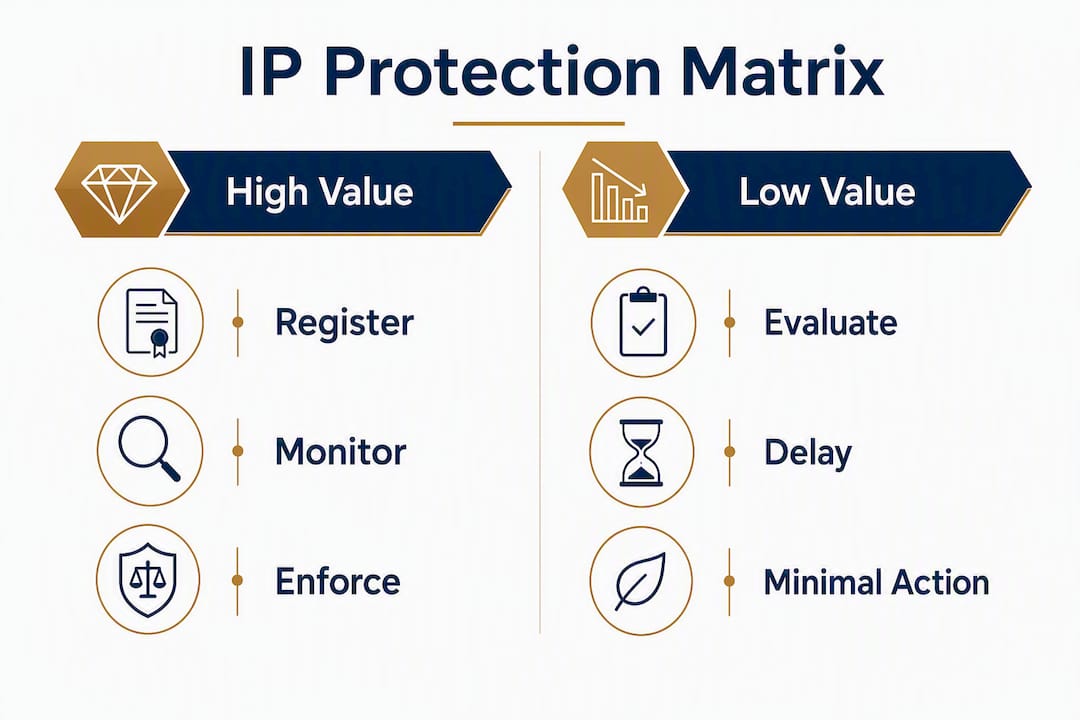
Use this to decide where to invest your protection budget:
| Commercial value | Enforceability likelihood | Recommended action |
|---|---|---|
| High | High | Register immediately; monitor actively |
| High | Low | Rely on trade secrets and NDAs; consider whether registration is feasible |
| Low | High | Register if cost is low (e.g., single-class trade mark); document carefully |
| Low | Low | Rely on copyright or unregistered rights; document creation date |
Pro Tip: Maintain a single IP register for the business: a spreadsheet listing each asset, its type, registration number (if any), renewal dates, ownership status, and any licences granted. This document becomes your evidence base in a dispute and your starting point for any due diligence in a funding round or acquisition.
Well-managed IP is a commercial asset that can be licensed, sold, or used as security. Treating it as such, rather than as a legal formality, changes how you prioritise protection decisions.
A DIY approach works for straightforward cases: a single trade mark in one class, a clear copyright ownership situation, or a basic NDA between two parties who both understand the terms. Beyond that, the cost of getting it wrong usually exceeds the cost of professional advice.
Situations that typically merit professional help:
Questions to ask an IP solicitor or attorney at a first meeting:
For straightforward issues, free resources are genuinely useful. The IPO’s step-by-step guide covers the basics clearly. The British Library Business & IP Centre offers free workshops and one-to-one advice sessions. IPO clinics, run in partnership with local enterprise partnerships, provide short advisory sessions at no cost.
For anything involving enforcement, cross-border rights, or significant commercial value, professional advice from an IP solicitor pays for itself. The protect and benefit from your intellectual property rights guidance from Ali Legal Ltd sets out where specialist legal input makes the clearest difference.
Most small businesses do the obvious things: they register a trade mark, maybe file a patent, and assume the job is done. The gap they leave open is the space between registration and enforcement, and it is where most IP value gets quietly eroded.
Registration is a starting point, not a shield. A trade mark you never monitor is a trade mark that gets diluted. A patent you cannot afford to enforce is a patent your competitors can study and design around. Copyright you have never documented is copyright you cannot prove in court. The practical reality for UK SMEs is that IP protection is an ongoing commercial discipline, not a one-time legal transaction.
There is also a Brexit dimension that many UK rights holders underestimate. Before 2021, a single EU trade mark covered the UK. Now, UK and EU trade marks are separate registrations with separate fees and renewal obligations. UK rights holders who relied on EU trade marks before Brexit should have received comparable UK rights automatically, but ongoing protection in both markets now requires active management of two separate portfolios. For businesses with European customers or suppliers, that means budgeting for territorial filings as a routine cost of doing business internationally, not an optional extra.
The owners who protect IP most effectively treat it the way they treat their financial accounts: catalogued, valued, reviewed annually, and defended when necessary. The ones who lose value are those who register once and then stop paying attention.
Protecting IP in the UK involves more moving parts than most business owners expect: clearance searches, registration filings, contract drafting, monitoring, and enforcement, each with its own timescales and legal risks. Ali Legal Ltd works with individuals and SMEs across all of these stages, offering practical, commercially grounded advice rather than theoretical legal commentary.

Ali Legal Ltd’s relevant services for IP protection include IP strategy advice tailored to your business model, drafting and reviewing IP assignment clauses and NDAs, enforcement support from cease-and-desist letters through to court proceedings, and cross-border dispute resolution for rights holders with international exposure. For businesses involved in acquisitions or investment rounds, the team also advises on IP due diligence and clean transfer of ownership.
Fixed-fee options are available for initial consultations and standard filings, so you know the cost before you commit. For complex matters, the scope of work is agreed upfront. If you are ready to get your IP properly protected, contact Ali Legal Ltd to arrange an initial consultation and find out exactly where your rights stand.
This article provides general information about UK intellectual property law and is not legal advice. IP law is complex and fact-specific; you should confirm your position with a qualified IP solicitor or the IPO before taking action.


