
Menu
Get Expert Legal Support Today

TL;DR:
- The Association of Personal Injury Lawyers is a UK non-profit organization that independently assesses solicitors for claimant injury work. Holding APIL accreditation signals demonstrated expertise and a commitment to claimant interests, especially at Senior Litigator or Fellow levels. Verifying credentials through APIL and the SRA ensures you choose a qualified, specialist personal injury lawyer.
The Association of Personal Injury Lawyers (APIL) is a UK not-for-profit organisation representing solicitors and barristers who act exclusively for injured claimants. Founded in 1990 and headquartered in Nottingham, APIL has a membership of approximately 3,000 across England, Wales, Scotland and Northern Ireland. Its individual accreditation scheme is a recognised quality mark that signals assessed competence, not just membership of a professional body.
When you are choosing a personal injury lawyer, the APIL accreditation badge is one of the clearest signals that the solicitor in front of you has been independently assessed, not simply signed up to a mailing list. The Law Society of England and Wales runs a separate Personal Injury Accreditation alongside it. Both are worth understanding before you instruct anyone.
Quick action checklist:
APIL describes itself as a not-for-profit campaign body working to secure access to justice for victims of negligence. That framing, confirmed in parliamentary written evidence, matters because it tells you whose side the organisation is on. Every member, by joining, commits to acting for claimants, not insurers or defendants.

APIL has a substantial membership, making it the UK’s largest claimant injury lawyer association.
Day to day, APIL does three things: it lobbies Parliament on legislation that affects injured people, it delivers training and conferences for member solicitors, and it publishes the Consumer Charter that sets out what claimants can expect from any member firm.
Membership is open to solicitors, barristers, legal academics and law students. That breadth is deliberate. The organisation wants to shape the next generation of claimant lawyers, not just credential the existing ones. For you as a claimant, the practical implication is a national network of practitioners who share a common standard of conduct and a shared commitment to your interests rather than to an insurer’s bottom line.
Membership and accreditation are not the same thing. Joining APIL requires subscribing to its code of conduct; individual accreditation requires passing an assessed competence test. The distinction matters enormously when you are picking a solicitor.
APIL’s accreditation scheme was established in September 1999. It awards quality marks at four levels: Litigator, Senior Litigator, Fellow and Senior Fellow. Only those who reach Senior Litigator or above are promoted to injured people as specialists. Reaching those tiers requires demonstrated experience in personal injury litigation, not just years of practice. Accredited members must also complete dedicated personal injury CPD annually to maintain their status.
What accreditation signals to you as a claimant:
Pro Tip: When you first speak to a solicitor, ask directly: “What is your APIL accreditation level?” A Senior Litigator or Fellow will say so immediately. If the answer is vague, treat that as a signal to keep looking.
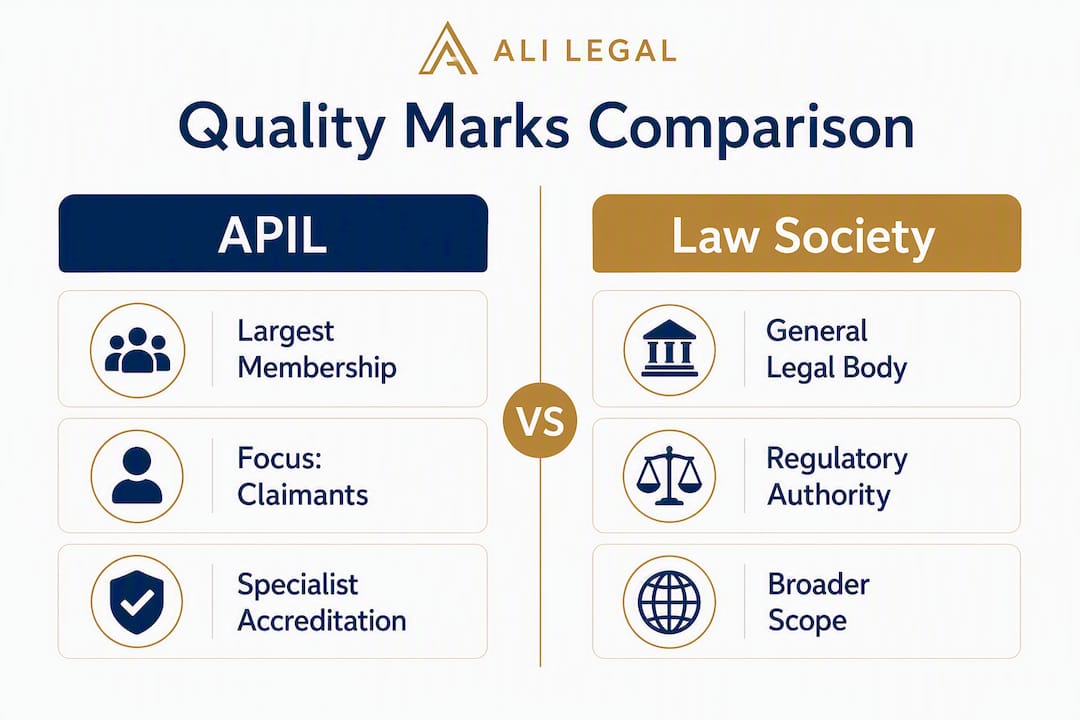
Three bodies dominate the quality-mark landscape for personal injury in the UK. They are not interchangeable.
| Dimension | APIL accreditation | Law Society PI Accreditation | MASS |
|---|---|---|---|
| Who runs it | APIL (not-for-profit, claimant body) | The Law Society of England and Wales | Motor Accident Solicitors Society |
| Scope | Broad personal injury (all types) | Broad personal injury | Road traffic accidents only |
| Claimant types served | All injury claimants | All injury claimants | Motor accident victims |
| Experience requirement | Assessed tiers; Senior Litigator+ for specialist promotion | Minimum three years and specific case-handling evidence | Membership criteria focused on motor claims |
| How to verify | APIL member directory + SRA register | Law Society Find a Solicitor + SRA register | MASS member directory |
| Best suited when | Choosing any PI specialist; broadest coverage | Formal Law Society mark matters to you | Your claim arises from a road traffic accident |
Practical takeaways:
Pro Tip: Before signing anything, ask for a written scope of services and a clear fee explanation. A solicitor who hesitates to put fees in writing is a red flag. Legitimate firms, including those working on a no-win no-fee basis, will always confirm the financial arrangement in a client care letter.
The APIL Consumer Charter sets out the standards every member commits to when handling a claimant’s case. It is not marketing copy; it is a binding commitment tied to membership.
Service standards claimants can use as benchmarks:
If a member falls short of these standards, you can raise a complaint with the firm’s internal complaints procedure first. If that fails, the Legal Ombudsman handles complaints about solicitors in England and Wales. The SRA can investigate conduct issues separately. You do not need to accept poor service simply because a solicitor holds an accreditation badge.
Most personal injury claims in the UK are funded through a conditional fee agreement (CFA), commonly called no-win no-fee. Under a CFA, you pay nothing if the claim fails; if it succeeds, the solicitor’s success fee is capped by statute. For a detailed breakdown of how legal fees work in accident cases, independent consumer guides are a useful starting point.
Common funding routes:
Timescales vary considerably. A straightforward road traffic accident claim with clear liability can resolve in six to twelve months. A catastrophic injury claim involving disputed liability, multiple experts and rehabilitation needs can run for several years. Factors that extend timetables include disputed liability, the need for specialist medical evidence, and court listing delays.
Watch out for claims farmers and upfront-fee demands. Any organisation that asks for payment before your claim is assessed, or that promises guaranteed compensation, is not operating within the regulated legal framework. Instruct only SRA-regulated solicitors.
Pro Tip: Ask your solicitor for a written fees estimate at the outset, and ask them to update it whenever the scope of work changes. This is your right under the SRA’s transparency rules, and any regulated firm will comply.
Contact a solicitor promptly. The general limitation period for personal injury claims in England and Wales is three years from the date of injury, or from the date you became aware of it. Miss that deadline and the court will almost certainly refuse to hear your claim.
Limitation periods are strict. Three years sounds like a long time, but gathering medical evidence, tracing witnesses and building a case takes longer than most claimants expect. Starting early protects your options.
First 72 hours: what to do
For a full breakdown of personal injury claim stages and compensation, Ali Legal Ltd’s consumer guides cover the process in detail.
The gap between an accredited specialist and a generalist solicitor handling personal injury as a sideline is wider than the badge suggests. APIL accreditation, particularly at Fellow or Senior Fellow level, means the solicitor has been assessed, not just approved. They have demonstrated competence in the specific area where your claim sits, whether that is road traffic, workplace injury, or clinical negligence.
What often gets overlooked is the difference between a solicitor who understands the law and one who understands how insurers behave. Insurers have specialist teams whose job is to minimise payouts. A Senior Litigator or Fellow who has handled hundreds of similar claims knows the tactics, the pressure points, and when a settlement offer is genuinely fair versus when it is a low opening bid. That experience is not visible on a firm’s website. The accreditation tier is the closest proxy you have.
Ali Legal Ltd’s approach to personal injury advice prioritises transparency from the first conversation: clear fee structures, honest case assessments, and experienced solicitors who tell you what your claim is actually worth rather than what you want to hear. If you are unsure whether you have a viable claim, or you want to understand your options before committing to a firm, contact Ali Legal Ltd for an initial discussion.
Use these official sources to check credentials and verify claims independently:
Trust signal: APIL’s approximately 3,000-strong membership represents the UK’s largest network of claimant injury lawyers. Cross-checking a solicitor’s name against both the APIL directory and the SRA register takes under five minutes and gives you two independent confirmations of their credentials.
If you want professional guidance rather than a directory search, contact Ali Legal Ltd directly. The team can advise on whether your circumstances warrant a personal injury claim and point you towards the right specialist for your case.
This article provides general information about UK personal injury law and professional accreditation. It is not legal advice. Confirm current rules and your specific position with a qualified solicitor or the relevant regulatory body.


