
Menu
Get Expert Legal Support Today

TL;DR:
- A personal injury lawyer represents individuals injured due to negligence and helps them claim compensation. They handle all stages of the process, from assessment and evidence gathering to negotiations and court representation. Early legal advice is crucial to preserve evidence and ensure a strong claim within the three-year limit.
A personal injury lawyer is a legal professional who specialises in representing individuals injured through another person’s or organisation’s negligence, helping them claim rightful compensation. Known formally as a personal injury solicitor in England and Wales, this type of lawyer handles everything from road traffic accidents to workplace injuries and public liability claims. The Limitation Act 1980 imposes a three-year deadline on most claims, making early legal advice critical. Understanding what personal injury lawyers do gives you the clearest possible picture of your rights and your realistic options after an accident.
A personal injury solicitor manages every stage of a claim on your behalf, from the first conversation through to final settlement or court judgment. The process is more structured than most people expect, and each stage requires specific legal knowledge to execute correctly.
The initial consultation is a critical fact-finding stage where a solicitor assesses whether your claim is viable and advises on the evidence you will need. Many clients first understand their full legal position at this meeting. A solicitor will ask about the circumstances of the accident, your injuries, any witnesses, and whether you have sought medical attention. This meeting sets the direction for everything that follows.

Solicitors handle evidence gathering including medical reports, witness statements, and accident documentation. Comprehensive evidence is necessary to establish liability and assess damages accurately. Your solicitor will request GP and hospital records, commission independent medical examinations, and obtain police or accident reports where relevant. Without this foundation, a claim is unlikely to succeed.
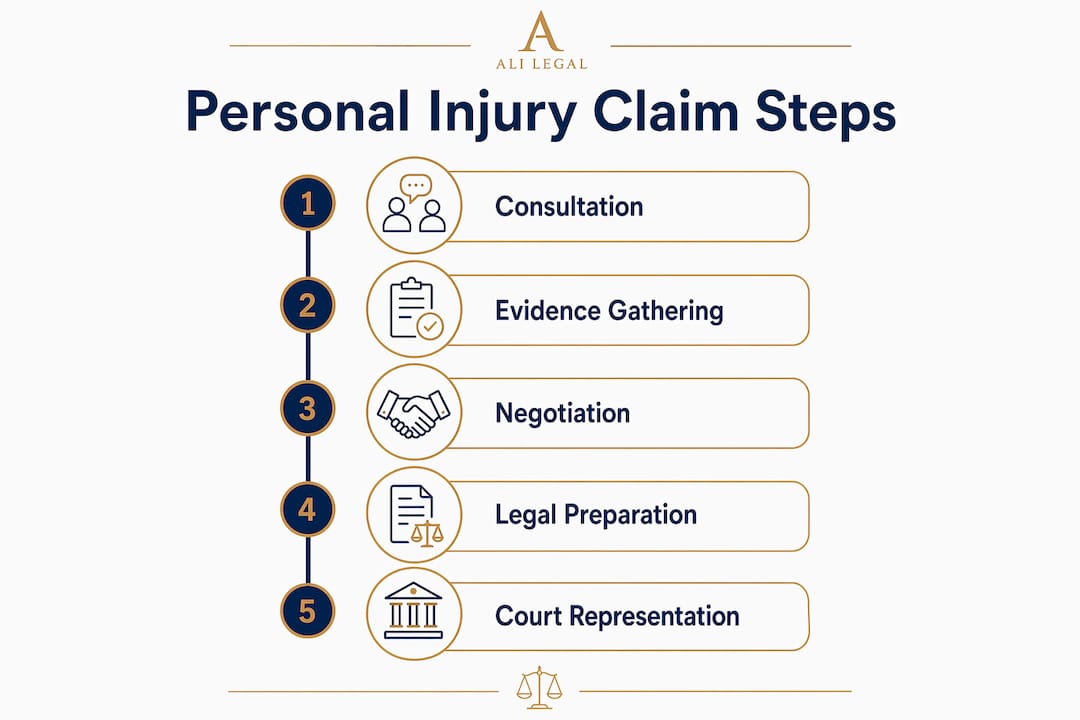
A personal injury solicitor manages communication with insurers to protect you from making premature statements that could harm your claim. Insurers commonly request statements early, and without proper guidance you may inadvertently undermine your case. Your solicitor handles all correspondence, challenges low settlement offers, and negotiates a figure that reflects your actual losses. This negotiation stage resolves the majority of claims without the need for a court hearing.
If negotiations fail, your solicitor prepares and files the formal legal documents needed to issue proceedings. They present your case to the court, cross-examine witnesses, and argue on your behalf. Court representation requires detailed procedural knowledge that goes well beyond general legal awareness.
Here is a summary of the core tasks a personal injury solicitor performs:
Pro Tip: Ask your solicitor at the first meeting whether your claim qualifies for a no win no fee arrangement. Under these agreements, solicitors bear the financial risk of the case, meaning you face no upfront costs to pursue your claim.
Specialist solicitors possess detailed knowledge of judicial guidelines and case law that is essential for accurately valuing claims for pain, suffering, and loss of amenity. An individual without that specialist knowledge is unlikely to calculate compensation correctly. Claim valuation is one of the most technically demanding parts of the process, and errors in either direction carry real consequences.
Personal injury compensation divides into two broad categories. General damages cover non-financial losses such as pain, suffering, and loss of amenity. Special damages cover financial losses including lost earnings, medical expenses, care costs, and travel to appointments. Solicitors apply the Judicial College Guidelines, a published framework used by courts across England and Wales, to calculate general damages. They then document every quantifiable financial loss to build the special damages figure.
The factors that determine claim value include:
“Specialist solicitors’ deep legal knowledge maximises claim success and appropriate compensation compared to self-representation. The gap between what an unrepresented claimant accepts and what a specialist negotiates can be substantial.”
Solicitors also commission independent expert reports, such as orthopaedic or neurological assessments, to support the valuation. These reports carry significant weight in negotiations and at trial. Settling without expert evidence often means accepting less than the claim is worth.
The three-year limitation period to bring a personal injury claim in England and Wales begins from the later of the accident date or the claimant’s date of knowledge. Missing that deadline usually means the claim cannot be heard in court. The Limitation Act 1980 governs these rules, and the courts apply them strictly.
The key steps and deadlines to understand are:
The three-year window sounds generous. In practice, it disappears quickly. CCTV footage and witness recollections can disappear fast, making immediate legal advice essential despite the stated time limits. Experts recommend seeking advice immediately after the accident, not months later. Early instruction gives your solicitor the best possible chance of building a strong case.
Statistic callout: Solicitors advise instructing them 6–9 months before the limitation deadline to allow adequate time for evidence gathering and procedural compliance.
A personal injury solicitor does more than manage paperwork. The support role extends into practical, financial, and emotional areas that significantly affect your recovery and your experience of the claims process.
The broader support a solicitor provides includes:
Pro Tip: If your injuries are serious and your claim is likely to take more than a year to resolve, ask your solicitor early about interim payment options. These can cover rehabilitation costs and lost income while the full claim progresses.
The coordination role is often underestimated. Solicitors regularly work alongside medical experts, occupational therapists, and financial advisers to build a picture of your needs. That joined-up approach produces better outcomes than legal representation alone. For further reading on your rights after an accident, the personal injury advice guide at Ali Legal Ltd covers the full claims landscape in detail.
From my experience working with clients who have been through the personal injury process, the single biggest mistake I see is people waiting too long to seek advice. They assume the three-year window is comfortable. It rarely is. Evidence degrades, witnesses move on, and medical records become harder to obtain. By the time some clients come to a solicitor, the strongest parts of their case have already weakened.
The second mistake is underestimating how much specialist knowledge affects the outcome. Claim valuation is not intuitive. The Judicial College Guidelines run to hundreds of pages. Case law shifts the acceptable range for specific injury types regularly. A client who negotiates directly with an insurer is almost always negotiating from a position of significant disadvantage. Insurers employ experienced claims handlers whose job is to settle cases for as little as possible.
I also think the legal profession has not always done enough to explain fee structures clearly. No win no fee arrangements exist precisely to remove the financial barrier to justice, yet many injured people still assume they cannot afford a solicitor. That assumption costs them. The personal injury claims process is designed to be accessible, and a specialist solicitor is the most effective way to navigate it. Choose a solicitor accredited by the Law Society’s Personal Injury Panel or a member of the Association of Personal Injury Lawyers. Accreditation signals genuine specialism, not just a general practice that occasionally handles injury claims.
— Panagiotis
Suffering an injury through no fault of your own is disorienting. Knowing where to turn for legal support should not add to that difficulty.

Ali Legal Ltd provides specialist legal advice to individuals pursuing personal injury claims, with a commitment to clear communication and transparent guidance at every stage. The team advises on claim viability, evidence requirements, and compensation valuation, working to secure the outcome you deserve. Ali Legal Ltd operates on a straightforward, client-first basis, explaining your options in plain language rather than legal jargon. Whether your claim involves a road traffic accident, a workplace injury, or a public liability matter, the team is ready to advise. Contact Ali Legal Ltd today for a consultation, and take the first step towards understanding your legal position. For related legal matters, the corporate law guide at Ali Legal Ltd offers further specialist insight.
A personal injury lawyer assesses your claim, gathers evidence, negotiates with insurers, and represents you in court if necessary. Their role covers every stage of the claims process from initial consultation to final settlement.
The three-year limitation period begins from the date of the accident or the date you gained knowledge that your injury was caused by negligence. Missing this deadline typically means the claim cannot proceed in court.
A solicitor calculates both general damages for pain and suffering and special damages for financial losses such as lost earnings and medical costs. They can also pursue interim payments to cover immediate needs before the final settlement is reached.
No win no fee agreements mean there are no upfront costs for most claimants. The solicitor bears the financial risk of the case and is paid only if the claim succeeds.
Contact a solicitor as soon as possible after the accident. Evidence such as CCTV footage and witness accounts can disappear quickly, and solicitors recommend instructing them well before the three-year deadline to allow adequate time for case preparation.


