
Menu
Get Expert Legal Support Today

Arbitration is a private, binding process where an impartial arbitrator hears evidence from both sides and delivers a legally enforceable decision. You do not go to court. Instead, the hearing takes place in a private venue, and the arbitration process runs under the framework of the Arbitration Act 1996, which governs proceedings in England, Wales, and Northern Ireland.
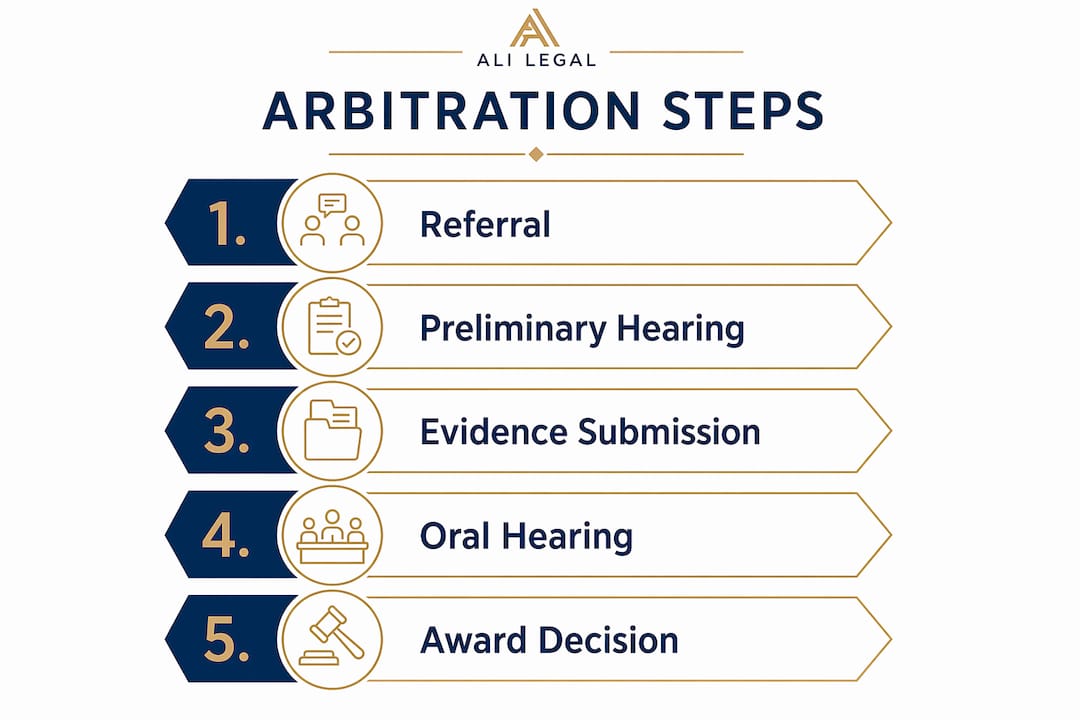
Here is what typically happens across the process:
The process begins well before anyone enters the hearing room. Once a dispute is referred to arbitration, usually under a clause in a contract or a separate agreement, the parties appoint an arbitrator. They may agree on one person jointly, or each appoint their own with those two then selecting a third.
Pre-hearing directions follow. The arbitrator issues orders covering document disclosure, the exchange of witness statements, and the hearing timetable. Under Section 34 of the Arbitration Act 1996, the tribunal decides all procedural and evidential matters unless the parties have agreed otherwise. That includes whether strict rules of evidence apply, whether oral or written submissions are used, and how documents are exchanged.
At the hearing itself, the arbitrator opens by confirming the issues in dispute. Each party then presents its case uninterrupted, calling witnesses and producing documents. Cross-examination follows, and the arbitrator may ask questions directly. Closing summaries give each side a final opportunity to draw together the key arguments before the arbitrator retires to deliberate.
Pro Tip: If your arbitration agreement references institutional rules such as those of the London Court of International Arbitration, read those rules carefully alongside the Arbitration Act 1996. Institutional rules often add procedural requirements that sit on top of the statutory framework.
One point that surprises many parties: oral hearings are not always mandatory. The arbitral tribunal may resolve disputes on written submissions alone unless the parties’ agreement or the applicable rules require a live hearing. In practice, most commercial disputes of any complexity do proceed to an oral hearing, but document-only arbitrations are common in lower-value or straightforward cases.
The arbitrator acts as a private judge, not a mediator. Unlike mediation, where a neutral helps parties negotiate, the arbitrator makes a binding decision based solely on the evidence and submissions presented. There is no negotiation, no facilitation, and no compromise unless the parties themselves reach one.
After the hearing, the arbitrator reviews all the evidence, applies the relevant law, and weighs the credibility of witnesses. The Arbitration Act 1996 requires the tribunal to act fairly and impartially, giving each party a reasonable opportunity to be heard. The written award sets out the findings of fact, the legal conclusions, and the remedy granted.
Timeline benchmarks under ACAS guidance: individual dispute hearings typically conclude with a written award within 14 days; collective dispute awards follow within 21 days; and hearings themselves last around half a day on average.
The procedural style of the hearing can vary depending on the legal backgrounds of the arbitrator and the parties’ representatives. English barristers and King’s Counsel tend to favour live cross-examination and oral advocacy more than practitioners from civil law traditions, who may prefer written submissions. That cultural difference can shape how the hearing feels in practice.
Speed is one of arbitration’s genuine advantages over litigation. ACAS guidance puts the average hearing at around half a day, with individual dispute awards issued within 14 days and collective dispute awards within 21 days. Court proceedings for equivalent disputes routinely take months or years to reach a final judgment.
Costs, however, require careful thought. Parties bear the arbitrator’s fees, any institutional administration fees, the cost of the hearing venue, and their own legal expenses. The Arbitration Act 1996 allows the tribunal to allocate costs in the award, so the losing party may be ordered to pay the winner’s reasonable costs. Whether that actually happens depends on the award and any costs agreement the parties have made.
| Cost element | Who pays initially | Recoverability |
|---|---|---|
| Arbitrator’s fees | Both parties jointly | Tribunal may order loser to pay |
| Legal representation | Each party | Tribunal may award reasonable costs |
| Hearing venue | Typically split | Included in costs order |
| Institutional fees | Both parties | Recoverable by award |
Compared with High Court litigation, arbitration tends to be faster and more predictable in cost, particularly for disputes where the parties have agreed on a sole arbitrator and a tight timetable. For guidance on how settlement claims interact with arbitration timelines, the practical benchmarks are worth reviewing before committing to a full hearing.
The Arbitration Act 1996 is the cornerstone of UK arbitration law. Its stated object is the fair resolution of disputes by an impartial tribunal without unnecessary delay or expense, and it gives parties wide freedom to agree their own procedures. The tribunal’s broad discretion under the Act covers everything from the language of proceedings to whether strict rules of evidence apply.
“The object of arbitration is to obtain the fair resolution of disputes by an impartial tribunal without unnecessary delay or expense.” — Arbitration Act 1996, Section 1
That principle of party autonomy is what makes arbitration genuinely flexible. Parties can tailor the process to their dispute rather than fitting it into a court’s fixed procedural rules. For cross-border disputes, that flexibility is particularly valuable, and the Act’s framework is recognised internationally as one of the most sophisticated arbitration statutes in the world.
Ali Legal Ltd advises and represents clients across the full range of arbitration matters, from commercial contract disputes to international arbitration proceedings. The firm’s practice spans commercial law, international disputes, and maritime law, giving clients practical support whether the arbitration is domestic or cross-border.
Pro Tip: Review any arbitration clause in your contract before a dispute arises. The clause determines the seat of arbitration, the governing rules, and the number of arbitrators. Getting legal advice at that stage is far cheaper than untangling a poorly drafted clause mid-dispute.
Each party to an arbitration has a defined role, and understanding it before the hearing prevents costly missteps. The claimant presents its case first, setting out the facts, the legal basis for the claim, and the remedy sought. The respondent then answers, challenging the claimant’s evidence and advancing any counterclaim.

Legal representatives, whether solicitors, barristers, or both, manage the procedural steps, draft submissions, prepare witnesses, and conduct cross-examination. Parties are not required to have legal representation, but in any dispute of real complexity, appearing without a lawyer carries significant risk. The arbitrator cannot assist an unrepresented party beyond basic procedural guidance.
Witnesses of fact give evidence about what happened. Expert witnesses, where the parties agree or the arbitrator directs, give opinion evidence on technical matters such as valuation, engineering standards, or industry practice. Each expert owes a duty to the tribunal, not to the party that instructed them, and the arbitrator weighs their evidence accordingly.
Yes, and it happens more often than people expect. Parties frequently reach a negotiated settlement after arbitration begins but before the hearing concludes. Once settled, the arbitrator can record the agreement as a consent award, giving it the same legal force as a contested award. That matters because a consent award is enforceable through the courts just as a judgment would be.
A party may also withdraw its claim entirely, which brings the arbitration to an end without a decision on the merits. Withdrawal does not necessarily avoid a costs order; the arbitrator retains jurisdiction to deal with costs even after the substantive claim is dropped. Settling a dispute before a final award gives both parties more control over the outcome and avoids the uncertainty of adjudication, but it requires both sides to be willing to negotiate.
The arbitration can also be stayed or adjourned if new evidence emerges or if the parties need more time to explore settlement. The arbitrator controls the timetable and can accommodate those situations within the procedural framework.
Enforcement is straightforward by design. Under the Arbitration Act 1996, an award made by the tribunal may be enforced by leave of the court in the same manner as a judgment or order of the High Court. In practice, the winning party applies to the court for permission to enforce, and the court grants it unless one of the very narrow grounds for refusal applies.
Those grounds are limited. A party can challenge an award under Section 67 (lack of substantive jurisdiction), Section 68 (serious irregularity), or Section 69 (a point of law, with permission). Courts uphold awards rigorously because finality is central to the purpose of arbitration. A losing party cannot simply relitigate the merits by bringing a court challenge.
For awards made in countries that have signed the New York Convention on the Recognition and Enforcement of Foreign Arbitral Awards, enforcement across borders follows a similarly streamlined path. England and Wales are signatories, so a UK award can be enforced in over 170 countries, and foreign awards can be enforced here on the same basis. That international reach is one reason commercial arbitration is the preferred dispute resolution method for cross-border contracts.
If you are facing an arbitration or need advice on enforcing an award, Ali Legal Ltd’s team handles international disputes and arbitration across multiple jurisdictions. Contact the firm directly for a consultation tailored to your situation.