
Menu
Get Expert Legal Support Today
TL;DR:
- A maritime lawyer advises clients on shipping, marine commerce, and navigation matters, handling disputes, contracts, and environmental compliance. They serve a diverse client base, including shipowners, insurers, and port operators, using court litigation or arbitration for dispute resolution. Their expertise combines legal, technical, and regulatory knowledge to prevent and manage maritime risks effectively.
A maritime lawyer is a legal specialist who advises and represents clients on all matters relating to shipping, marine commerce, and navigation. Known formally as an admiralty lawyer, this professional handles everything from shipping contracts and disputes to marine insurance claims, vessel finance, and environmental compliance. What does a maritime lawyer do in practice? The answer spans a wide range of legal work governed by UK statutes such as the Merchant Shipping Act, international conventions including MARPOL, and the jurisdiction of the UK Admiralty Court. Whether you are a shipowner, insurer, port operator, or cargo trader, understanding this role is the first step to protecting your interests at sea.

Maritime lawyers handle a wide range of shipping and marine commerce matters, from small cargo claims to complex, multi-jurisdictional disputes. The breadth of work divides neatly into two categories: “wet” work and “dry” work.
Wet work covers incidents at sea. These are urgent, high-stakes matters where speed and technical knowledge are critical.
Dry work covers the commercial and contractual side of maritime business. This is where most day-to-day advisory work sits.
The main legal issues maritime lawyers handle include:
Pro Tip: If you operate vessels commercially, retain a maritime lawyer before a dispute arises. Reviewing your charterparty and insurance arrangements in advance costs far less than resolving a contested claim after the fact.
Maritime lawyers represent a broad and diverse client base. Clients range from global shipowners and Protection & Indemnity (P&I) Clubs to commercial insurers, port operators, offshore service providers, and private individuals involved in yachting or fishing. Major P&I Clubs such as Gard, Britannia, and NorthStandard manage the liabilities of thousands of vessels worldwide. That scale illustrates why specialist legal support is not optional for these organisations.
The typical client groups maritime lawyers serve include:
The diversity of this client base reflects the fact that maritime law sits at the intersection of international trade and regulation. Any business that moves goods by sea, operates vessels, or provides marine services will encounter maritime legal issues at some point.
Maritime dispute resolution is a specialist field with its own procedures, forums, and rules. Maritime lawyers use several methods depending on the nature and value of the dispute.
Pro Tip: In a maritime casualty, instruct a lawyer within hours, not days. Evidence degrades fast at sea, and early legal involvement protects your position before investigators arrive.
For clients involved in international maritime disputes, understanding the available forums and applicable rules before a dispute arises gives a significant tactical advantage.
Maritime law operates at the intersection of international trade, environmental regulation, and insurance. This creates high barriers to entry but strong opportunities for lawyers who develop genuine depth. The knowledge base required goes well beyond standard legal training.
| Knowledge area | Examples |
|---|---|
| International conventions | MARPOL, Hague Rules, Athens Convention, STCW |
| UK statutes | Merchant Shipping Act, Carriage of Goods by Sea Act |
| Standard contract forms | BIMCO clauses, GENCON, NYPE, SHELLVOY, ASBATANKVOY |
| Technical nautical knowledge | Voyage data recorders, stability calculations, cargo stowage |
| Insurance frameworks | P&I Club rules, hull and machinery policies, war risks |
| Cross-border legal issues | Conflict of laws, foreign jurisdiction clauses, flag state rules |
Maritime lawyers negotiate contracts using standard forms such as GENCON, NYPE, and BIMCO clauses. These documents govern hire terms, delay liabilities, and safe port warranties. A lawyer who does not understand what a “WIBON” or “WIPON” clause means in a charterparty cannot properly advise a shipowner on their exposure.
The technical dimension is equally demanding. Maritime lawyers must interpret nautical charts, understand vessel stability, and read engineering reports. They work alongside marine surveyors and engineers to translate technical facts into legal arguments. This cross-disciplinary skill set is what separates a competent maritime lawyer from a general commercial litigator attempting to handle a shipping case.
The Merchant Shipping Act and MARPOL Convention together regulate a wide range of maritime activities. Enforcement actions under these frameworks can lead to fines, vessel detentions, or criminal liability. Advising clients on compliance requires a lawyer who understands both the legal text and the operational realities of running a vessel.
Maritime lawyers add value well beyond resolving disputes after they arise. Their most significant contribution is often preventive. Strategic commercial advice on shipbuilding, fleet financing, and environmental compliance protects clients from costly problems before they develop.
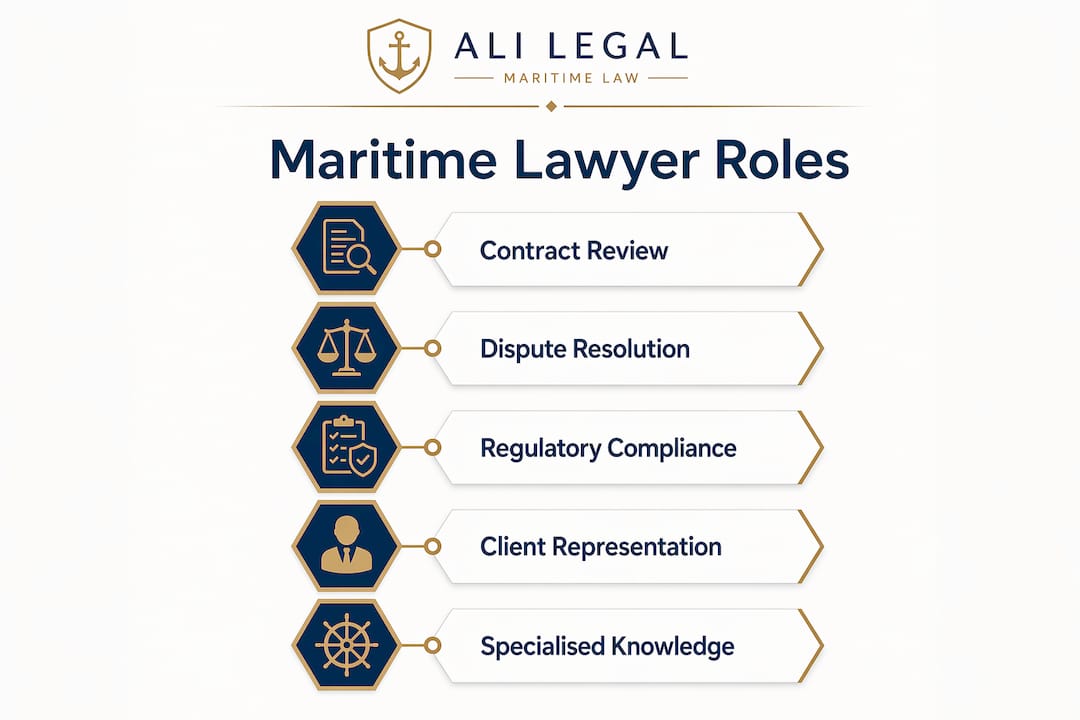
The practical benefits maritime lawyers provide include:
The range of this work reflects a broader truth: maritime law is not just for when things go wrong. Businesses that engage maritime lawyers proactively spend less on disputes and manage their commercial risks more effectively.
Maritime law has changed more in the past decade than in the previous fifty years. Environmental regulation, driven by IMO targets and MARPOL amendments, has pushed compliance work to the front of most shipping lawyers’ practices. Clients who once thought of their maritime lawyer as someone to call after a collision now need ongoing regulatory advice as a matter of course.
What strikes me most, having worked across shipping, commercial, and international disputes, is how much the role demands genuine cross-disciplinary thinking. A maritime lawyer who cannot read a stability report or understand how a P&I Club subrogation works is operating at a disadvantage. The lawyers who serve their clients best are those who invest time in understanding the industry, not just the law.
The growth of LMAA arbitration as the preferred forum for high-value disputes has also changed the practice. Arbitration under London Maritime Arbitrators Association rules rewards lawyers who can present technical evidence clearly and manage proceedings efficiently. Courtroom advocacy skills matter, but so does the ability to work with marine surveyors and engineers to build a coherent factual case.
My view is that the most important shift is cultural. Clients now expect their maritime lawyer to be a commercial partner, not just a litigator. That means understanding the client’s business, anticipating problems, and giving clear advice quickly. Fixed-fee arrangements and transparent communication are no longer differentiators. They are the baseline expectation.
— Panagiotis
Ali Legal Ltd advises individuals and businesses on UK and international maritime law, covering the full range of legal issues that arise in shipping and marine commerce.

Whether you need a charterparty reviewed, a cargo claim pursued, or advice on MARPOL compliance, Ali Legal Ltd provides clear, direct legal support without unnecessary delay. The firm’s maritime law services cover dispute resolution, contract review, vessel finance, and regulatory compliance, serving shipowners, insurers, port operators, and businesses of all sizes. For clients facing cross-border disputes or international arbitration, Ali Legal Ltd also handles international disputes and arbitration across multiple jurisdictions. Contact Ali Legal Ltd directly to discuss your maritime legal matter with a specialist.
A maritime lawyer advises clients on shipping contracts, marine insurance, vessel finance, and regulatory compliance, and represents them in court or arbitration when disputes arise. Day-to-day work ranges from reviewing charterparties and bills of lading to managing casualty responses and instructing marine surveyors.
Wet work covers sea incidents such as collisions, salvage, and cargo loss, while dry work covers contracts, insurance, and compliance matters. Both types of work require specialist knowledge of international conventions and UK statutes.
A ship accident attorney is a maritime lawyer who specialises in personal injury and casualty claims arising from incidents at sea. They advise injured seafarers, vessel owners, and insurers on liability, compensation, and the applicable legal frameworks including the Merchant Shipping Act.
Most high-value UK maritime disputes resolve through LMAA arbitration under London Maritime Arbitrators Association rules, with arbitrators who are often experienced practitioners or master mariners. The UK Admiralty Court and Commercial Court handle cases requiring judicial intervention, including vessel arrest applications.
A maritime lawyer is advisable for any cargo claim involving significant loss, disputed liability, or complex insurance issues. They identify which convention applies, manage the claims process with insurers, and pursue or defend proceedings efficiently.


