
Menu
Get Expert Legal Support Today

TL;DR:
- Many believe a force majeure clause automatically cancels contracts during disruptions, but it actually requires meeting specific conditions. It is a contractual provision, not a legal right, and applies only when certain criteria are satisfied, such as unforeseeability, external control, and direct impact on performance. Proper drafting, notice, and mitigation are essential; otherwise, claims risk failure despite the occurrence of a qualifying event.
Most people assume a force majeure clause is a get-out-of-jail-free card that cancels a contract the moment something goes wrong. It is not. Understanding what is force majeure correctly is the difference between protecting your business and finding yourself in breach. Force majeure is a contractual provision, not an automatic legal right, and it operates only when specific conditions are met. This guide walks you through the force majeure definition, what triggers it, what it actually does to your obligations, and what the courts look for when disputes arise.
The phrase itself is French, meaning “superior force.” It entered commercial contract law through civil law traditions, particularly French and continental European legal systems, before becoming common in English commercial contracts over the past century. That origin matters, because in English law, force majeure has no default standing. Unlike civil law jurisdictions where courts may imply it, English common law requires you to include it explicitly in the contract for it to apply at all.

This is one of the most misunderstood points in contract law. Force majeure is fundamentally different from common law doctrines such as frustration or impossibility. Those doctrines can apply even without a written clause, but they are narrow, difficult to establish, and unpredictable in outcome. A well-drafted force majeure clause in a contract gives parties far more control, certainty, and flexibility than relying on common law alone.
So what qualifies as a force majeure event? The clause itself defines this, and that definition varies from contract to contract. However, a standard force majeure events list typically includes:
The common thread is that these are extraordinary events, outside anyone’s reasonable control, that were not foreseeable when the contract was signed.
Knowing that a force majeure clause exists in your contract is only the starting point. Whether it actually protects you depends on satisfying several distinct conditions. Courts look at each of these carefully when a dispute reaches litigation or arbitration.
The event must be unforeseeable. If a risk was known or reasonably anticipated at the time of contracting, it generally will not qualify. A construction company signing a contract during a publicly announced storm season would struggle to argue that a storm was unforeseeable.
The event must be beyond the affected party’s control. This is not merely inconvenience. The party cannot have caused or contributed to the event, and it must be genuinely outside their ability to prevent or manage.
The event must make performance impossible or impracticable. Critically, it is not enough that performance has become more expensive or commercially unattractive. Increased costs alone do not meet the threshold unless the contract specifically includes commercial hardship as a qualifying trigger. This distinction catches many businesses off guard.
The event must directly prevent performance. There must be a clear causal link between the event and the failure to perform. A party cannot claim force majeure because an event disrupted their business generally if their specific contractual obligations were still performable.
The affected party must have attempted to mitigate. Courts and arbitrators require that reasonable mitigation efforts be made. Stopping performance and waiting for the event to pass, without exploring alternatives, will typically sink a force majeure claim.
Notice must be served correctly and on time. This is where many otherwise valid claims fail. Missing notice deadlines or serving notice in the wrong format, to the wrong person, or outside the contractual timeframe can invalidate the claim entirely, regardless of how genuine the force majeure event was.
Pro Tip: Read your force majeure clause carefully before an event occurs, not after. Check the notice period, the required format (written, email, registered post), and who must receive it. Being prepared in advance is the only way to avoid a procedural error under pressure.
Not all force majeure clauses are created equal. Many businesses sign contracts containing boilerplate language copied from templates, and then discover, when it actually matters, that the clause does not cover the very risk that has materialised. Generic boilerplate clauses frequently omit industry-specific risks or lack the procedural detail needed to enforce them.
Bespoke drafting is the standard to aim for. A shipping company should have clauses addressing port closures, sanctions, and rerouting obligations. A technology firm should consider data centre failures, cyberattacks, and regulatory shutdowns. A retailer should think about supply chain disruptions, customs delays, and import restrictions. The clause should reflect the actual risk profile of the contract, not a generic list written for a theoretical industry.
When reviewing or negotiating a force majeure clause, pay close attention to these elements:
A practical point on mitigation language: the UK Supreme Court ruling in RTI Ltd v MUR Shipping BV in 2024 confirmed that reasonable endeavours provisions do not require a party to accept non-contractual performance. In that case, the affected party was not obliged to accept payment in a different currency simply because it would have resolved the disruption. The original contractual terms stand.
Pro Tip: When negotiating contracts, push for a defined list of qualifying events that reflects your industry, a clear notice mechanism, and a specified escalation period after which either party can terminate. Vagueness in any of these areas creates risk for both sides.
Invoking a force majeure clause is not the end of the contractual relationship. The force majeure clause meaning in most commercial contracts is that it manages obligations during disruption, rather than ending them outright. Force majeure typically suspends obligations temporarily while the qualifying event persists.
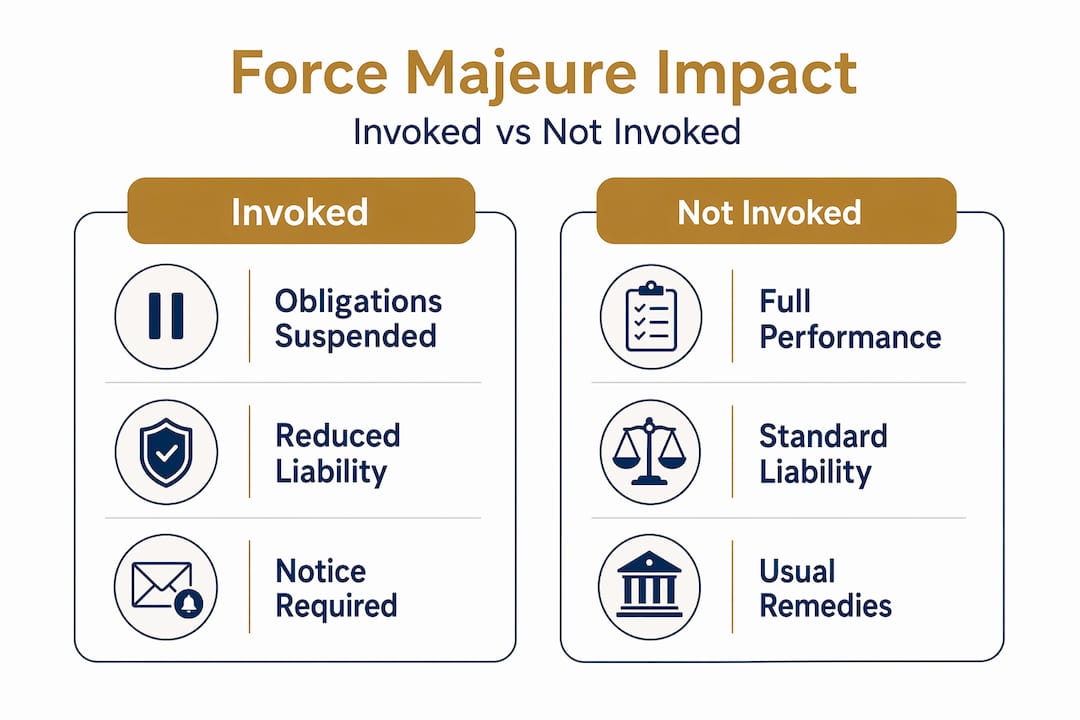
The table below summarises the main consequences depending on what the clause provides:
| Scenario | Effect on contract | Effect on liability |
|---|---|---|
| Valid force majeure invoked | Obligations suspended for duration of event | Party excused from breach during event |
| Force majeure persists beyond agreed period | Termination right may arise | Neither party liable for non-performance |
| Procedural requirements not met | Clause cannot be relied upon | Party may be in breach |
| Event does not meet qualifying criteria | Clause does not apply | Normal liability for breach resumes |
| Mitigation not demonstrated | Claim likely to fail | Party may face damages claim |
The key distinction from common law frustration is control and predictability. Frustration discharges the contract entirely and can have unpredictable consequences for payments already made, work already done, and future obligations. A force majeure clause, by contrast, operates according to its own terms. That predictability is exactly why well-drafted contractual clauses offer better protection than relying on common law doctrines.
Understanding the force majeure clause meaning in the abstract only goes so far. Seeing it applied to real scenarios is more instructive.
Consider a UK-based importer with a supply contract for goods manufactured in a country that becomes subject to sudden government sanctions. If the contract contains a force majeure clause listing government actions as qualifying events, and the importer serves valid notice within the required timeframe while demonstrating attempts to source alternative supply, the clause should operate to suspend obligations. Without the clause, they may face a breach claim.
Now consider a hotel group that cancelled all bookings during the COVID-19 pandemic. Many contracts contained force majeure clauses; others relied on common law frustration. The outcomes differed significantly depending on precise clause wording, notice compliance, and whether the clause listed pandemics or government restrictions as qualifying events.
Typical scenarios where force majeure clauses come into play include:
The 2024 UK Supreme Court ruling in RTI Ltd v MUR Shipping BV reinforced a critical principle. The court confirmed that parties are not required to accept creative workarounds that deviate from the original contract terms. This protects contractual certainty, but it also underscores why the original clause must be drafted with precision, because the court will apply it strictly as written.
I have seen businesses spend months drafting detailed commercial contracts and then accept a standard force majeure clause without a second thought. It is the most common and costly oversight in contract negotiation, and it happens because force majeure feels like a theoretical problem until it suddenly is not.
In my experience, the clauses that fail most often are not failing because of what they say. They fail because of what they omit. No industry-specific qualifying events. No clear notice mechanism. No defined mitigation obligation. No escalation period leading to termination. When a genuine crisis hits, the clause cannot do the work the business assumed it would.
Procedural compliance is where I see the most damage done. A business experiences a legitimate force majeure event, their lawyers confirm the clause applies, and then it emerges that no one served notice within the contractual deadline. The claim collapses not on the merits but on a missed administrative step. Strict adherence to notice requirements is not optional, even when the force majeure event itself is undisputed.
The RTI v MUR decision in 2024 was a useful reminder that English courts will hold parties to the precise terms they agreed. That is both a protection and a warning. Your clause will be enforced as written. If it is vague, narrow, or procedurally incomplete, you will bear the consequences. The answer is not to rely on judicial sympathy. The answer is to draft commercial contracts with the same rigour you would apply to payment terms or liability caps.
— Panagiotis

Force majeure disputes move quickly. Whether you need to invoke a clause, respond to a counterparty’s invocation, or challenge whether a qualifying event actually occurred, the legal and procedural stakes are high from day one. Alilegal’s team brings deep expertise in commercial contract disputes, including force majeure claims at every stage from initial advice through to litigation or arbitration.
If you are dealing with a contract dispute involving performance obligations, civil litigation support from a team that understands both the legal principles and the commercial realities makes a material difference to outcomes. Alilegal also advises on bespoke contract drafting and clause negotiation to protect your position before a crisis arises. Fixed fees. Straight answers. Contact Alilegal today for a consultation.
Force majeure is a contractual provision that excuses or suspends a party’s performance obligations when an extraordinary, unforeseeable event beyond their control makes performance impossible or impracticable. It has no default existence under English law and must be expressly included in the contract.
A force majeure event is triggered when a qualifying event occurs, such as a natural disaster, war, or government action, that was unforeseeable at the time of contracting and directly prevents performance. The affected party must also comply with notice requirements and demonstrate mitigation efforts.
No. Force majeure typically suspends obligations during the qualifying event rather than cancelling the contract outright. Termination rights may arise only if the clause expressly provides for them and the event persists beyond a defined period.
Generally no. Increased costs or commercial hardship do not meet the threshold for force majeure unless the contract specifically includes them as qualifying triggers. The standard test requires that performance be impossible or impracticable, not merely more expensive.
Failing to serve notice correctly and on time can invalidate a force majeure claim even where the event itself would otherwise qualify. Courts treat procedural compliance as a condition of relying on the clause, not as an administrative formality.


