
Menu
Get Expert Legal Support Today

TL;DR:
- Many business owners mistakenly believe restrictive covenants provide broad legal protection against competition. These clauses must protect legitimate interests like trade secrets and client relationships, or they risk being unenforceable in court. Properly drafted, role-specific covenants with clear scope and consideration can effectively safeguard a business’s valuable assets.
Many business owners insert restrictive covenants into their contracts believing they act as a broad legal shield against any form of competition. They don’t. Restrictive covenants are contractual clauses in employment, commercial, shareholder, partnership, or M&A agreements that limit post-termination activities to protect legitimate business interests such as goodwill, trade secrets, client relationships, and workforce stability. The key word here is legitimate. Poorly drafted covenants get struck down in court every year, leaving businesses exposed at the very moment they need protection most. This guide clarifies what these clauses are, what types exist, how enforceability is tested, and how to draft them properly.
| Point | Details |
|---|---|
| Covenants protect business interests | Restrictive covenants are not blanket bans; they defend goodwill, trade secrets, and client relationships. |
| Enforceability demands precision | Courts require covenants to be tightly linked to legitimate interests with reasonable scope and duration. |
| Tailored drafting is essential | Bespoke, role-appropriate wording avoids legal pitfalls and increases enforceability. |
| Global variations impact contracts | Laws governing restrictive covenants differ across jurisdictions, affecting cross-border business strategy. |
| Expert advice maximises protection | Legal guidance ensures covenants serve your business and withstand scrutiny. |
A restrictive covenant is, at its core, a contractual promise to refrain from doing something. In a commercial context, that “something” is usually competing, soliciting clients or employees, or disclosing sensitive information after a contract ends or a business changes hands. These clauses appear across a wide range of agreements, including employment contracts, shareholder agreements, partnership deeds, franchise arrangements, and merger and acquisition (M&A) deals.
The purpose is not to punish a departing employee or freeze a competitor out of the market. Courts in England and Wales are firm on this point. A covenant must protect a proprietary interest, which means something specific and valuable that your business has built up over time. As defined by the ICAEW, these clauses exist to safeguard goodwill, trade secrets, client relationships, and workforce stability. They are not a tool for preventing general competition.
The types of proprietary interests worth protecting typically include:
Understanding defining commercial contracts helps set the wider context for how these clauses sit within a business’s legal framework. A restrictive covenant is only one mechanism within the broader contractual architecture, but it is often the one most heavily contested.
“A court will not enforce a restrictive covenant simply because it exists in a signed contract. It will look beneath the surface to ask: what legitimate interest is this clause actually protecting, and is the restriction proportionate to that interest?”
One common misconception is that the length or complexity of a covenant determines its strength. In reality, a brief, precisely worded non-solicitation clause tied explicitly to a specific client relationship can outperform a sweeping five-page non-compete that covers every sector imaginable. Substance beats scale in this area of law every time.
With the foundation in place, it is worth examining the specific categories of restrictive covenants used in business contracts, because each serves a different protective function and carries different enforceability implications.
The four most common types are:
Each type has a distinct role. Non-competes are the most contentious and frequently litigated. Non-solicitation clauses, by contrast, are generally viewed more favourably by courts because they target specific relationships rather than whole market sectors. NDAs are typically the most robust because they protect objectively definable information rather than activities.

The prevalence of these clauses globally illustrates how seriously businesses take post-termination risk. OECD data shows up to 25% of workers in some OECD countries are subject to non-competes, while 80% of S&P 1500 CEO contracts include non-competes of one to two years. Perhaps most surprisingly, these clauses appear even in low-wage roles, a trend that is now attracting significant legal scrutiny.
| Covenant type | Typical scope | Enforceability | Common context |
|---|---|---|---|
| Non-compete | Industry, geography, duration | Moderate, role-dependent | Employment, M&A |
| Non-solicitation | Named clients or staff | Generally stronger | Commercial, employment |
| Non-disclosure | Specific information categories | Strong if well-defined | All contract types |
| Garden leave | Notice period duration | Strong if paid in full | Senior employment |
Pro Tip: In a business sale, covenants tied to the purchase price are often more enforceable than equivalent employment covenants. The arms-length nature of the deal and the substantial consideration exchanged gives courts more reason to uphold them. Review the approach to UK contract law explained to understand how consideration principles apply more broadly.
For commercial and M&A transactions, the bargaining dynamic changes significantly. Both parties are typically advised, the risks are understood, and the consideration is explicit. This matters because commercial law essentials for businesses remind us that enforceability often depends as much on context as on wording.
Enforceability is where many businesses get a rude awakening. A signed covenant is not automatically enforceable. UK courts apply a clear test: is the restriction reasonable in protecting a legitimate business interest, and is it reasonable with reference to the interests of the parties and the public?
There are four core factors courts examine:
Courts will not save a poorly drafted covenant by rewriting it. They may apply the “blue pencil” rule to sever an unenforceable part if the remainder still makes sense, but this is not guaranteed, and relying on it is a risky strategy.
When a breach occurs, the two primary remedies are injunctions and damages. LexisNexis guidance confirms that businesses should seek injunctions urgently, as courts favour prompt action. Waiting months to respond to a breach signals that the harm was not serious, weakening the case. Damages are available where financial loss can be proven, but quantifying lost business is notoriously difficult.
The international picture adds another layer of complexity, particularly for businesses with cross-border operations or employees working remotely across jurisdictions. 2025 data shows stark variation: California bans employment non-competes outright, Washington has introduced sweeping restrictions, Texas limits healthcare non-competes to one year within five miles, and at least 13 US states tightened their laws in 2025 with wage thresholds. Florida remains permissive for high-compensation roles.
Understanding statutory limitation for UK businesses is also relevant here, particularly where businesses consider the timing of legal action following a covenant breach.
“Courts do not enforce restraint of trade clauses as a matter of course. Public policy demands a balance between contractual freedom and the freedom to work and trade.”
Remote working has added genuine complexity to the geography question. A clause restricting competition within a 50-mile radius made perfect sense when an employee worked from a fixed office. When that same employee works from anywhere in the country, geography-based restrictions become harder to justify and easier to challenge.
Good drafting is where abstract legal principle meets real business protection. The most enforceable covenants are those written with a specific role, a specific interest, and a specific risk in mind. Here is how to approach it.
Tailor to the individual role and seniority. A covenant appropriate for a chief revenue officer with access to every client account and strategic plan is not appropriate for a junior sales assistant. ICAEW guidance is explicit: covenants must tie to proprietary interests, not serve as a general barrier. Blanket clauses applied uniformly across all staff invite challenge.
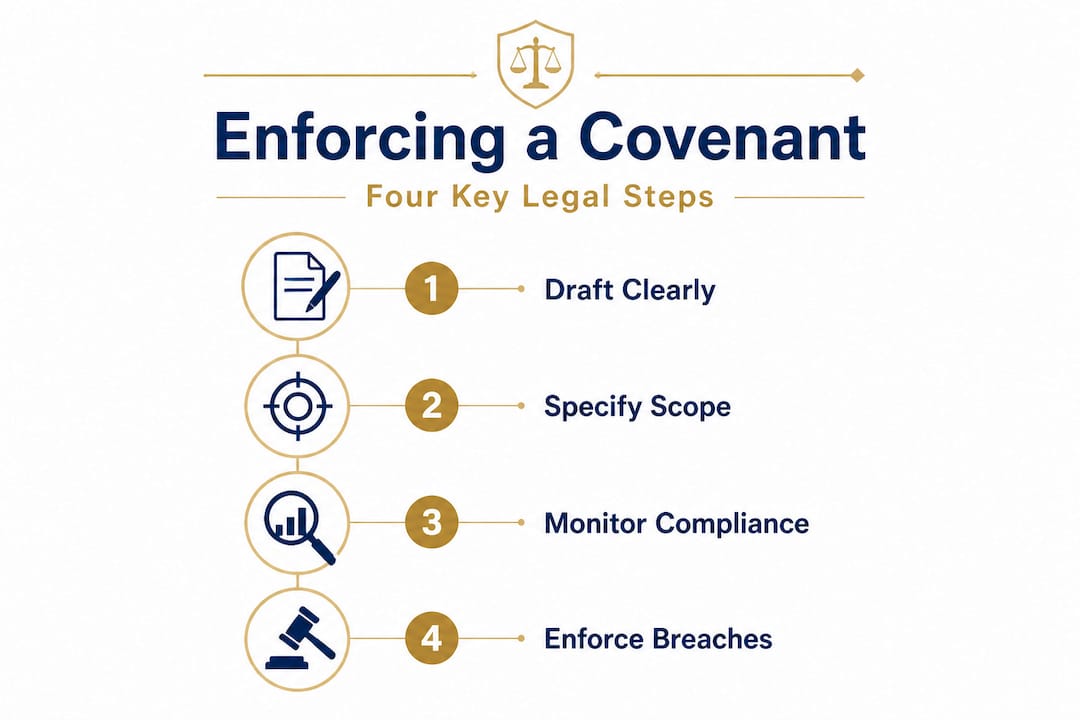
Name the interest explicitly. Rather than vague language about “competitive activities,” specify what is being protected. Is it the list of 50 named enterprise clients that the employee managed personally? Is it the pricing algorithm developed over four years? Name it, because courts respond to specificity.
Document the rationale and consideration. Particularly in business sale agreements, courts look more favourably on covenants where goodwill protection and purchase price are clearly linked. The more transparent the rationale, the harder it is to argue the covenant is unreasonable.
Practical drafting guidance worth following:
Pro Tip: Seek advice under legal privilege in UK business when reviewing your covenant strategy. Legal advice privilege protects the content of those discussions from disclosure in litigation, giving you a safer space to assess risk candidly.
For businesses operating under franchise models, understanding how franchise law for business ownership intersects with covenant obligations is particularly important, as franchise agreements often include their own specific restrictions that must align with your employment and commercial contracts.
The review cycle matters as much as the initial drafting. A covenant written five years ago may reference geographic territories that no longer reflect your business, or fail to account for remote working norms that courts now factor into enforceability assessments. Annual reviews, particularly after significant business changes, are a sound investment.
Here is the uncomfortable reality we see repeatedly: businesses spend money on contracts but not on thinking. They take a precedent covenant from a previous deal, adjust the names and dates, and consider the job done. Then, two years later, they sit in a solicitor’s office having just watched a departing director walk straight to a competitor, and wonder why the covenant is not holding up.
Generic, one-size-fits-all covenants fail because courts are sophisticated. They look past the clause as written to ask what it is actually doing. A non-compete covering every sector in every geography for three years is not protecting goodwill. It is attempting to suppress competition. Courts increasingly strike these down, and public policy considerations explicitly require a balance between contractual freedom and the freedom to trade.
Remote and hybrid work has fundamentally changed the geography of risk. An employee who never set foot in a physical office still has access to every client relationship, every pricing model, and every strategic plan. Yet many businesses still default to geographically-defined covenants that courts find increasingly difficult to apply meaningfully. The solution is not to abandon geography entirely but to supplement it with role-specific, interest-specific restrictions that do not depend on physical location to make sense.
The businesses that fare best in this area treat restrictive covenants as a living part of their commercial strategy, not a one-off legal box-tick. They invest in bespoke drafting tied to named roles and specific interests, build regular legal review into their contract management cycles, and maintain documentation that explains precisely why each restriction exists. When a dispute arises, that paper trail is often the difference between a successful injunction and an unenforceable clause. Consider your commercial lease law obligations as an analogy: the same rigour you apply to property obligations should apply to the covenants protecting your business’s most valuable commercial assets.
Protecting your business with well-drafted restrictive covenants requires more than downloading a template. The legal landscape is shifting, courts are scrutinising overbroad clauses more closely than ever, and the consequences of getting it wrong are significant.

At Ali Legal, we work with business owners and executives to draft, review, and enforce restrictive covenants that actually stand up. Our commercial litigation services cover disputes from injunction applications to damages claims, with strategic advice at every stage. Whether you are facing a potential breach or building covenants into a new shareholder or M&A agreement, our team provides clear, fixed-fee guidance. Read our civil litigation guide to understand the process, then contact us to discuss your specific position.
Restrictive covenants are legally binding if they protect legitimate business interests and are reasonable in scope, duration, and geography. A signed covenant alone does not guarantee enforceability.
No. Courts are clear that covenants cannot protect against mere competition itself; they must be tied explicitly to proprietary interests such as trade secrets, goodwill, or specific client relationships.
Courts typically grant injunctions urgently to prevent further breach, and can award damages where financial loss is proven. Acting promptly after a breach is critical to a successful application.
Yes, and M&A covenants are generally more enforceable than employment covenants because they involve arms-length negotiation, substantial consideration linked to the purchase price, and clear goodwill protection.
Significant differences exist across jurisdictions. For example, California bans employment non-competes entirely, while Florida remains permissive for high-compensation roles, and 13 US states tightened their restrictions in 2025 alone.


