
Menu
Get Expert Legal Support Today

Commercial contracts sit at the heart of every serious business relationship, yet ICC arbitration cases registered 841 disputes in 2024 with a combined value exceeding $102 billion. That figure does not include the estimated $1 trillion SMEs write off annually in unresolved low-value claims. The uncomfortable question is not whether disputes happen, but whether your contracts are genuinely protecting you or quietly exposing you to losses you cannot afford.
| Point | Details |
|---|---|
| Enforceability matters most | A contract is only as protective as its enforceable terms and clarity. |
| Mistakes cost billions | Poorly drafted contracts can trigger disputes, write-offs, and headline losses. |
| Key clauses prevent risk | Indemnity, liability, and tailored dispute resolution are vital for business safety. |
| Fine print hides traps | Standard terms can contain pitfalls; legal review is essential before signing. |
| Invest in proactive strategy | Treat contracts as business tools—bring in legal expertise to align with your goals. |
A commercial contract is a legally binding agreement between two or more parties engaged in business activity. It differs from a casual arrangement or handshake deal because it creates enforceable obligations that courts and arbitrators can uphold. Understanding defining commercial contracts is the first step towards using them as genuine business tools rather than administrative formalities.
Every valid commercial contract rests on a few core elements:
Without these, what looks like a contract may be worthless in court. As one commercial law principle puts it:
“A contract is only as strong as the clarity of its terms and the certainty of its obligations.”
Commercial contracts also carry specific clauses that ordinary agreements lack: indemnity provisions, liability caps, termination rights, and dispute resolution mechanisms. These are not boilerplate. They are the machinery that determines who bears the cost when something goes wrong. Getting drafting legal certainty right from the outset saves significant time and money later.
A well-drafted contract does several things simultaneously. It tells both parties exactly what is expected, when payment is due, what standard of performance is required, and what happens if either side falls short. Commercial contracts provide legal enforceability and clarity on obligations, payment, timelines, and remedies for breach.
Here is how that protection works in practice:
Pro Tip: Before signing any contract, map out your three biggest risks in that relationship. Check whether the contract addresses each one explicitly. If it does not, negotiate an amendment before you sign.
The financial stakes are stark. SMEs write off $1 trillion annually in unresolved low-value disputes. Many of those losses stem from agreements that were vague, informal, or simply not reviewed by a solicitor. Navigating commercial contracts proactively is far cheaper than resolving disputes reactively. When your interests are protected in every clause, you operate with confidence rather than anxiety.
Abstract warnings are easy to ignore. Concrete examples are not. Consider what poor or absent contracts have cost real organisations.
| Incident | Root cause | Financial impact |
|---|---|---|
| Swiss-Austrian train deal | Invalid e-signature voided €3bn contract | Entire deal collapsed |
| McLaren contract dispute | Breach of commercial agreement | $12M awarded in damages |
| AOL-Time Warner merger | Misaligned contractual obligations | $99B+ in losses |
The €3bn train deal voided due to an invalid e-signature is particularly instructive. The underlying commercial intent was sound. The failure was purely technical: an execution error that a competent legal review would have caught. McLaren’s $12M award and the AOL-Time Warner collapse illustrate that contract failures scale with the size of the deal.
“The most expensive contract is the one you thought was fine until it wasn’t.”
For smaller businesses, the impact is less dramatic but equally damaging. Unresolved disputes drain management time, delay growth, and erode supplier and client relationships. Understanding types of business litigation helps you recognise when a contract weakness is about to become a courtroom problem. Reviewing civil dispute examples shows how quickly ordinary commercial disagreements escalate without clear contractual terms.

Knowing what a protective contract looks like is half the battle. Key mechanics include clear definitions, payment terms, liability limits, indemnity provisions, termination clauses, and dispute resolution procedures.
Here is a breakdown of the essential components:
| Clause | Primary function | Most commonly negotiated? |
|---|---|---|
| Indemnity | Allocates liability for losses | Yes |
| Liability cap | Limits financial exposure | Yes |
| Termination | Controls exit rights | Yes |
| Payment terms | Ensures cash flow certainty | Often |
| Dispute resolution | Determines resolution path | Sometimes |
The three most negotiated clauses are indemnity, liability, and termination. This is not coincidence. These are the provisions that determine who pays when things go wrong. Investing time in drafting for certainty on these clauses is where legal expertise delivers the greatest return. Ensuring protective clauses are tailored to your specific deal is non-negotiable.
Pro Tip: Never accept a liability cap that is lower than the realistic value of what you stand to lose in the relationship. If the other party insists on a low cap, treat it as a signal about how much risk they expect to create.
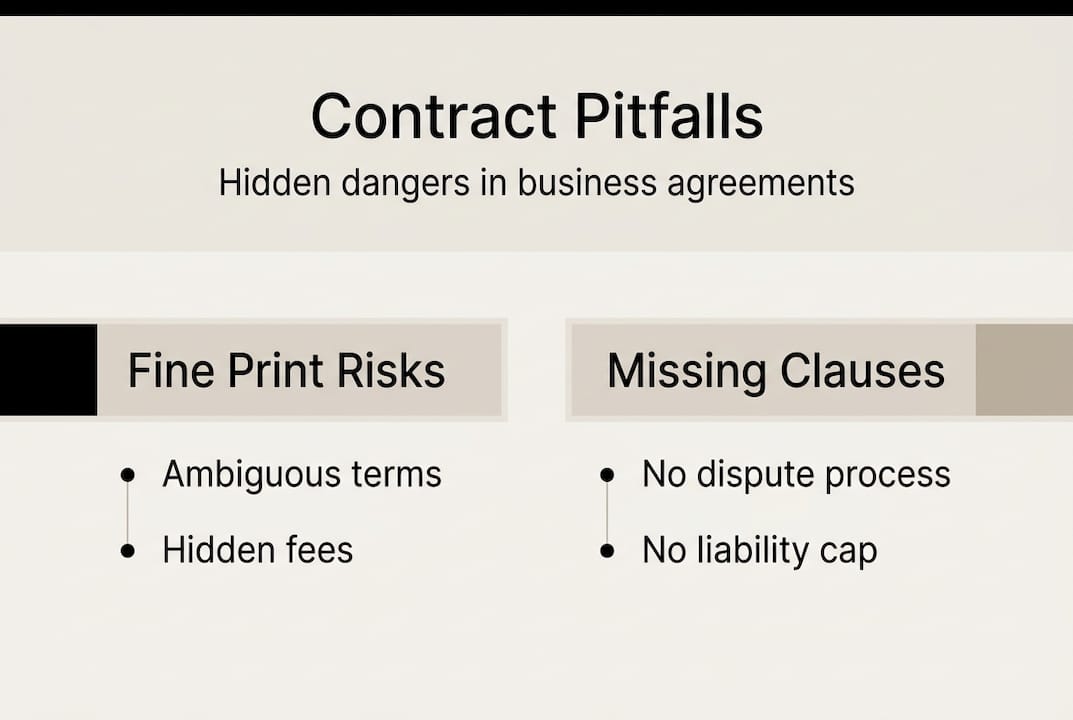
Even experienced business owners are caught out by contract provisions that appear standard but carry significant risk. Termination clauses are not boilerplate: they can grant unexpected rights to the other party, override your assumed protections, and trigger consequences you did not anticipate.
The most common pitfalls include:
“The clause you skimmed over is usually the one that costs you.”
The lesson is straightforward: never assume a clause is harmless because it looks familiar. Navigating key terms carefully before signing is the single most effective way to avoid these traps. A solicitor reviewing a contract for two hours costs a fraction of what a single dispute will.
The most commercially sophisticated businesses treat contracts as operational assets, not administrative burdens. Involving legal expertise early to align agreements with business goals, using playbooks for consistency, and viewing contracts as investments yields smoother operations and fewer disputes.
Pro Tip: Build a simple contract playbook for your most common deal types. It should list your non-negotiable positions, your preferred fallback positions, and the clauses where you have flexibility. This saves time in every negotiation and ensures consistency across your team.
Practical steps for strategic contracting:
Understanding the value of legal counsel at the strategic level, rather than only in a crisis, is what separates businesses that grow confidently from those that lurch from one dispute to the next.
Enforceability is not just a legal concept. It is a commercial advantage. When both parties know that terms are clear and binding, the incentive to perform is stronger and the temptation to exploit ambiguity disappears. Disputes average 2.3 months for arbitration resolution, but unresolved low-value claims drag on far longer and suppress SME growth.
Well-drafted contracts reduce dispute frequency in several ways:
When disputes do arise, efficient dispute resolution mechanisms built into the contract keep costs manageable. Knowing the steps for resolving disputes swiftly means you spend less time in conflict and more time running your business.
Pro Tip: Always include a tiered dispute resolution clause: negotiation first, then mediation, then arbitration or litigation. This structure encourages resolution at the cheapest level and reserves court action as a genuine last resort.
Every insight in this article points to the same conclusion: the quality of your contracts directly determines the quality of your commercial relationships and your financial security. Reactive legal support after a dispute has started is always more expensive than proactive contract drafting before one begins.

At Ali Legal, we specialise in drafting, reviewing, and negotiating commercial contracts that protect your interests in every clause. Whether you need contract drafting expertise for a new deal or commercial litigation support when a relationship breaks down, our team provides clear, fixed-fee advice with no surprises. We work quickly, communicate plainly, and focus on outcomes that matter to your business. Contact us today to arrange a consultation and make your contracts work as hard as you do.
Poorly drafted contracts risk being unenforceable, creating costly disputes, or resulting in severe financial losses. High-profile failures such as the voided €3bn train deal show how a single drafting error can collapse an entire agreement.
Templates carry real risk if not tailored to your specific deal. Standard termination clauses can grant unexpected rights or create loopholes that lead to costly disputes.
Indemnity, liability caps, and dispute resolution clauses are the most pivotal. These provisions are the most heavily negotiated because they determine who bears the financial consequences when something goes wrong.
Use clear, tailored clauses and include tiered dispute resolution mechanisms such as mediation and arbitration. Unresolved low-value claims suppress SME growth, making accessible resolution mechanisms essential.
Engage legal expertise whenever an agreement affects key revenue, involves significant risk, or deviates from your standard terms. Involving legal counsel early aligns contracts with your business goals and prevents costly reactive disputes.


