
Menu
Get Expert Legal Support Today

Many UK business owners believe due diligence is only necessary for large corporations during complex mergers. This misconception leaves small and medium enterprises vulnerable to hidden liabilities that could derail their transactions. Due diligence is a critical process for all UK businesses and individuals involved in significant transactions, whether you’re purchasing property, acquiring a company, or entering a major investment. This guide explains what due diligence is, why it matters in UK legal contexts, and how it helps you make safer business and investment decisions.
| Point | Details |
|---|---|
| Risk identification | Due diligence uncovers legal, financial, and operational risks before transactions complete. |
| Multiple types | It involves legal, financial, operational, reputational, and compliance checks tailored to each transaction. |
| Ongoing process | The process is multi-stage and continuous, not a one-time task. |
| Negotiation power | Thorough due diligence improves your negotiation position and reduces deal risks. |
| Common mistakes | Misconceptions about due diligence can cause costly errors if ignored. |
Due diligence is a thorough investigation and verification process conducted before major transactions to uncover financial, legal, and operational risks. It protects individuals, small businesses, and large corporations alike from entering agreements that could lead to unexpected liabilities or disputes. The purpose is straightforward: gather and analyse all relevant information about a transaction to make informed decisions and negotiate from a position of strength.
This process applies to various scenarios. When purchasing commercial property, due diligence reveals title defects, planning restrictions, or environmental issues. During corporate acquisitions, it exposes hidden debts, pending litigation, or intellectual property problems. For investment decisions, it assesses the target’s compliance with regulations and operational sustainability.
Skipping or rushing due diligence can lead to unforeseen financial obligations, hidden liabilities, litigation risk, and deal collapse. UK data shows that SMEs often underestimate due diligence necessity, increasing their vulnerability to these risks. The financial impact can be devastating, with businesses facing claims that exceed the transaction value itself.
The types of risks uncovered through due diligence include:
“Due diligence is not optional for UK businesses. It’s a fundamental requirement that protects your investment and ensures compliance with legal obligations before committing to any significant transaction.”
Understanding these fundamentals helps you approach transactions with appropriate caution and preparation. The UK due diligence legal requirement extends across multiple transaction types, making it essential knowledge for any business owner or investor.
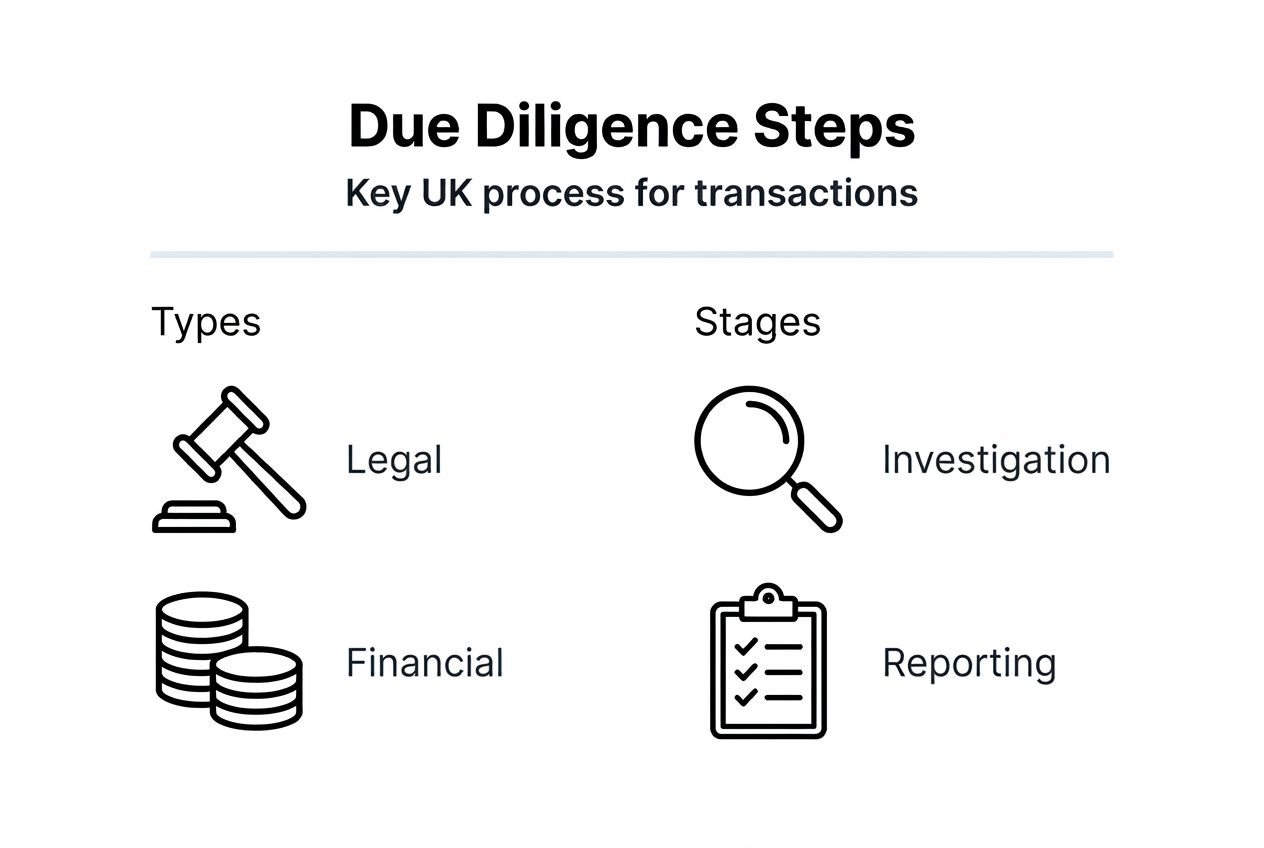
Different transactions require specific types of due diligence. Understanding each category helps you allocate resources effectively and engage the right experts for your situation.
Legal due diligence focuses on contracts, litigation exposure, intellectual property rights, and regulatory compliance. Legal due diligence involves detailed review of contracts, litigation exposure, intellectual property, and regulatory compliance before mergers or property purchases. This type is critical for corporate acquisitions and property transactions where legal risks could derail the deal.
Financial due diligence examines accounting records, tax returns, revenue streams, debts, and financial projections. It verifies that financial statements accurately represent the business’s health and identifies any hidden liabilities or overvalued assets.
Operational due diligence assesses business processes, technology systems, supply chains, and key personnel. It reveals inefficiencies or dependencies that could affect post-transaction performance.
Reputational due diligence investigates the target’s market standing, customer satisfaction, and any negative publicity. This matters particularly when brand value is significant to the transaction.
Compliance due diligence verifies adherence to industry regulations, employment law, data protection requirements, and environmental standards. Understanding the compliance officer role UK businesses must fulfil helps structure this aspect correctly.
| Type | Focus Area | Key Activities | Application Scenarios |
|---|---|---|---|
| Legal | Contracts, litigation, IP | Document review, title searches, litigation checks | Mergers, property purchases, investments |
| Financial | Accounts, tax, debts | Financial statement analysis, tax review, asset valuation | All transactions involving monetary exchange |
| Operational | Processes, systems, personnel | Site visits, process mapping, technology audits | Acquisitions where business continuity matters |
| Reputational | Brand, customer relations | Market research, media analysis, customer surveys | High-profile acquisitions, brand-sensitive deals |
| Compliance | Regulations, standards | Regulatory review, policy audits, certification checks | Regulated industries, cross-border transactions |
Examples of when each type proves critical:
Pro Tip: Engage specialists in each due diligence area rather than relying on generalists. A corporate lawyer, forensic accountant, and operational consultant working together provide comprehensive coverage that a single adviser cannot match.
The solicitor role in acquisitions often coordinates these different due diligence streams, ensuring nothing falls through the cracks. Understanding 2025 rules legal due diligence helps you stay compliant with current requirements.
Due diligence follows a structured yet adaptable process. Due diligence is not a one-time check but an ongoing process including investigation, verification, reporting, and monitoring. Each stage builds on the previous one, creating a comprehensive understanding of the transaction’s risks and opportunities.
The typical process includes these stages:
Typical documents required include articles of association, shareholder agreements, employment contracts, customer contracts, supplier agreements, financial statements for three years, tax returns, property titles, lease agreements, intellectual property registrations, litigation records, insurance policies, and regulatory licences.
Stakeholders typically involved are solicitors handling legal review, accountants conducting financial analysis, technical experts assessing operational matters, company directors providing information, and external advisers offering specialist expertise.
Pro Tip: Balance thoroughness with transaction timelines by prioritising high-risk areas first. If time is limited, focus on financial records, major contracts, and litigation exposure before expanding to secondary concerns.
The corporate law checklist steps provides a framework for organising this process. Remember that due diligence adapts as new information emerges. Discovering one issue often reveals others, requiring additional investigation before proceeding.
Real estate and corporate transactions each require tailored due diligence approaches reflecting their unique risk profiles.

Real estate due diligence focuses on physical and legal property aspects. Investigations include structural surveys to identify defects, title searches confirming ownership and revealing restrictions, environmental assessments checking contamination, planning permission verification for intended use, lease reviews identifying tenant obligations, and local authority searches revealing planned developments affecting value.
Legal due diligence includes property inspections, ownership verification, contracts, litigation, and intellectual property reviews in these transactions. Common risks uncovered include title defects preventing clear ownership transfer, restrictive covenants limiting property use, undisclosed structural problems requiring expensive repairs, planning violations risking enforcement action, and environmental contamination creating cleanup liability.
Corporate due diligence examines the business entity comprehensively. Key activities include contract review identifying unfavourable terms or automatic termination clauses, litigation searches revealing pending claims, intellectual property audits confirming ownership and protection, regulatory compliance checks ensuring all licences remain valid, and financial analysis verifying profitability and identifying hidden liabilities.
Risks frequently discovered in corporate transactions:
Due diligence findings directly affect negotiation strategies. Discovering structural defects in property transactions typically leads to price reductions or seller-funded repairs. In corporate deals, uncovered litigation might require indemnities protecting the buyer from losses, or escrow arrangements holding back purchase price until resolution.
The solicitor role acquisitions involves managing these complex investigations. Understanding merger and acquisition UK processes helps you navigate corporate transactions effectively. Properly drafting commercial contracts following due diligence findings protects your interests long term.
Several misconceptions prevent businesses from conducting effective due diligence. Recognising these errors helps you avoid costly mistakes.
Misconception 1: Only large corporations need due diligence. Many believe due diligence is only for large corporations; actually, it reduces but does not remove all risks and is vital for all business sizes. Small business transactions carry proportionally greater risk because owners typically have more personal exposure. A single undiscovered liability could threaten their entire financial security.
Misconception 2: Due diligence guarantees no risks remain. Due diligence significantly reduces risk but cannot eliminate it entirely. Some issues remain hidden despite thorough investigation. The process identifies material risks allowing informed decisions, not perfect certainty.
Misconception 3: It’s a one-time check. Effective due diligence continues after transaction completion. Circumstances change. Representations made during negotiations may prove inaccurate. Ongoing monitoring catches emerging issues before they become serious problems.
Misconception 4: Due diligence is purely defensive. While risk identification is important, due diligence also reveals opportunities. It might uncover undervalued assets, identify operational improvements, or highlight market advantages not initially apparent.
Misconception 5: You can conduct it yourself without professional help. Complex transactions require specialist expertise. Legal, financial, and technical issues demand professional analysis. Attempting DIY due diligence often misses critical problems that experts would immediately recognise.
Myths versus facts:
Correcting these misconceptions improves your approach to transactions. Understanding due diligence misconceptions helps you avoid the costly errors that derail deals or create post-completion problems.
Due diligence findings directly influence transaction terms and outcomes. The information discovered provides powerful negotiation leverage and informs critical decisions.
Price adjustments are the most common outcome. Discovering undisclosed liabilities justifies reducing the purchase price pound for pound. Finding overvalued assets supports similar reductions. In property transactions, structural defects often lead to price negotiations reflecting repair costs plus a discount for inconvenience.
Warranty and indemnity negotiations protect buyers against discovered risks. If due diligence reveals potential litigation, you might require specific indemnities covering all losses from those claims. For tax issues, warranties confirming accurate tax returns with indemnities for any assessments provide protection.
Conditions precedent might be added to the contract. You could make completion conditional on resolving identified regulatory violations, obtaining necessary consents, or key employees signing new contracts.
Deal structure modifications address discovered issues. Finding pension deficits might lead to excluding the pension scheme from the transaction. Intellectual property problems could result in licensing arrangements rather than outright purchase.
Go or no-go decisions ultimately rest on due diligence findings. Some issues prove too significant to overcome through price adjustments or indemnities. Walking away from a bad deal is often the wisest outcome.
Negotiation leverage points derived from due diligence:
Pro Tip: Engage legal counsel early in the due diligence process, not after discovering problems. Lawyers experienced in commercial contracts drafting can immediately assess the significance of findings and advise on appropriate responses, maximising your negotiation outcomes.
The quality of your due diligence directly correlates with your negotiation success. Thorough investigation supported by expert analysis gives you confidence to either proceed with appropriate protections or withdraw before committing resources to a problematic transaction.
Conducting effective due diligence requires systematic preparation and execution. These practical steps help individuals and business owners manage the process confidently.
Pro Tip: Don’t overlook continuous monitoring after the initial process. Circumstances change between agreement and completion. What was accurate initially may no longer be true. Regular updates protect you from surprises at completion.
Balancing thoroughness with deal timelines requires prioritisation. Focus first on areas most likely to contain material issues. For corporate transactions, that typically means financial records, major contracts, and litigation exposure. Expand to secondary areas as time permits.
The solicitor role in acquisitions includes coordinating these various due diligence streams. Professional guidance ensures you don’t miss critical steps while maintaining momentum towards completion.
Due diligence protects UK businesses and individuals from entering transactions with hidden risks that could prove financially devastating. It’s a multi-stage, ongoing process requiring systematic investigation across legal, financial, operational, reputational, and compliance areas. While it cannot guarantee perfect outcomes, thorough due diligence significantly reduces risk and provides the foundation for confident decision-making.
The process applies to all transaction sizes and types. Small businesses benefit as much as large corporations. Property purchases require the same rigour as corporate acquisitions. The investment in proper due diligence pays dividends through better negotiated terms, avoided problems, and successful transaction outcomes.
Early engagement with legal and financial experts improves results dramatically. Professionals spot issues that inexperienced reviewers miss. They know where problems typically hide and how to verify representations effectively.
Next actionable steps to start due diligence effectively:
Approaching transactions with this structured due diligence mindset transforms how you evaluate opportunities. You’ll negotiate from strength, avoid costly mistakes, and build a sustainable business through informed decision-making.
Navigating due diligence requires experienced legal guidance to protect your interests and maximise transaction outcomes. Ali Legal offers comprehensive support throughout the entire process, from initial planning through to post-completion monitoring.
Our team has extensive experience conducting due diligence for property transactions, corporate acquisitions, and investment decisions across diverse industries. We understand UK legal requirements and identify risks that could derail your transaction or create future liabilities. When disputes arise from undiscovered issues, our civil litigation services provide robust representation to protect your position.

For corporate transactions, our specialised solicitors guide you through complex merger and acquisition insights while conducting thorough investigations into target companies. We understand the solicitor role in acquisitions and coordinate all aspects of your due diligence efficiently.
Key services include legal due diligence reviews covering contracts, litigation, and compliance, financial analysis coordination with accountant partners, negotiation support to secure favourable terms, contract drafting reflecting due diligence findings, and ongoing monitoring arrangements protecting your interests post-completion.
Contact Ali Legal early in your transaction planning. Early engagement allows us to shape your due diligence strategy appropriately and prevent costly mistakes. Our transparent fixed-fee arrangements mean you’ll know costs upfront, allowing confident budgeting for professional support that genuinely strengthens your position.
Due diligence is a thorough investigation and assessment process before major transactions to identify risks and ensure informed decisions. It covers legal, financial, and operational checks relevant to UK businesses and individuals. The process verifies that what you’re being told about a property, business, or investment is accurate and complete.
Typically the buyer or investor leads due diligence to safeguard their interests before committing funds. It should be conducted early during negotiations to allow risk identification before deals progress too far. Starting due diligence after agreeing terms often reveals problems when you’ve lost negotiation leverage.
Skipping due diligence exposes you to unexpected financial liabilities, hidden debts, and legal disputes that could exceed the transaction value. You face potential deal collapse or costly renegotiations when problems surface later. Without proper investigation, you lose negotiation leverage and make decisions based on incomplete or inaccurate information, often with devastating financial consequences.
Due diligence significantly reduces risks but cannot guarantee complete elimination of all potential problems. Some issues remain hidden despite thorough investigation, and circumstances can change between agreement and completion. That’s why ongoing monitoring after the initial process remains essential for catching emerging issues before they become serious problems.


