
Menu
Get Expert Legal Support Today

Securing the right contract terms can be the difference between lasting growth and unexpected setbacks for UK small business owners. Every clause, negotiation tactic, and agreement has the potential to shape your financial stability and prevent expensive legal battles. With strategic negotiation frameworks and a clear understanding of legal protections, you gain the confidence to approach business deals on stronger ground, ready to build safer, more profitable partnerships.
Contract negotiation represents a strategic dialogue where two or more parties interact to establish mutually agreeable terms within a business relationship. At its core, this process involves carefully discussing, proposing, and refining contractual conditions that protect each party’s interests while creating a foundation for successful collaboration. Structured negotiation frameworks help businesses navigate complex discussions with precision and professionalism.
Business contract negotiations encompass multiple critical elements, including financial terms, performance expectations, risk allocation, and legal protections. Small and medium enterprises (SMEs) must approach these discussions with thorough preparation, understanding that every clause can significantly impact their operational and financial landscape. Effective negotiators analyse potential scenarios, anticipate counterparty positions, and develop flexible strategies that balance assertiveness with collaborative problem-solving.
Successful contract negotiations require a blend of strategic thinking, emotional intelligence, and technical understanding. Small business owners must research market standards, understand their negotiation leverage, and communicate their requirements clearly and professionally. This involves preparing comprehensive documentation, setting realistic objectives, and maintaining a professional demeanour throughout discussions. The goal is not to win at all costs, but to create an agreement that provides sustainable value for all parties involved.
Pro tip: Before entering contract negotiations, create a comprehensive checklist of your non-negotiable terms and potential compromise areas to maintain clarity and focus during discussions.
Business negotiations are complex interactions that can be broadly categorised into different types, each requiring unique approaches and strategies. Negotiation strategies typically fall into two primary frameworks: distributive and integrative negotiations. Distributive negotiation represents a competitive approach where parties view the negotiation as a fixed-value scenario, often resulting in a win-lose outcome where one party’s gain is another’s loss.
Integrative negotiations, by contrast, represent a more collaborative model focused on creating mutual value. In this approach, small and medium enterprises can explore multiple dimensions of an agreement, seeking solutions that satisfy broader interests beyond simple financial transactions. These negotiations require advanced communication skills, creativity, and a willingness to understand the underlying needs and motivations of all parties involved. Team negotiations add another layer of complexity, involving multiple stakeholders and requiring sophisticated coordination and consensus-building techniques.
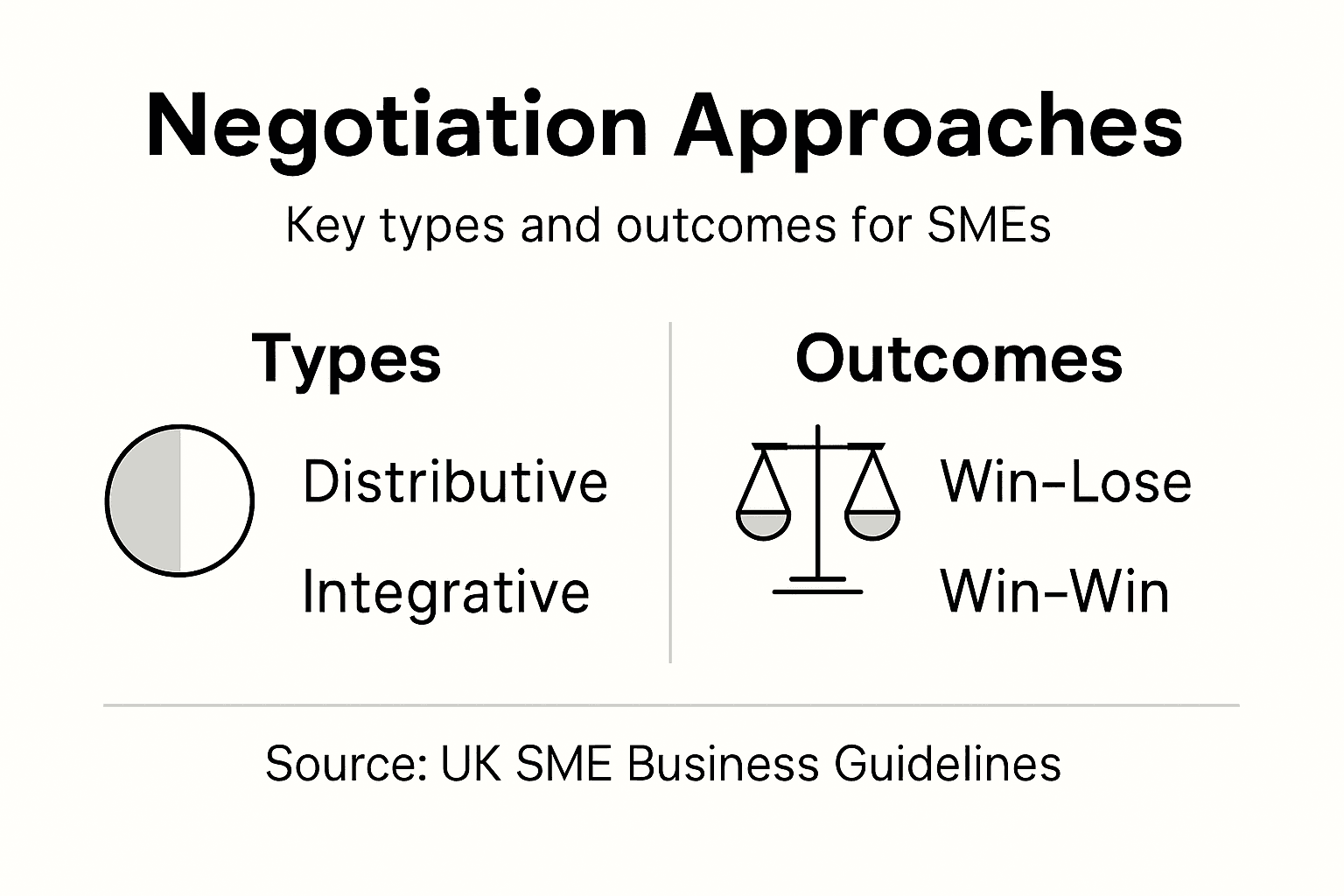
Here is a comparison of typical negotiation approaches in business contracts:
| Approach | Main Objective | Typical Outcome | Business Scenario |
|---|---|---|---|
| Distributive | Maximise individual gain | Win-lose, fixed value | One-time transactions |
| Integrative | Create mutual benefit | Win-win, expanded value | Ongoing partnerships |
| Team Negotiation | Build consensus | Coordinated agreement | Multi-stakeholder deals |
The negotiation process generally follows a structured progression of stages. Preparation is crucial, involving comprehensive research, setting clear objectives, and understanding potential negotiation scenarios. The information exchange stage allows parties to communicate their initial positions and requirements. Bargaining involves active discussion, proposal, and counterproposal, where negotiators seek to find common ground. Closing represents the critical moment of agreement, while execution ensures the negotiated terms are implemented effectively. Throughout these stages, successful negotiators must balance assertiveness with flexibility, maintaining professional composure while pursuing their organisation’s strategic interests.
Pro tip: Always develop a comprehensive negotiation playbook that outlines your organisation’s core objectives, potential compromise zones, and non-negotiable terms before entering any business discussion.
The United Kingdom’s contract law provides a comprehensive legal framework that governs business interactions, balancing protection for all parties while maintaining flexibility for commercial negotiations. UK contract negotiation strategies are rooted in a complex system combining statutory legislation and common law principles. This intricate framework establishes fundamental requirements such as offer, acceptance, consideration, and the intention to create legally binding relationships, providing small and medium enterprises with essential guidelines for robust contractual agreements.
Key legislative instruments play a crucial role in protecting business interests and ensuring fair negotiations. The Unfair Contract Terms Act 1977 and Consumer Rights Act 2015 are particularly significant, offering mechanisms to prevent exploitative contractual clauses and safeguard organisational interests. These regulations mandate transparency, prohibit unreasonable terms, and provide legal recourse for businesses encountering potentially damaging contractual conditions. For small and medium enterprises, understanding these legislative protections is paramount in developing strategies that mitigate potential legal risks and establish equitable negotiation frameworks.
Public sector procurement represents another critical dimension of the United Kingdom’s legal landscape for contract negotiations. Recent legislative developments, such as the Procurement Act 2023, have transformed how government contracts are awarded, emphasising principles of transparency, equal treatment, and demonstrable value for money. These regulations create structured pathways for businesses, particularly SMEs, to engage in public sector tendering processes. By establishing clear pre-market engagement protocols, standardised tendering procedures, and comprehensive post-award management guidelines, the framework aims to level the playing field and provide smaller organisations with meaningful opportunities to compete for government contracts.
The table below summarises key UK legal instruments impacting contract negotiation:
| Legal Instrument | Primary Focus | Business Protection Offered |
|---|---|---|
| Unfair Contract Terms Act | Limits unfair terms | Prevents exploitative clauses |
| Consumer Rights Act | Safeguards consumer contracts | Ensures transparency and fairness |
| Procurement Act 2023 | Government contract process | Standardises public sector tenders |
Pro tip: Consult a legal professional to conduct a comprehensive review of your standard contract templates, ensuring alignment with current UK legislative requirements and protecting your organisation’s interests.
Small and medium enterprises can significantly improve their contract negotiation outcomes by adopting strategic approaches that prioritise thorough preparation and clear communication. SME contract negotiation strategies emphasise the importance of understanding both your own organisational objectives and the potential constraints and needs of the counterparty. This requires comprehensive research, detailed market analysis, and a nuanced approach to identifying potential areas of mutual benefit beyond simple financial considerations.
Developing a robust internal framework for contract negotiations involves multiple critical components. Small businesses must establish clear internal roles and responsibilities, ensuring that team members understand their specific contributions to the negotiation process. This includes designating lead negotiators, subject matter experts, and support personnel who can provide rapid insights during discussions. Practical preparation involves creating comprehensive bid documentation, gathering evidence-based value propositions, and developing flexible negotiation strategies that can adapt to changing circumstances while maintaining core organisational objectives.
Successful negotiations also demand exceptional relationship management skills. Small and medium enterprises should focus on building long-term collaborative partnerships rather than viewing each contract as a transactional encounter. This approach requires demonstrating reliability, transparency, and a genuine commitment to delivering value. By leveraging their inherent strengths such as agility, personalised customer service, and innovative problem-solving capabilities, SMEs can differentiate themselves from larger, more bureaucratic competitors. Understanding market conditions, researching potential counterparties, and presenting clear, compelling value propositions are crucial elements in securing favourable contract terms.
Pro tip: Create a standardised internal negotiation playbook that documents your organisation’s negotiation principles, acceptable compromise ranges, and non-negotiable terms to ensure consistent and strategic approach across all contract discussions.
Contract negotiations present numerous potential risks for small and medium enterprises, with improper risk allocation representing a significant operational hazard. Risk allocation strategies are crucial in preventing contract failures and minimising financial exposure. The most common pitfalls emerge from inadequate risk assessment, where businesses either accept disproportionate contractual risks or fail to identify potential areas of vulnerability that could compromise their operational integrity.

Key risk areas for SMEs include unclear performance specifications, ambiguous liability clauses, and inappropriate financial mechanisms that transfer excessive risk to the smaller party. Businesses must develop robust risk assessment frameworks that meticulously analyse potential contractual vulnerabilities. This involves conducting comprehensive due diligence on counterparties, understanding detailed specification requirements, and establishing clear performance metrics. Critically, SMEs should prioritise transparent communication, ensuring all contractual terms are explicitly defined and potential contingencies are thoroughly explored before finalising agreements.
Mitigating contractual risks requires a strategic and proactive approach. Small businesses should implement rigorous internal review processes that involve legal professionals, financial experts, and operational managers in contract evaluation. This multidisciplinary approach helps identify potential risks across different organisational dimensions. Effective risk management also involves continuous monitoring of contract performance, maintaining flexibility to adjust terms when circumstances change, and developing comprehensive exit strategies. By anticipating potential challenges and building appropriate safeguards into contractual frameworks, SMEs can significantly reduce their exposure to financial and operational risks associated with complex business negotiations.
Pro tip: Develop a standardised risk assessment checklist that systematically evaluates potential contractual vulnerabilities across financial, legal, operational, and strategic dimensions before entering any negotiation.
Contract negotiation can be challenging for small and medium enterprises facing complex legal frameworks and risk allocation concerns. If you find yourself navigating unclear contractual terms or seeking to create agreements that truly protect your business interests, Ali Legal offers tailored solutions designed to bring clarity, speed, and confidence to your negotiations. Our client-centred approach ensures you receive straightforward advice on topics like risk assessment, legislative compliance, and collaborative negotiation strategies that align with your organisational goals.

Don’t leave your contract terms to chance. Connect with our experienced team for transparent legal guidance that helps you avoid common pitfalls and secure favourable, sustainable agreements. Visit Contact Ali Legal today to schedule a consultation. Discover how our fixed fees and long-term client focus can empower your SME to negotiate from a position of strength and build lasting partnerships. Make your next negotiation your best yet by contacting Ali Legal now.
Contract negotiation involves a strategic dialogue between two or more parties to establish mutually agreeable terms within a business relationship, protecting each party’s interests for successful collaboration.
The two main types of negotiation approaches are distributive negotiations, which are competitive and result in a win-lose outcome, and integrative negotiations, which are collaborative and focus on creating mutual value for all parties involved.
SMEs can improve their negotiation outcomes by conducting thorough preparation, understanding both their own objectives and the needs of the counterparty, and fostering long-term relationships rather than treating contracts as one-off transactions.
SMEs should be cautious of unclear performance specifications, ambiguous liability clauses, and inappropriate financial mechanisms. Developing a robust risk assessment framework and maintaining clear communication can help mitigate these risks.


