
Menu
Get Expert Legal Support Today

International law shapes how British companies manage cross-border risks and regulatory obligations. Global disputes now impact over 60 percent of corporate transactions involving United Kingdom businesses. For corporate lawyers and business owners, a clear understanding of international rules is crucial in protecting commercial interests and maintaining compliance. This guide reveals how strategic use of global legal frameworks gives British organisations more control over international disputes, contractual challenges, and compliance requirements.
International law represents a sophisticated legal framework governing interactions between nations, organisations, and global entities. At its core, international law establishes rules and principles that facilitate diplomatic relations, economic cooperation, and conflict resolution across borders. Public international law serves as a critical mechanism for maintaining global order and resolving complex transnational challenges.
The scope of international law extends far beyond traditional diplomatic negotiations. It encompasses diverse domains including human rights, trade regulations, environmental protections, maritime interactions, and security protocols. By creating standardised guidelines, international law enables businesses to operate with greater predictability and reduces potential risks associated with cross-border transactions. Treaties, customary practices, and decisions from international judicial bodies collectively form the foundational structure of this complex legal system.
For United Kingdom businesses, understanding international law becomes paramount in navigating global markets. The legal framework provides essential guidelines for conducting international trade, protecting intellectual property rights, managing cross-border disputes, and ensuring compliance with multinational regulatory standards. International business law offers strategic insights into managing legal complexities that arise when operating beyond domestic boundaries.
Pro tip: When expanding internationally, consult legal experts specialising in international business law to develop comprehensive compliance strategies and mitigate potential legal risks.
International law for businesses encompasses several critical categories designed to regulate complex global interactions. International business law comprises multiple specialised legal domains that provide frameworks for multinational commercial activities. These legal types include international commercial law, trade law, corporate governance regulations, competition law, and arbitration mechanisms.
Public international law represents one fundamental category, governing relationships between states and international organisations. This domain influences business operations by establishing rules around trade agreements, environmental obligations, digital privacy standards, and human rights compliance. Private international law, alternatively, focuses on resolving legal conflicts between private entities operating across different jurisdictions, addressing challenges such as contractual disputes, intellectual property protection, and cross-border transaction regulations.
Another significant category involves supranational law, which creates binding regulations that transcend individual national legal systems. These frameworks are particularly crucial for businesses operating within economic unions or integrated market regions. By establishing uniform standards, supranational law reduces legal uncertainties and provides predictable guidelines for international commercial interactions. Cross-border dispute resolution mechanisms form an essential component of these legal frameworks, enabling businesses to manage potential conflicts efficiently and strategically.
Here’s a comparison of major types of international law relevant to business:
| Law Category | Main Focus | Typical Business Impact |
|---|---|---|
| Public International | State relations, treaties | Trade agreements, compliance |
| Private International | Private cross-border disputes | Contract resolution, IP protection |
| Supranational | Above national laws, unions | Predictable standards, simplified rules |
Pro tip: When expanding internationally, develop a comprehensive understanding of different international law types to strategically navigate complex regulatory landscapes and minimise potential legal risks.
Cross-border commercial activities are fundamentally shaped by intricate legal frameworks that provide essential guidelines for international business interactions. Cross-border civil judicial cooperation represents a critical mechanism for maintaining legal predictability and mutual trust between jurisdictions. These frameworks establish comprehensive rules governing jurisdiction, conflict resolution, judgment recognition, and enforcement across different national legal systems.

The United Kingdom’s approach to cross-border legal frameworks emphasises creating robust mechanisms for managing international commercial disputes. Key elements include bilateral treaties, multilateral conventions, and sophisticated institutional arrangements that provide clear pathways for resolving complex transnational legal challenges. Cross-border litigation requires businesses to navigate nuanced legal territories, understanding how different jurisdictions interpret and apply international commercial regulations.
British businesses must carefully consider multiple legal dimensions when operating internationally. These dimensions include understanding jurisdiction selection clauses, recognising potential conflicts between different national legal systems, and developing strategies for managing potential disputes. Specific areas of focus involve intellectual property protection, contract enforcement, trade compliance, and mechanisms for resolving disagreements that transcend national boundaries. By comprehensively understanding these legal frameworks, organisations can significantly reduce operational risks and create more stable international business relationships.
Pro tip: Invest in comprehensive legal mapping of target international markets to anticipate potential regulatory challenges and develop proactive compliance strategies.
UK companies operate within a complex regulatory landscape that demands rigorous adherence to multiple compliance requirements. UK company compliance involves comprehensive statutory obligations that extend far beyond basic registration procedures. These requirements encompass critical areas such as corporate governance, financial reporting, tax regulations, employment standards, and ongoing legal documentation.
The fundamental compliance obligations for businesses include maintaining accurate statutory registers, appointing qualified directors, submitting annual confirmation statements, and ensuring transparent financial reporting. Foreign entities and non-resident businesses face additional scrutiny, with specific requirements mandating a registered UK office, proper director appointments, and meticulous record-keeping. Corporate law compliance demands proactive management to prevent potential legal complications that could result in substantial financial penalties or even company dissolution.
British regulatory frameworks emphasise robust governance mechanisms that protect stakeholder interests and maintain market integrity. Key compliance dimensions include data protection regulations, health and safety standards, environmental reporting requirements, and sector-specific legal obligations. Companies must develop comprehensive internal compliance programmes that systematically track and address evolving regulatory landscapes. This approach involves regular audits, staff training, and establishing clear accountability mechanisms to ensure consistent adherence to statutory requirements.
Pro tip: Implement a centralised compliance management system that provides real-time tracking of regulatory changes and automates documentation processes to reduce administrative burdens.
International business operations inevitably expose organisations to complex legal risks that demand sophisticated management strategies. International dispute resolution centres provide critical mechanisms for mitigating potential legal challenges by offering neutral arbitration and mediation services that help businesses navigate cross-border commercial conflicts efficiently.
UK businesses face multifaceted legal exposures ranging from contractual disputes and regulatory compliance challenges to intellectual property conflicts and potential transnational litigation risks. These exposures require comprehensive risk management approaches that include robust contract drafting, strategic dispute resolution mechanisms, and proactive legal compliance strategies. Cross-border dispute resolution plays a pivotal role in managing potential legal uncertainties and preserving critical commercial relationships.
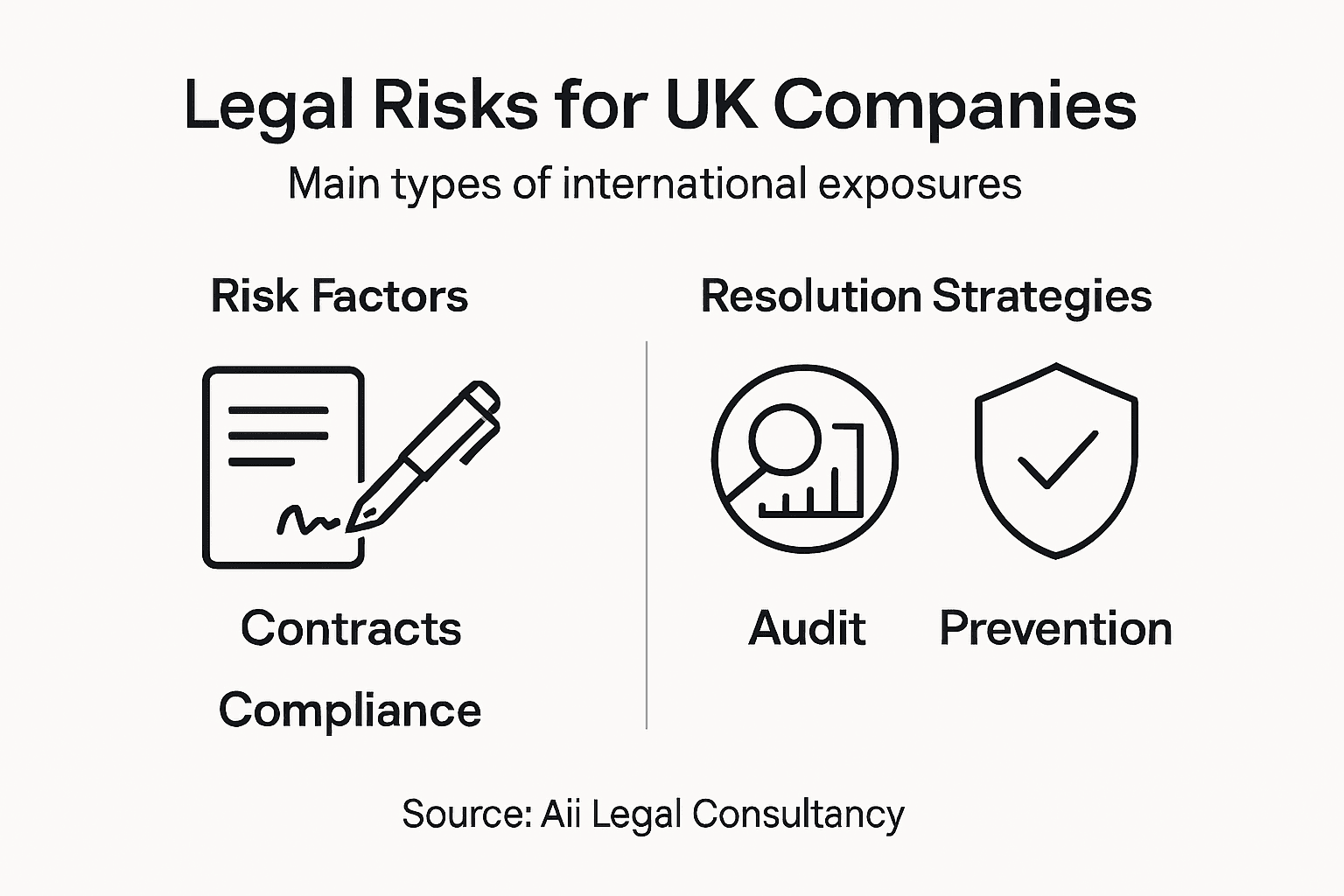
Effective legal risk management involves developing nuanced strategies that anticipate potential conflicts and establish clear protocols for resolution. Key considerations include selecting appropriate jurisdictional frameworks, implementing precise contractual dispute resolution clauses, understanding international arbitration rules, and maintaining comprehensive documentation. British companies must cultivate a proactive approach to legal risk, recognising that prevention and strategic preparation are significantly more cost-effective than reactive litigation strategies.
Key risk management factors in international business law at a glance:
| Risk Factor | Business Strategy | Expected Benefit |
|---|---|---|
| Jurisdiction Selection | Choose favourable forum | Lower litigation risk |
| Contract Precision | Include clear dispute clauses | Faster dispute resolution |
| Regulatory Monitoring | Track global legal changes | Improved compliance, fewer fines |
| Arbitration Preparation | Understand rules and protocols | Reduce time and costs |
Pro tip: Develop a comprehensive international legal risk assessment framework that includes regular legal audits, scenario planning, and continuous monitoring of regulatory changes across target markets.
Navigating the complexities of international law is critical for UK businesses aiming to thrive in global markets. The article highlights key challenges such as understanding public international law, managing cross-border disputes, and meeting rigorous compliance obligations. If you are confronted with legal uncertainties concerning international trade, regulatory compliance, or dispute resolution, Ali Legal offers clear, strategic solutions designed to protect and empower your business.
Why choose Ali Legal

Take control of your international legal risks today. Consult with Ali Legal’s specialist team to develop a robust compliance strategy and dispute resolution plan that aligns with your business goals. Reach out now via our Contact Us page to start your journey towards confident global expansion. Discover more about our expertise in International Dispute Legal Risks and Cross-Border Litigation UK Guide to give your business the legal edge it deserves.
International law provides UK businesses with essential guidelines for conducting international trade, protecting intellectual property rights, managing cross-border disputes, and ensuring compliance with multinational regulatory standards.
International law establishes rules and principles that facilitate economic cooperation and reduce potential risks associated with cross-border transactions, making it easier for businesses to operate in multiple jurisdictions.
UK businesses should be aware of public international law, private international law, and supranational law, as these frameworks govern state relations, private disputes, and binding regulations beyond national laws.
UK companies can improve compliance by developing comprehensive internal compliance programmes, conducting regular audits, and implementing centralised systems to track regulatory changes and automate documentation processes.


