
Menu
Get Expert Legal Support Today

Over £1 billion flows into the British economy each year through foreign investment and skilled migration. For many British small and mid-sized businesses, tapping into global talent means facing a maze of legal rules and common myths about immigration. Whether you are welcoming international employees or investors, understanding the reality behind business immigration gives you the practical edge for smarter planning and risk reduction.
Business immigration represents a strategic legal pathway for companies seeking to recruit skilled international talent or expand their operations across national boundaries. At its core, business immigration involves obtaining specialised visas and work permits that enable foreign professionals to legally enter and contribute to a host country’s economic ecosystem.
Contrary to popular misconceptions, business immigration is not merely about moving workers between countries. It encompasses a nuanced process involving complex legal frameworks, compliance requirements, and strategic workforce planning. Businesses must navigate intricate regulations that vary significantly across jurisdictions. Understanding these immigration law complexities requires expert guidance and meticulous preparation.
Several persistent myths surround business immigration. Many believe it is a simple administrative process, when in reality, it demands sophisticated legal strategies. Common misconceptions include the notion that all skilled workers can automatically relocate, or that companies can quickly hire international talent without significant documentation. In truth, each immigration pathway involves specific eligibility criteria, substantial paperwork, and potential financial investments.
The landscape of business immigration continues to evolve, influenced by geopolitical dynamics, economic shifts, and changing labour market needs. Organisations must remain adaptable and well-informed about emerging trends and regulatory updates. Successful business immigration strategies require proactive planning, comprehensive understanding of legal requirements, and a commitment to supporting international talent integration.
Pro Tip: Research Thoroughly: Before initiating any business immigration process, conduct comprehensive research on specific visa categories, eligibility requirements, and potential challenges specific to your target country and industry.
The United Kingdom offers several strategic business immigration routes designed to attract talented professionals and innovative entrepreneurs. These pathways provide businesses with opportunities to recruit international talent and support economic growth through carefully structured legal frameworks.
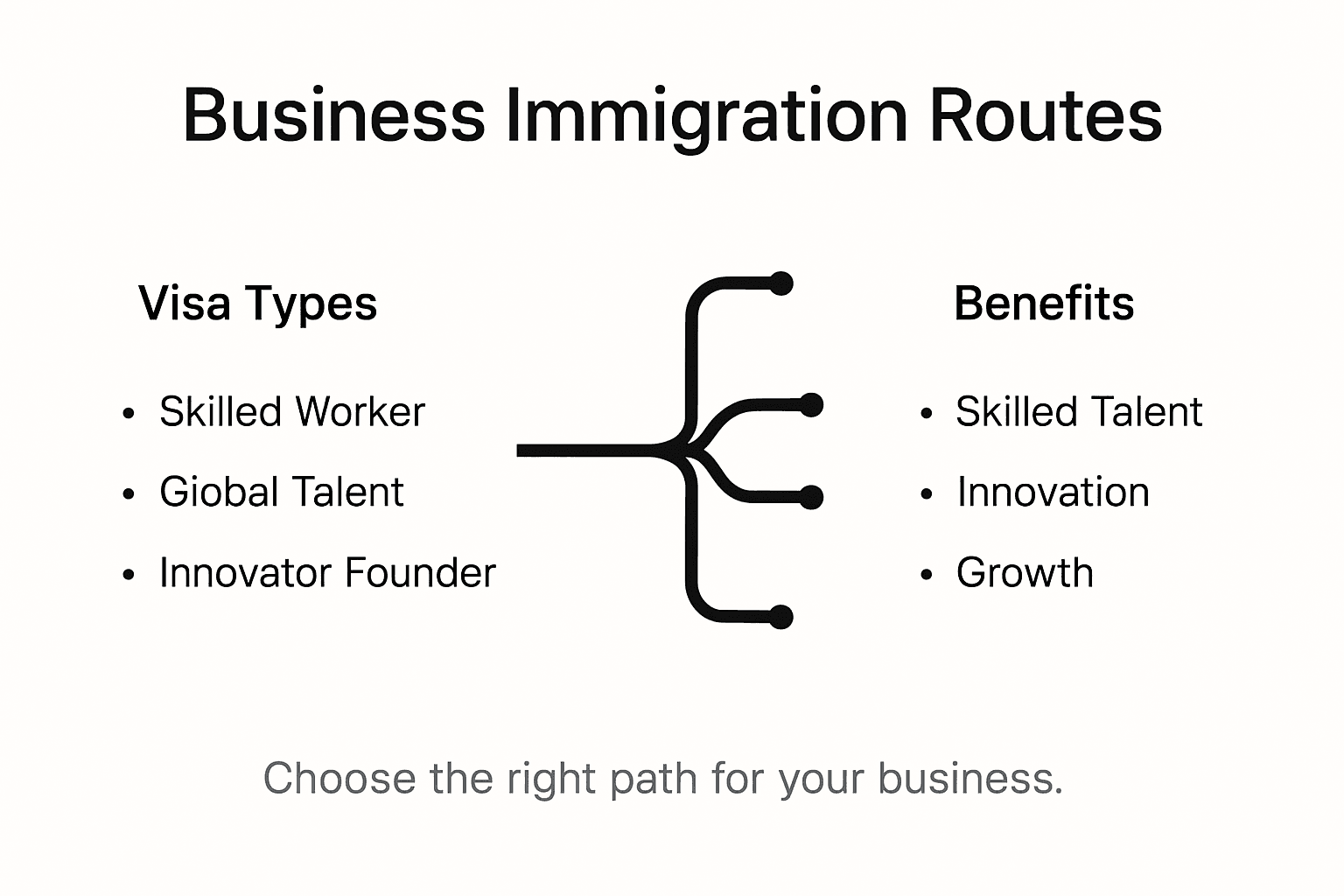
Primary business immigration routes include the Skilled Worker Visa, which remains the most popular pathway for companies seeking to recruit international talent. This visa allows organisations to sponsor skilled professionals who meet specific salary and skill requirements. Additionally, the business immigration landscape encompasses specialised routes like the Global Talent Visa for exceptional researchers and innovators, and the Innovator Founder Visa targeting entrepreneurs with innovative business concepts.
Understanding the nuanced differences between these immigration routes is crucial for businesses. The Skilled Worker route requires a valid job offer from a licensed sponsor, whereas the Global Talent Visa allows more flexibility for internationally recognised experts. The Innovator Founder Visa specifically supports individuals looking to establish innovative businesses in the United Kingdom, with stringent criteria designed to attract high-potential entrepreneurs.
Navigating these immigration pathways requires meticulous planning and comprehensive legal understanding. Businesses must consider factors such as minimum salary thresholds, skill level requirements, English language proficiency, and specific documentation needed for each visa category. Successful applications demand strategic preparation, detailed documentation, and a thorough comprehension of the evolving regulatory landscape.
Here’s a concise comparison of major business immigration routes available in the United Kingdom:
| Route Name | Target Applicants | Key Eligibility Criteria | Unique Feature |
|---|---|---|---|
| Skilled Worker Visa | Skilled professionals | Job offer, salary threshold, skill level | Requires licensed sponsor |
| Global Talent Visa | Researchers, innovators | International recognition, endorsement | No job offer required |
| Innovator Founder Visa | Entrepreneurs with business ideas | Innovative concept, investment proof | Supports new UK businesses |
Pro Tip: Strategic Planning: Consult with immigration specialists early in your recruitment process to understand the most appropriate visa route for your specific business needs and potential candidate profiles.
Business immigration in the United Kingdom demands comprehensive understanding of eligibility criteria and intricate application procedures. Organisations must navigate complex requirements that encompass legal, professional, and administrative dimensions of recruiting international talent.
The sponsorship and application framework involves multiple critical components. Employers must first obtain a valid sponsor licence, which requires demonstrating the ability to effectively manage international recruitment. Key eligibility requirements include specific salary thresholds, skill level assessments, and stringent English language proficiency standards. Potential candidates must typically hold qualifications equivalent to a UK bachelor’s degree or possess demonstrable expertise in their professional domain.

Sponsorship entails significant legal responsibilities for businesses. Licensed sponsors must maintain detailed records, track employee movements, and ensure compliance with Home Office regulations. This involves reporting any changes in an employee’s circumstances, monitoring visa expiration dates, and maintaining comprehensive documentation. Each visa category presents unique requirements, with the Skilled Worker route demanding precise job role classifications and minimum salary levels that vary depending on the specific occupation.
The application process itself requires meticulous preparation and understanding of complex documentation requirements. Applicants must submit comprehensive evidence including academic qualifications, professional certifications, proof of English language proficiency, and detailed employment contracts. Background checks, including criminal record verification, are standard procedure. Businesses must work closely with potential employees to compile accurate, comprehensive applications that meet all regulatory standards.
Pro Tip: Documentation Precision: Maintain a systematic, digital documentation management system that tracks all visa-related paperwork, expiration dates, and compliance requirements to prevent potential administrative oversights.
Employers engaging in business immigration assume substantial legal responsibilities that extend far beyond standard recruitment practices. These obligations represent a critical framework designed to protect both international workers and the broader national labour market.
The legal landscape for sponsors involves comprehensive monitoring and reporting requirements. Businesses must maintain meticulous records, track employment law compliance with exceptional precision, and ensure ongoing adherence to Home Office regulations. Key responsibilities include verifying an employee’s right to work, maintaining accurate documentation, reporting significant changes in employment status, and ensuring continued eligibility throughout the visa duration.
Sponsorship duties encompass multiple critical dimensions. Employers must conduct rigorous pre-employment checks, including identity verification, qualification authentication, and criminal background assessments. They are legally obligated to monitor sponsored employees’ immigration status, reporting any breaches or changes promptly. This includes tracking visa expiration dates, ensuring continued employment compliance, and maintaining a systematic approach to workforce documentation.
Failure to meet these legal obligations can result in severe consequences, including substantial financial penalties, suspension of sponsorship licences, and potential criminal prosecution. Businesses must implement robust internal systems that create comprehensive audit trails, demonstrating proactive compliance with complex immigration regulations. This requires continuous staff training, systematic documentation processes, and a commitment to understanding the evolving legal landscape of business immigration.
Pro Tip: Compliance Vigilance: Establish a dedicated compliance team or assign a specific individual responsible for tracking and managing all immigration-related documentation and regulatory requirements to minimise potential legal risks.
Business immigration involves substantial financial investments and complex regulatory challenges that can significantly impact an organisation’s strategic planning. Direct and indirect costs encompass multiple dimensions, ranging from application fees and legal support to potential compliance penalties and administrative overheads.
The financial landscape of business immigration is multifaceted, with organisations facing significant expenses beyond basic visa processing. Corporate law compliance strategies become critical in managing potential financial risks. Typical cost components include sponsor licence fees, which range from £536 to £1,476 depending on business size, individual visa application fees typically between £625 and £1,423, and mandatory health surcharges for each international employee.
Below is a summary of typical costs and risks associated with UK business immigration:
| Expense/Risk Type | Typical Range or Example | Business Impact | Mitigation Strategy |
|---|---|---|---|
| Sponsor licence fee | £536 to £1,476 | Increases overhead | Budget for licence renewal |
| Visa application fee | £625 to £1,423 per applicant | Affects hiring decisions | Plan recruitment costs |
| Health surcharge | £624+ annually per employee | Ongoing annual expense | Factor into long-term planning |
| Compliance penalty | Up to £20,000 per breach | Severe financial risk | Establish internal audit system |
Common pitfalls in business immigration often stem from inadequate preparation and insufficient understanding of regulatory nuances. Businesses frequently encounter challenges such as incomplete documentation, missed reporting deadlines, and failure to maintain accurate employee records. These oversights can trigger severe consequences, including substantial financial penalties, potential licence suspension, and legal prosecution. Organisations must develop robust internal systems that provide comprehensive tracking, systematic documentation, and proactive compliance management.
Risk mitigation requires a sophisticated, multi-layered approach. Successful businesses invest in specialised training programmes, implement digital compliance tracking systems, and maintain ongoing legal consultations. This proactive strategy helps organisations navigate the complex regulatory environment, minimise potential financial exposure, and maintain the integrity of their international recruitment processes.
Pro Tip: Financial Preparation: Develop a comprehensive budgeting strategy that accounts for all potential immigration-related expenses, including application fees, legal consultations, compliance management, and potential contingency costs.
Navigating the complexities of business immigration in the United Kingdom requires more than knowledge—it demands strategic legal expertise to overcome challenges like eligibility requirements, sponsorship obligations, and compliance risks. This article highlights critical pain points such as understanding visa categories, maintaining meticulous documentation, and avoiding costly penalties. At Ali Legal, we specialise in providing clear, fast, and transparent legal guidance tailored to your business immigration needs.
Trust our client-centric approach to help you manage the Skilled Worker Visa, Global Talent Visa, and Innovator Founder Visa processes with confidence. We ensure your organisation meets all legal duties while minimising financial risks and avoiding common pitfalls. Let us handle the intricate paperwork and evolving regulations so you can focus on growing your business internationally.

Are you ready to simplify your business immigration journey and secure the right legal foundation? Contact Ali Legal today for straightforward advice and expert support. Speak with a solicitor who understands your unique challenges and is committed to your success. Take the first step now by visiting our Contact Us page or exploring how our business immigration services can benefit you.
Business immigration refers to the legal process that allows companies to recruit skilled international talent or expand operations across borders by obtaining specialised visas and work permits for foreign professionals.
Business immigration is vital as it enables organisations to access a broader talent pool, drive innovation, and remain competitive in a global marketplace by integrating skilled professionals into their workforce.
Common myths include the belief that business immigration is a simple administrative process and that all skilled workers can relocate automatically. In reality, it involves complex legal frameworks, specific eligibility criteria, and extensive documentation.
Companies should consider eligibility criteria, sponsorship responsibilities, and the documentation needed for various visa categories. It’s also essential to stay updated on regulatory changes and to consult with immigration specialists for strategic planning.


