
Menu
Get Expert Legal Support Today

Most major british companies now include arbitration clauses in their contracts, shaping how disputes are handled in and out of the courtroom. With over 80 percent of large United Kingdom firms relying on these provisions, understanding their nuances is vital for businesses and individuals alike. This overview will clarify what arbitration clauses are, why their structure matters under british law, and how they can influence the outcome of commercial disagreements.
Arbitration clauses represent specialised legal provisions designed to outline alternative dispute resolution mechanisms within contractual agreements. These clauses provide parties with a structured pathway to resolve potential conflicts outside traditional court systems, offering a more flexible and potentially cost-effective approach to legal disagreements.
In the context of UK legal frameworks, arbitration clauses serve as critical contractual instruments that define the procedural mechanisms for dispute resolution. They typically specify key parameters such as the number of arbitrators, the selection process, the governing legal jurisdiction, and the procedural rules that will guide the arbitration proceedings. By establishing these parameters in advance, parties can create a predictable and mutually agreed upon dispute resolution strategy.
The structural complexity of arbitration clauses demands precise drafting and careful consideration. Arbitration agreements are distinct from standard contractual provisions, as they create a separate legal mechanism for resolving disputes. Unlike litigation, arbitration allows parties to choose their adjudicators, maintain confidentiality, and potentially resolve conflicts more efficiently. This autonomy enables businesses and individuals to craft dispute resolution strategies tailored to their specific needs and industry requirements.
Legal professionals emphasise the importance of comprehensive arbitration clause drafting to ensure enforceability and clarity. The clause must explicitly outline the scope of disputes covered, the arbitration process, and the legal principles that will govern the proceedings. Ambiguity in these provisions can lead to potential challenges and undermine the effectiveness of the arbitration mechanism.
Pro Tip for Contract Drafting: Consult a specialised legal professional when drafting arbitration clauses to ensure they comprehensively address potential dispute scenarios and align with current legal standards in your specific industry or sector.
Arbitration agreements manifest in two primary forms, each serving distinct legal purposes within contractual frameworks. These variations represent critical mechanisms for dispute resolution across different sectors and legal contexts.
The first type encompasses anticipatory arbitration clauses, which are embedded directly within original contracts and pre-emptively establish dispute resolution protocols. These clauses proactively address potential future conflicts by defining arbitration parameters before any disagreement emerges. They provide a structured approach that allows parties to agree on procedural elements such as arbitrator selection, jurisdiction, and potential remedies in advance.
In contrast, submission agreements represent the second primary arbitration clause type, typically formed after a specific dispute has already arisen. These agreements emerge when parties mutually decide to resolve an existing conflict through arbitration, rather than pursuing traditional litigation. Such agreements offer flexibility and demonstrate a collaborative approach to conflict resolution, enabling parties to craft bespoke solutions tailored to their specific disagreement.
Beyond these fundamental classifications, arbitration clauses can further differentiate based on industry-specific requirements. Sectors like shipping, construction, and international commerce often develop nuanced arbitration provisions reflecting their unique operational complexities. These specialised clauses might incorporate detailed technical provisions, sector-specific terminology, and procedural mechanisms that align with industry standards and practices.
Here is a summary of the key distinctions between arbitration clause types:
| Clause Type | Timing of Agreement | Typical Use Case | Main Advantage |
|---|---|---|---|
| Anticipatory Arbitration | Before any dispute arises | Standard in commercial contracts | Proactive conflict management |
| Submission Agreement | After a conflict has emerged | Ad hoc dispute settlements | Tailored resolution for specific cases |
Pro Tip for Legal Strategy: Carefully analyse the specific context and potential future scenarios when drafting arbitration clauses to ensure comprehensive coverage and maximum flexibility in potential dispute resolution pathways.
The United Kingdom’s legal framework for arbitration clauses represents a sophisticated and nuanced system that balances contractual autonomy with procedural integrity. The UK Supreme Court has provided critical guidance on determining the governing law of arbitration agreements, establishing a comprehensive approach to interpreting and enforcing these contractual provisions.
Central to the UK’s arbitration legal framework is the Arbitration Act 1996, which provides the foundational legislative structure governing arbitration agreements. This Act establishes key principles, including party autonomy, the ability to choose arbitration procedures, and the court’s supportive role in arbitration processes. The legislation ensures that arbitration clauses maintain legal validity and can be effectively enforced, providing a robust mechanism for dispute resolution outside traditional court systems.
Recent judicial developments have further refined the legal landscape surrounding arbitration clauses. English Commercial Court rulings have affirmed the validity of sophisticated contractual mechanisms, such as unilateral option clauses, demonstrating the legal system’s adaptability to complex commercial arrangements. These judgments underscore the UK’s commitment to providing a flexible yet structured approach to arbitration, recognising the evolving needs of commercial entities in resolving disputes.
The legal framework additionally emphasises the principle of separability, which treats arbitration clauses as distinct legal agreements independent of the primary contract. This approach ensures that the validity of an arbitration clause remains unaffected even if the underlying contract is challenged, providing parties with a reliable dispute resolution mechanism that maintains its legal integrity under various circumstances.
Pro Tip for Legal Compliance: Carefully review the specific requirements of the Arbitration Act 1996 and consult with specialised legal counsel to ensure your arbitration clauses are drafted with precision and align with current legal standards.
Arbitration clauses transform dispute resolution from traditional litigation into a structured, consensual process that offers parties significantly more control over their legal proceedings. Practical interpretation of these clauses requires understanding their intricate operational mechanisms, which extend far beyond simple contractual language.

The operational process typically begins when a dispute emerges, triggering the predetermined arbitration mechanism. At this point, the clause outlines specific procedural steps, including selecting arbitrators, determining the jurisdiction, establishing timelines, and defining the scope of evidence admissibility. Unlike court proceedings, arbitration allows parties to choose decision-makers with specialised expertise relevant to their specific industry or conflict, creating a more targeted approach to dispute resolution.
Practically, arbitration clauses function through a series of negotiated stages. The initial phase involves both parties acknowledging the arbitration agreement’s validity and selecting an appropriate arbitration forum. Subsequently, they must agree on procedural rules, such as the number of arbitrators, the language of proceedings, and the location where arbitration will take place. These negotiations require careful consideration, as the chosen parameters can significantly impact the eventual dispute resolution outcome.
Technical considerations play a crucial role in the practical implementation of arbitration clauses. Parties must carefully draft provisions that specify precise mechanisms for initiating arbitration, including notification requirements, timeframes for responses, and detailed protocols for presenting evidence. The enforceability of these clauses depends on their clarity, specificity, and alignment with established legal standards, making meticulous drafting an essential component of effective arbitration agreements.
Pro Tip for Dispute Resolution: Consult experienced legal professionals when drafting arbitration clauses to ensure comprehensive coverage of potential scenarios and maximise the clause’s effectiveness in resolving potential future conflicts.
Defective arbitration clauses can introduce substantial financial and legal risks that extend far beyond simple contractual disagreements. These risks emerge from poorly constructed provisions that fail to anticipate potential complexities in dispute resolution, potentially undermining the entire purpose of establishing an arbitration mechanism.
Financial considerations play a critical role in evaluating arbitration’s viability. Institutional arbitration typically involves higher upfront costs, including administrative fees, arbitrator compensation, and potential venue expenses. While these costs can be significant, they are often offset by the process’s efficiency and the potential to avoid protracted litigation. Parties must carefully weigh the financial implications, considering factors such as the dispute’s complexity, the amount in contention, and the potential long-term cost savings compared to traditional court proceedings.
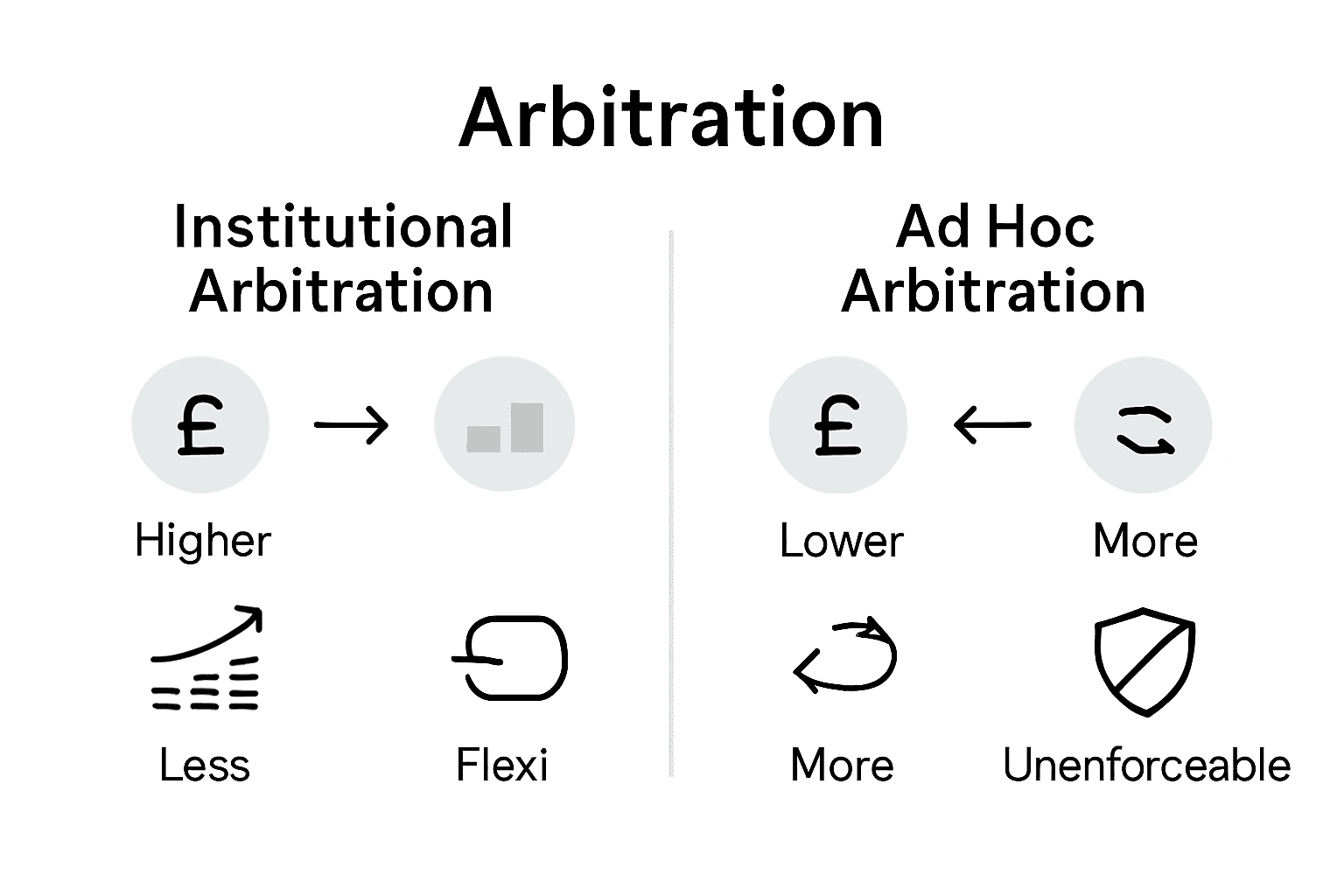
Different dispute resolution alternatives present unique trade-offs between institutional and ad hoc arbitration approaches. Mediation emerges as a particularly attractive alternative, offering a collaborative approach that can preserve business relationships while potentially reducing costs. Negotiation and expert determination represent additional strategies, each with distinct advantages depending on the specific nature of the dispute. These alternatives provide flexibility that traditional arbitration might not afford, allowing parties to select a resolution mechanism most appropriate to their specific circumstances.
The table below compares arbitration to other common dispute resolution options:
| Method | Costs Involved | Flexibility | Outcome Enforceability |
|---|---|---|---|
| Arbitration | Moderate to high fees | High (procedure choice) | Strong (binding awards) |
| Mediation | Low to moderate fees | Very high | Variable (if agreement) |
| Litigation | Often high court costs | Low (court imposed) | Very strong (court orders) |
| Negotiation | Minimal to low costs | Highest (informal) | Depends on contract |
Risks associated with arbitration extend beyond financial considerations. Potential challenges include limited appeal options, the risk of selecting inappropriate arbitrators, and potential enforceability issues across different jurisdictions. Parties must conduct thorough due diligence, carefully draft arbitration clauses, and consider the specific context of potential disputes to mitigate these inherent risks effectively.
Pro Tip for Risk Management: Conduct a comprehensive cost-benefit analysis and carefully evaluate alternative dispute resolution mechanisms before committing to a specific arbitration approach, ensuring alignment with your organisation’s strategic objectives and potential conflict scenarios.
Understanding the complex role of arbitration clauses in UK contracts reveals common challenges such as drafting clear dispute resolution mechanisms, ensuring enforceability under the Arbitration Act 1996, and managing risks related to costs and procedural flexibility. Key concerns include establishing precise arbitration terms, avoiding ambiguity, and maintaining control over the process while protecting your legal interests.
Ali Legal specialises in guiding individuals and businesses through these complexities with strategic legal advice. Our team helps you draft and review arbitration clauses that are tailored to your specific contracts and industry requirements. Benefit from fixed fees and transparent communication while we ensure your agreement aligns with UK legal frameworks and maximises dispute resolution effectiveness.
Looking to safeguard your contracts with trusted legal expertise and avoid costly misunderstandings?

Contact our expert solicitors today for a straightforward consultation on arbitration clauses and dispute resolution. Take the proactive step now by visiting Ali Legal Contact Us and secure your business with precise, legally sound arbitration agreements.
An arbitration clause is a specific provision within a contract that outlines the procedures for resolving disputes through arbitration instead of traditional court litigation.
Arbitration clauses provide parties with a structured process for dispute resolution that is typically more flexible, confidential, and cost-effective than litigation.
The two primary types of arbitration clauses are anticipatory arbitration clauses, which are included before any disputes arise, and submission agreements, which are formed after a dispute has occurred.
Precise drafting ensures that arbitration clauses are enforceable and clear, reducing the risk of ambiguity that could lead to challenges in the arbitration process.


