
Menu
Get Expert Legal Support Today

Many british businesses and professionals underestimate just how complex international legal expertise has become. With over 75 percent of global companies facing challenges that stem from conflicting legal systems, understanding this topic is more crucial than ever. This article clears up the common myths and reveals why mastering cross-border law now involves cultural fluency, multilingual skills, and strategic negotiation—qualities that set true international experts apart.
International legal expertise represents a sophisticated realm of professional knowledge extending far beyond traditional legal practice. At its core, this specialised discipline involves understanding complex legal frameworks that operate across national boundaries, requiring profound comprehension of diverse legal systems, international treaties, and transnational regulatory environments.
The scholarly analysis from the Berkeley Journal of International Law illuminates that international legal expertise encompasses more than merely knowing multiple legal codes. It demands nuanced understanding of how different jurisdictions interact, interpret, and enforce legal principles. Professionals in this field must navigate intricate diplomatic channels, comprehend cultural variations in legal reasoning, and develop strategies that transcend singular national legal paradigms.
Contrary to popular misconception, international legal expertise is not a monolithic skill set. Comprehensive research from the Max Planck Encyclopedia of Public International Law reveals it involves multifaceted competencies: understanding comparative legal structures, managing cross-border disputes, interpreting international conventions, and developing adaptive legal strategies that respect multiple regulatory environments. These professionals are linguistic and cultural translators as much as legal practitioners, bridging complex systemic differences with precision and diplomatic acumen.
Key characteristics of genuine international legal expertise include:
Cross-border legal knowledge has become increasingly critical in our interconnected global economy, encompassing multiple complex domains that demand sophisticated legal understanding. These areas require professionals to navigate intricate legal landscapes that transcend traditional national boundaries, requiring deep expertise and strategic approach.
International contract law and trade regulations represent one primary arena where cross-border legal expertise proves essential. Businesses engaging in transnational commerce must understand nuanced contractual frameworks, reconcile divergent legal interpretations, and develop strategies that accommodate multiple regulatory environments. This involves intricate negotiations, comprehensive risk assessment, and the ability to draft agreements that maintain legal validity across different jurisdictions.
Data protection and international privacy management have emerged as another crucial domain requiring specialised cross-border legal knowledge. With increasing digital interconnectedness, legal professionals must comprehend complex international data transfer regulations, ensuring compliance with varied regional privacy standards. These challenges demand sophisticated understanding of evolving technological landscapes and their corresponding legal implications.
Key domains necessitating robust cross-border legal expertise include:
International legal practitioners function as sophisticated global navigators, bridging complex legal systems through intricate professional strategies that transcend traditional geographical boundaries. Their work demands exceptional adaptability, deep cultural intelligence, and a nuanced understanding of transnational legal frameworks.

Professional networks and collaborative methodologies form the cornerstone of international legal practice. These practitioners cultivate extensive global connections, enabling them to exchange critical insights, share emerging legal interpretations, and develop comprehensive strategies for managing cross-border legal challenges. By maintaining robust professional relationships across different jurisdictions, they create adaptive networks that facilitate rapid knowledge transfer and strategic problem-solving.
Analytical approaches and strategic research methodologies are fundamental to their operational effectiveness. International legal practitioners must continuously analyse complex legal landscapes, integrating comparative legal research, understanding subtle contextual variations, and developing flexible interpretative frameworks that can accommodate diverse regulatory environments. This requires not just legal expertise, but also sophisticated analytical skills, technological proficiency, and an ability to synthesise information from multiple legal traditions.
Key operational characteristics of international legal practitioners include:
Navigating global legal frameworks represents a complex and dynamic challenge that demands sophisticated understanding of diverse regulatory landscapes. Legal professionals must develop intricate strategies to comprehend, interpret, and effectively operate across multiple jurisdictional boundaries, each with its unique legal nuances and regulatory requirements.
Accessing legal information across different regulatory systems presents profound challenges for international legal practitioners. Understanding these systems requires more than superficial knowledge; it demands deep analytical skills, comprehensive research capabilities, and an ability to synthesise complex legal principles from varied cultural and legislative contexts. Practitioners must constantly adapt their interpretative frameworks to accommodate the subtle variations in legal approaches across different nations.
Harmonising regulatory frameworks and managing cross-border compliance represents another critical dimension of global legal navigation. This process involves not just understanding individual legal systems, but developing adaptive strategies that can reconcile seemingly contradictory regulatory requirements. Successful navigation requires a combination of technological proficiency, nuanced cultural intelligence, and sophisticated legal reasoning that can bridge regulatory gaps and create coherent legal solutions.
Key strategies for effectively navigating global legal frameworks include:
Inadequate international legal support represents a profound risk for businesses and individuals operating in an increasingly interconnected global environment. The consequences of insufficient legal expertise can extend far beyond simple miscommunication, potentially resulting in substantial financial losses, regulatory penalties, and long-term strategic complications.
Technological reliability and legal research challenges highlight significant risks associated with inadequate international legal support. Organisations relying on superficial or technologically unreliable legal research methodologies expose themselves to substantial misinformation risks. These challenges become particularly acute when navigating complex cross-jurisdictional legal landscapes, where nuanced understanding is critical for effective decision making and risk management.
Cross-jurisdictional legal complexities further underscore the potential dangers of insufficient international legal expertise. Different legal systems possess unique interpretative frameworks, procedural requirements, and fundamental philosophical approaches to resolving disputes. Failing to comprehend these intricate variations can lead to catastrophic misunderstandings, inappropriate legal strategies, and potentially devastating legal consequences for organisations operating across multiple regulatory environments.
Key risks of inadequate international legal support include:
The landscape of legal solutions has transformed dramatically, revealing profound differences between local and international legal approaches. While local legal systems remain anchored in specific national contexts, international legal solutions demand a more nuanced, adaptable, and globally integrated perspective that transcends traditional jurisdictional boundaries.
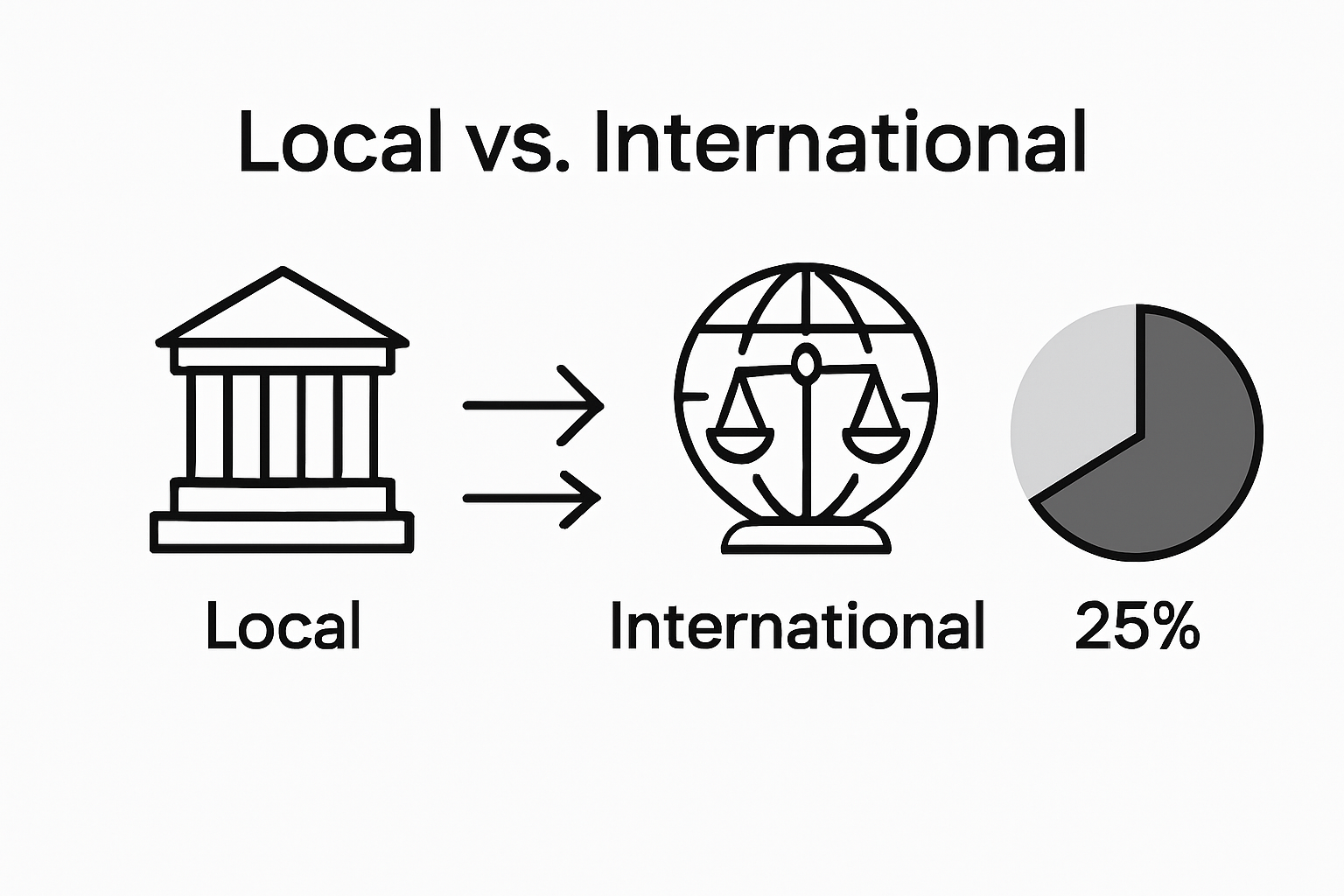
Cross-border regulatory cooperation illuminates the critical distinctions between local and international legal frameworks. Local legal solutions typically focus on specific national regulations, cultural contexts, and immediate jurisdictional concerns. In contrast, international legal solutions require comprehensive understanding of multiple regulatory environments, intricate diplomatic negotiations, and sophisticated mechanisms for reconciling divergent legal interpretations across different national systems.
Global crisis response and legal adaptability further demonstrates the fundamental differences between local and international legal approaches. While local legal systems often respond to challenges through established national protocols, international legal solutions demand more flexible, collaborative strategies that can rapidly adapt to unprecedented global developments. This requires not just legal expertise, but also advanced intercultural communication skills, technological proficiency, and the ability to synthesise complex legal principles from multiple jurisdictional perspectives.
Key comparative aspects of local versus international legal solutions include:
Navigating the complexities of international legal frameworks is a challenge no individual or business should face alone. This article highlights the critical pain points such as managing cross-border disputes, understanding comparative legal structures, and ensuring compliance with multifaceted regulatory environments. Without specialised international legal expertise, your organisation risks regulatory non-compliance, financial exposure, and strategic setbacks. Ali Legal understands these challenges and offers tailored solutions that combine swift communication, clear advice, and fixed fees to guide you confidently through global legal landscapes.

Explore how you can benefit from practical insights and dedicated support by visiting our Uncategorized Legal Resources. When international disputes or cross-border regulations demand clear strategic action, do not hesitate to reach out through our contact page for a direct consultation. Take control now and ensure your international legal matters are handled with precision and cultural intelligence by partnering with Ali Legal.
International legal expertise refers to the specialised knowledge required to navigate complex legal frameworks that exist across national boundaries. It involves understanding various legal systems, international treaties, and transnational regulations.
International legal expertise is crucial for businesses operating globally, as it helps them manage cross-border disputes, understand regulatory compliance, negotiate contracts, and protect their intellectual property in multiple jurisdictions.
Key areas requiring international legal expertise include international trade contracts, multinational corporate governance, data protection laws, and cross-border intellectual property rights protection.
Inadequate international legal support can lead to severe consequences for organisations, including regulatory non-compliance, increased vulnerability to legal disputes, financial exposure, and reputational damage in the global market.


