
Menu
Get Expert Legal Support Today

Most people need one of three things: a straightforward will, a will that creates a trust for specific beneficiaries, or a lifetime trust set up while you’re still alive. The right choice depends on who you’re providing for and what you’re protecting. The most common trusts are bare, discretionary, and interest-in-possession, each suited to different family circumstances, from minor children to blended households.
A single will is the standard document most adults need. It names your executors, sets out your beneficiaries, appoints guardians for children under 18, and covers what happens if a beneficiary dies before you. Gov recommends professional advice once your estate involves overseas property, a business, or anyone who might contest the will.
Mirror wills are near-identical wills made by two people, usually spouses or partners, each leaving their estate to the other and then to the same beneficiaries. They’re not legally binding on each other, so either party can change theirs after the first death, which surprises many couples who assumed the arrangement was fixed. Mutual wills solve that problem by including a binding agreement not to change the terms after one partner dies, though enforcing that agreement later can still mean a legal dispute. Joint wills, a single document for two people, are rarer today because they create real complications during probate and most solicitors steer clients toward mirror wills instead.
A trust will (or will containing a testamentary trust) doesn’t just distribute assets. It sets conditions on how and when beneficiaries receive them. This matters most for second marriages, where you might want your spouse to have income from the estate for life while the capital ultimately passes to your children, or for young beneficiaries who shouldn’t inherit a lump sum at 18.
Beyond these, a few other documents come up regularly:
Once you’ve decided a will needs a trust, or that a lifetime trust makes more sense, the next question is which structure fits. GOV.UK groups the main trust types by how much control beneficiaries have over the assets and how much discretion trustees hold.
Bare trusts give the beneficiary an absolute right to both capital and income once they turn 18 in England and Wales. Trustees hold the assets until then but have no say over how they’re eventually used. These suit simple gifts, a grandparent putting money aside for a grandchild, for example, where there’s no need for ongoing control.
Interest-in-possession trusts split the benefit: a life tenant receives income from the trust for life, or for a fixed period, while the capital passes to other beneficiaries later. This structure is common in second-marriage situations, where a surviving spouse gets the income from investments or a rental property, and the underlying capital eventually goes to children from an earlier relationship.
Discretionary trusts hand trustees complete control over who receives income or capital, and when. Nobody has an automatic entitlement. This flexibility makes discretionary trusts the go-to choice for blended families, where circumstances might change significantly over the years, or for protecting a beneficiary who isn’t good with money. Settlors usually leave a letter of wishes guiding trustees informally, without making it legally binding.
A handful of statutory and protective trusts serve narrower purposes:
Consider a widow with two stepchildren and two biological children. A discretionary trust lets trustees weigh each person’s circumstances year by year rather than locking in fixed shares that might no longer make sense a decade later. Compare that with a young couple leaving everything to children who are currently 8 and 11: an 18 to 25 trust, or a simple bare trust with staged access, addresses the real risk of handing over a large sum to a barely-adult beneficiary. Attwaters Solicitors’ comparison of these structures makes the same point: the right trust depends entirely on how much control you want beneficiaries to have, not on which sounds most sophisticated.
A will trust, also called a testamentary trust, only comes into existence when you die. It sits dormant inside your will until then. A lifetime trust, by contrast, takes effect the moment you create it, which means assets placed into it are typically outside your estate for probate purposes straight away.
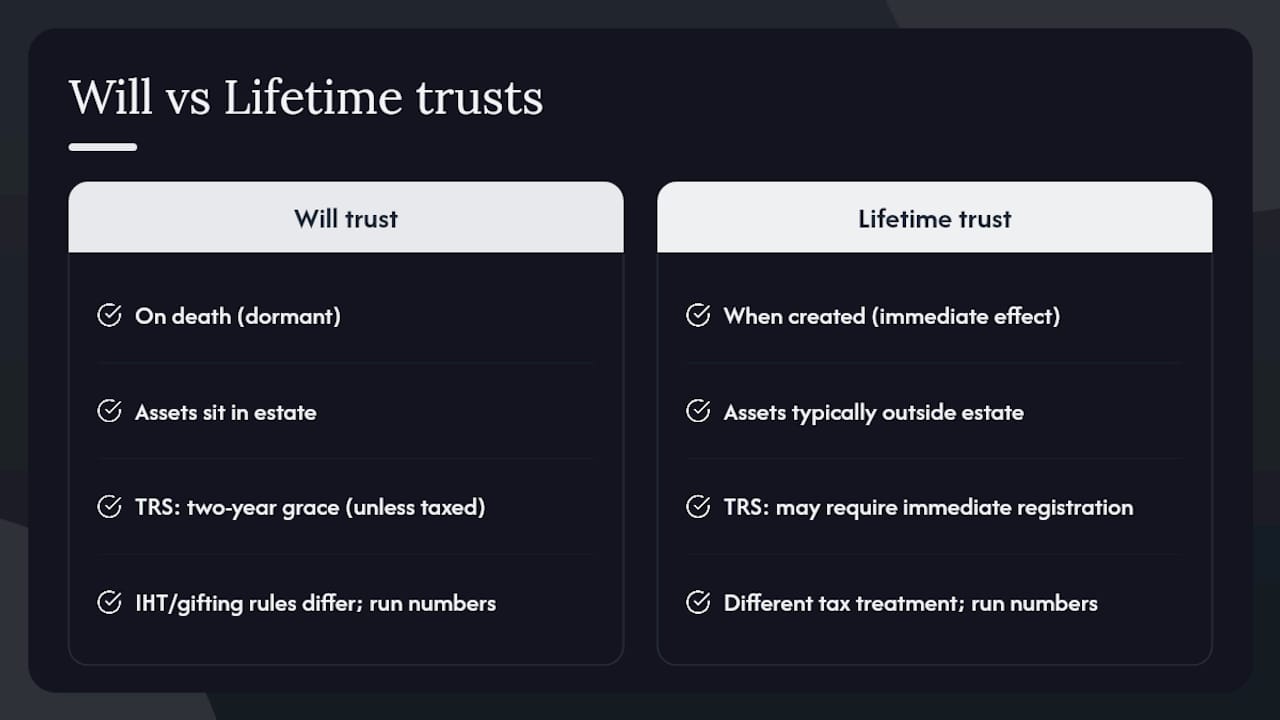
That timing difference drives most of the practical distinctions. Which?'s comparison of will trusts and lifetime trusts notes that lifetime trusts can sidestep some of the probate delay affecting will trusts, since the assets never sit in the estate awaiting a grant of probate.
Registration rules also diverge. Trusts created by a will generally get a two-year grace period on the Trust Registration Service before they must be registered, unless the trust picks up a UK tax liability sooner, in which case registration is required immediately. Tax treatment differs too, particularly around inheritance tax and lifetime gifting rules, so this is rarely a decision to make without running the numbers first.
Trustees are the legal owners of trust assets, but they hold them for someone else’s benefit, not their own. The Law Society’s guidance on trusts is blunt about the scope of that duty: trustees must follow the settlor’s wishes, manage the assets properly, and deal with any tax due.
In practice, that breaks down into a handful of recurring tasks:
Pro Tip: Set a calendar reminder for the two-year TRS deadline the day probate is granted. Trustees who wait until the deadline is looming often discover the required information, like full beneficiary details, takes longer to gather than expected.
The most common pitfall isn’t dishonesty, it’s simply underestimating the admin. Trustees often assume a trust “runs itself” once set up, then miss a registration trigger or fail to keep records tidy enough to satisfy HMRC on request.
Start by mapping your circumstances against the structures already covered, then narrow down using these steps:
Costs and timelines vary with complexity. A straightforward will can often be drafted quickly for a fixed fee, while a will containing multiple trusts, or a lifetime trust alongside it, takes longer and usually reflects that in the price.
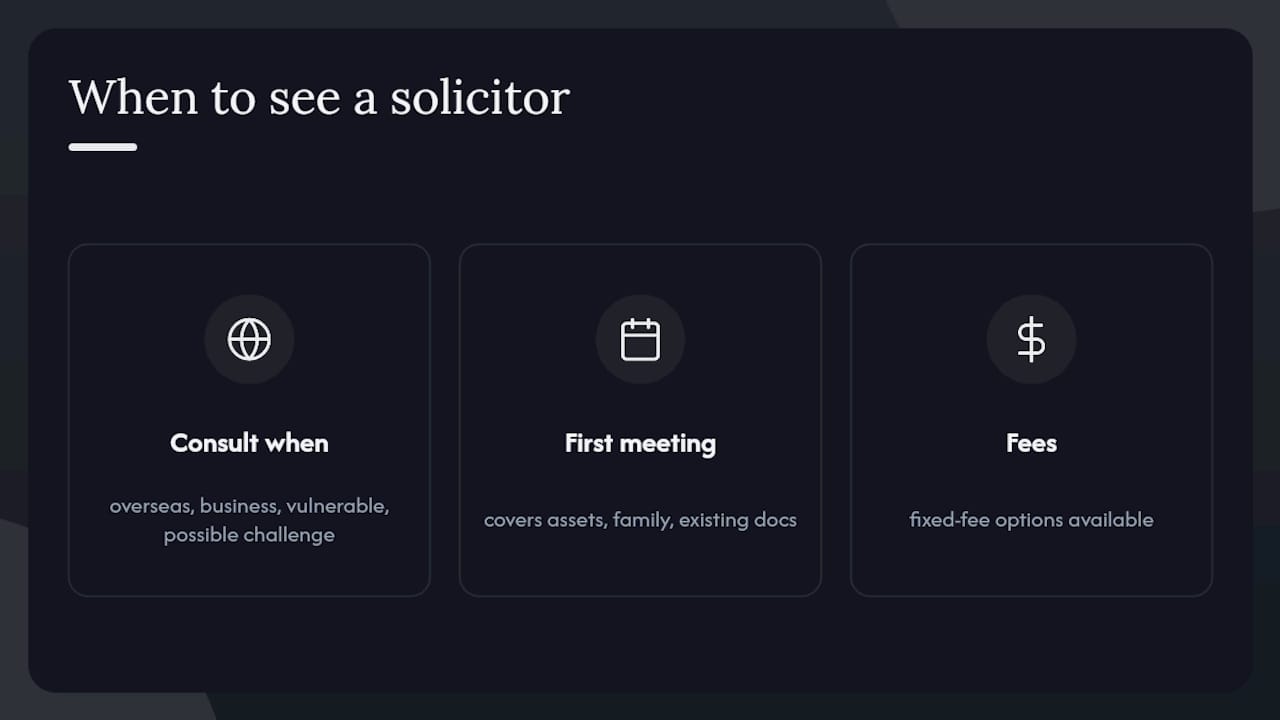
Overseas assets, a business interest, a vulnerable beneficiary, or any hint that someone might challenge your will are the clearest signals to get professional advice rather than a DIY template. Ali Legal Ltd’s wills, trusts and probate team, working alongside Panagiotis, advises on exactly these situations. A first appointment typically covers your assets, family circumstances, and existing documents, and fixed-fee options are available so costs are agreed upfront.
Most disputes trace back to unclear intentions, not the wrong trust structure. Protecting vulnerable beneficiaries and keeping capital intact for the people you actually meant to benefit matters more than picking the most sophisticated-sounding option. A well-drafted bare trust beats a poorly-managed discretionary one every time. Paperwork clarity, in the deed, the letter of wishes, the tax filings, is what prevents family disputes years later, and it’s worth getting tailored advice before you commit to a structure.
— Panagiotis
Ali Legal Ltd is the practical alternative to piecing together templates and guesswork: fixed-fee wills, testamentary trusts, lifetime trusts, and probate support, all handled with the same fixed-fee transparency the firm applies across its work.

Whether you need a simple will drafted quickly or a discretionary trust structured around a blended family, the team can scope the work and quote a fixed fee before anything is signed. Bring details of your assets, a list of intended beneficiaries, and any existing will or trust paperwork to your first appointment, and you’ll leave with a clear plan rather than more questions. Explore the full wills, trusts and probate service or get in touch directly through Ali Legal Ltd’s contact page to book an initial consultation.
For official detail beyond this guide, GOV.UK’s trust taxation pages and the Law Society’s trust explainer are reliable starting points. Ali Legal Ltd’s own guide to trusts in wills and this overview of trusts in legacy planning add further practical context.
This article is general information, not a substitute for advice from a qualified lawyer. Consult a qualified legal professional about your own circumstances before acting on anything here.


