
Menu
Get Expert Legal Support Today

In-house legal counsel is a qualified solicitor or barrister employed directly by a company, rather than a law firm, to give legal advice and manage risk for that single employer. The role has moved well beyond drafting contracts and chasing signatures: today’s in-house lawyer sits close to the board, shapes commercial strategy, and still carries the same professional duties to the public interest that any solicitor owes, regardless of who signs their salary.
In-house counsel’s work splits roughly into two streams: reactive legal support and proactive business advice. On any given week, that might mean reviewing a supplier contract on Monday, advising HR on a disciplinary process on Tuesday, and briefing the finance director on a regulatory change by Friday.
The core duties tend to include:
Scope shifts sharply with company size. A sole in-house lawyer at a fifty-person business will touch everything from a lease renewal to a data breach in the same afternoon. At a listed company, the general counsel might run a team of specialists covering employment, competition, and disputes separately, with the generalist work pushed down to junior lawyers or paralegals. Around a quarter of practising solicitors in England and Wales now work in-house rather than in private practice, a shift that has changed how firms and clients relate to each other.
Being paid by the company you advise creates a structural tension that private practice lawyers rarely face in the same way. The regulator’s answer is blunt: your duties as a solicitor come before your duties as an employee.
The SRA Standards and Regulations require in-house solicitors to comply with the same mandatory principles as those in private practice, including acting with independence and in the public interest, even when that advice is unwelcome to the person paying the invoice. The Bar Standards Board applies a comparable framework to barristers working in-house, though the BSB’s guidance sets narrower limits on scope of practice than solicitors face, and flags particular care for barristers who sit on boards or in management, where mixing legal and commercial roles can blur the line the profession relies on.
Practical safeguards make the difference between a title and a genuine independent function:
Pro Tip: If you’re moving in-house, ask at interview stage who legal reports to and whether that person has ever overridden legal advice. The answer tells you more about the job than the salary line.
The Law Society frames the in-house solicitor as a critical friend to the organisation, someone trusted enough to be in the room but independent enough to say no. That framing only holds if the board actively protects it.
Ten years ago, plenty of in-house lawyers were called in after a decision had already been made, to paper over the risk retrospectively. That model is fading. Boards increasingly expect legal to be present when the decision is still being shaped, not just when it needs signing off.
Several forces are driving that shift:
The Law Society’s own ethics framework makes the point directly: in-house solicitors are increasingly expected to sit in decision-making forums as strategic partners, not simply respond to questions after the fact. Performance measurement has followed suit, with many legal teams now assessed on deal velocity, dispute avoidance, and cost saved against external counsel benchmarks, alongside the traditional metric of matters closed without incident.
Job titles in-house are inconsistent across sectors, which causes genuine confusion for anyone comparing roles between companies. A few conventions do hold reasonably firm.
General counsel (GC) typically sits as the most senior lawyer in the organisation, often reporting directly to the chief executive and sometimes holding a seat on the executive committee. Chief legal officer (CLO) is functionally similar but signals a broader remit that might include compliance, government affairs, or company secretarial functions folded into one role. Legal director and head of legal usually sit a tier below, managing day-to-day legal operations and a small team, and reporting up to the GC or directly to the board in smaller companies without a GC at all.
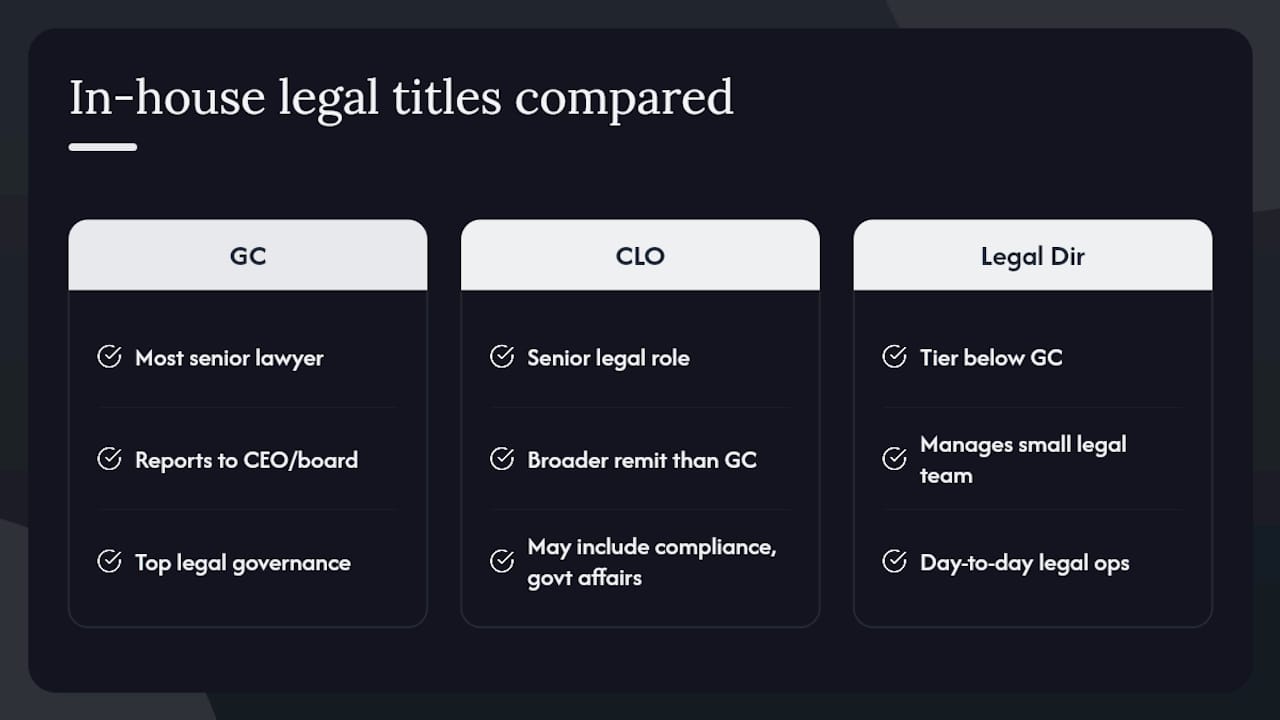
Board access matters for reasons beyond ego. A GC who reports into the CFO, rather than directly to the chief executive or board, can find legal risk framed purely as a cost line rather than a governance issue. The SRA’s guidance for governing boards makes clear that organisations employing in-house solicitors must give them clear reporting lines and enough support to meet their professional duties without fear of being sidelined for inconvenient advice.
In small teams, work usually splits by necessity rather than design: one generalist handles everything routine, while genuinely specialist matters (a complex cross-border dispute, a regulatory investigation, a large acquisition) get pushed to external counsel with the in-house lawyer managing the relationship and translating advice for the business.
Technical grounding still matters. Contract drafting, negotiation, and a working grasp of data protection law are baseline expectations, and most in-house roles now expect at least a passing familiarity with M&A structures, even for lawyers who will never lead a deal themselves. But the skill that separates a good in-house lawyer from a merely competent one is translation: turning a legal risk into three sentences a sales director will actually act on.
Soft skills carry disproportionate weight in-house compared with private practice. Influencing people who don’t have to listen to you, reading commercial priorities correctly, and communicating risk without either alarming the board or understating it, all matter more day to day than knowing an obscure point of contract law.
The market signal: Robert Half’s 2026 UK Legal, Risk and Compliance Salary Guide reports that hybrid working has become the norm across in-house legal teams, alongside strong demand for contract management, data privacy, and regulatory expertise. Retention data in the same guide suggests flexibility now ranks alongside pay as a factor keeping senior lawyers from moving on.
Salary bands vary enormously by sector and seniority, and any single figure quoted without that context is close to meaningless, so treat headline numbers in recruitment marketing with caution and check them against a named guide before relying on them.
Even a well-staffed in-house team cannot handle everything alone, and knowing when to instruct external counsel is itself a skill. Complex litigation, specialist regulatory investigations, and jurisdictions where the company has no local expertise are the classic triggers for going outside. Routine contract work, employment queries, and anything the in-house team has handled a dozen times before generally stays put.
Managing that external relationship well means more than picking a familiar firm name. The SRA notes that instructing and overseeing external counsel is a core part of the in-house function, not an occasional add-on.
Pro Tip: Keep a simple spreadsheet logging matter type, firm, fee arrangement, and outcome. After a year, it tells you exactly which firms earn their fees and which don’t.
Hiring managers look for three things above all else: relevant post-qualification experience, exposure to the sector the company operates in, and evidence you can operate commercially, not just legally.
For a fuller breakdown of typical legal counsel duties in UK businesses, it’s worth reading how responsibilities differ by sector before applying.
Corporate governance runs on documentation and accountability, and in-house counsel usually sits at the centre of both. Board minutes, delegated authority matrices, shareholder resolutions, and statutory filings all typically pass through the legal team before they become binding, which puts in-house counsel in a position to catch governance failures before they become expensive ones.

Decision-making at board level increasingly treats legal input as a standing agenda item rather than a final check. A well-run legal function flags regulatory exposure, contractual risk, and litigation history before a strategic decision is taken, not after the fact when options have narrowed. That means in-house counsel often draft board papers jointly with finance or strategy teams, rather than reviewing them once they’re already finished.
The tension is that legal counsel advising on governance must also operate within that same governance structure, reporting to the people whose decisions they’re sometimes required to challenge. The Law Society’s ethics framework addresses this directly, describing good practice as identifying the client clearly (the company as a legal entity, not any individual director) and keeping advice pitched at the right governance level so it reaches the people who actually need to act on it. In practice, that often means insisting a concern goes to the full board rather than being absorbed and quietly dropped by a single executive.
Regulatory compliance work has grown from a niche specialism into a core part of most in-house roles, driven by the sheer volume of sector-specific rules companies now face, from financial conduct regulation to environmental and product safety standards.
In-house counsel typically own the compliance calendar: tracking filing deadlines, monitoring changes to relevant regulation, and translating new rules into practical guidance for operational teams who have no legal training and no time to read a regulator’s consultation paper themselves. That translation function is often undervalued, but it’s frequently the difference between a rule being followed correctly and a rule being technically read but practically ignored.
When something goes wrong, whether a data breach, a health and safety incident, or a missed filing, in-house counsel usually lead the initial response: assessing whether the issue needs reporting to a regulator, managing communications with that regulator, and coordinating any internal investigation. Getting that sequencing right matters. Reporting too early without proper facts can mislead a regulator; reporting too late can turn a manageable issue into an enforcement action.
Smaller companies without a dedicated compliance function often lean on legal to fill that gap entirely, which stretches the in-house lawyer’s remit well beyond drafting and negotiation into something closer to a compliance officer role, frequently without additional resource to match.
Legal risk management in-house works best as a continuous process rather than a one-off exercise triggered only when something breaks. The most effective in-house lawyers build a rolling risk register covering contractual exposure, litigation history, regulatory change, and operational vulnerabilities, then revisit it quarterly rather than leaving it to gather dust after the first draft.
Mitigation typically takes one of a few forms. Contractual protections, such as indemnities, liability caps, and termination rights, get negotiated upfront rather than relied on after a dispute starts. Insurance cover gets checked against actual risk exposure rather than assumed adequate because a policy exists. And internal training, particularly for sales and procurement teams who sign agreements without legal sign-off, closes the gap between what legal drafts and what the business actually does day to day.
The harder judgement call is deciding which risks are worth escalating and which can be absorbed. Not every contractual gap needs a board discussion, and treating every risk as equally urgent trains stakeholders to tune out legal’s warnings altogether. Effective in-house counsel calibrate that signal carefully, reserving the loudest alarm for the risks that genuinely warrant it.
Conflicts of interest look different in-house than they do in private practice, where a conflicts check usually happens before a firm even takes on a new client. In-house counsel work for one client permanently, but that single client contains multiple internal interests that can pull in different directions: a subsidiary’s interests against the parent company’s, one department’s priorities against another’s, or an individual director’s personal exposure against the company’s.
The clearest example is when a director faces personal liability for a decision the company is also defending. In-house counsel acting for the company cannot simultaneously advise that director in a personal capacity, since the two interests can diverge sharply once liability is contested. The Law Society’s guidance is explicit that the client is the organisation itself, not any individual within it, which is the anchor point for resolving most of these situations.
Practical management usually means directing the individual to independent external advice at the company’s expense, documenting clearly who the legal advice was given to and on what basis, and being willing to say plainly when a matter has moved beyond what in-house counsel can properly advise on. Group structures add another layer: a lawyer employed by a parent company advising a subsidiary needs clarity on which entity is actually the client before the advice is even given, not after a dispute forces the question.
Data protection has become one of the fastest-growing areas of in-house legal work, and in most companies without a dedicated data protection officer, that responsibility lands on legal by default. It covers everything from reviewing data processing agreements with suppliers to advising on international data transfers and responding when a breach actually happens.
Cybersecurity incidents move fast, and in-house counsel are usually the ones deciding, often within hours, whether an incident triggers a regulatory notification obligation and what needs to be communicated to affected individuals. Getting the legal assessment wrong in either direction, over-reporting or under-reporting, carries real consequences, which makes this one of the higher-pressure parts of the modern role.
Beyond incident response, in-house counsel increasingly sit on the buying decision for data-related technology and vendor contracts, since a poorly negotiated data processing clause with a third-party supplier can create liability exposure long before any breach occurs. Robert Half’s 2026 salary guide lists data privacy expertise among the most sought-after skills for in-house hires, a demand driven directly by how much of this work now sits with legal rather than IT.
The hardest negotiations an in-house lawyer handles are frequently internal, not external. Persuading a sales director to walk away from a lucrative deal because of an unacceptable liability clause takes more skill than negotiating the clause itself, because the audience has no legal training and every commercial incentive to disagree.
Effective in-house counsel learn to frame legal risk in language the business actually uses: revenue impact, timeline delay, reputational exposure, rather than statute references and case citations that mean little outside a law degree. That reframing is often what separates a lawyer whose advice gets followed from one whose emails get skimmed and ignored.
Internal stakeholder management also means knowing when to push and when to let a decision go. Not every piece of advice needs to be a hill to die on, and in-house lawyers who treat every point as equally critical tend to lose credibility exactly when they need it most, on the issue that genuinely matters. Building that judgement usually takes real time in the seat, watching which battles were worth fighting and which weren’t.
Ali Legal Ltd works alongside in-house teams regularly, supporting corporate transactions, cross-border disputes, and fixed-fee document review when internal capacity runs short during a busy quarter. What stands out from that vantage point is how often in-house counsel are stretched thin across compliance, governance, and commercial advice simultaneously, with little slack for the specialist matters that genuinely need outside expertise. A well-run external relationship, built on clear scope and fixed fees rather than open-ended hourly billing, tends to free in-house teams to focus on the strategic work only they can do. Businesses weighing up support for corporate and M&A matters or cross-border complexity often find that the right external partner amplifies an in-house team’s judgement rather than replacing it, working alongside them for the long-term legal relationships that keep both cost and risk under control.
Most commentary on in-house counsel focuses on the strategic upside: sitting closer to the board, shaping decisions earlier, escaping the billable hour. That’s real, but it undersells the harder truth, which is that in-house lawyers carry the same professional duties as any solicitor while facing daily pressure from the one relationship where independence is genuinely difficult to hold: the employer who signs their pay cheque.
The regulatory frameworks from the SRA and BSB assume that independence, but they can’t manufacture it inside an organisation that hasn’t built the reporting structure to protect it. That’s the gap I’d flag to anyone considering the move in-house or sitting on a board that employs one: independence on paper means nothing if the lawyer’s line manager is also the person whose decision they’re meant to challenge. The good news is that this is a structural problem with a structural fix. Boards that build in clear escalation routes and genuinely welcome unwelcome advice get lawyers who catch problems early. Boards that don’t get lawyers who learn, quickly, which risks are worth mentioning and which aren’t worth the friction, and that’s a far more expensive lesson to teach a legal team than most executives realise.
— Panagiotis


