
Menu
Get Expert Legal Support Today

TL;DR:
- Most organizations recognize the importance of succession planning but often fail to implement it effectively, making them vulnerable to leadership gaps. Effective succession planning involves continuous development of internal talent across all critical roles, aligned with business strategy and overseen by the board to ensure organizational resilience. Regular review, diversity, strategic alignment, and legal safeguards are essential to building a sustainable leadership pipeline that supports growth and stability.
Most boards say CEO succession planning is critical, yet many executives have not fully implemented plans or are actively working on them. That gap between intention and action is precisely where businesses become vulnerable. Leadership transitions are inevitable, whether through retirement, resignation, illness, or rapid growth. The organisations that navigate them well are not lucky. They are prepared. This article cuts through the confusion surrounding succession planning and gives you a clear, practical framework for building leadership continuity that protects your business, your people, and your stakeholders.
| Point | Details |
|---|---|
| Succession planning defined | It is a structured process for developing future leaders to fill key business roles when needed. |
| Strategic business value | Effective succession planning reduces disruption and protects long-term growth. |
| Step-by-step framework | Follow practical phases: identify roles, assess talent and gaps, then build targeted development plans. |
| Avoid common pitfalls | Update succession plans regularly and balance structured processes with people-centred judgement. |
Succession planning is widely misunderstood. Many business owners treat it as a list of names kept in a drawer or a conversation saved for when someone announces their departure. Both approaches miss the point entirely.
“Succession planning is the process of identifying and developing internal talent to fill critical roles when they become vacant.” — University of Washington’s Professional and Organisational Development
That definition carries real weight. Notice it says developing talent, not just identifying it. Succession planning is a continuous, methodical investment in people, not a one-off administrative exercise.
Common misconceptions are worth addressing directly:
A truly client-centric succession planning approach also considers how leadership transitions affect the people your organisation serves. Clients and customers notice when trusted contacts disappear without a smooth handover. Succession planning protects those relationships too.
Now that the concept is clear, it is vital to understand why succession planning is a critical strategy rather than an administrative task. The business case is compelling and the risks of inaction are significant.
Reduces business disruption. When a key person leaves without a ready successor, organisations typically lose momentum. Teams look for direction. Projects stall. Clients grow nervous. A well-prepared succession pipeline keeps operations steady even when change is unavoidable.
Builds bench strength. A proactive leadership pipeline rather than a one-time event is what separates resilient businesses from fragile ones. Building bench strength means having two or three credible candidates ready for each critical role, not scrambling to hire externally under pressure.
Supports long-term growth. Organisations that invest in internal talent signal to employees that careers can grow within the company. That reduces turnover, improves morale, and keeps institutional knowledge inside the business.
| Business impact | Without succession planning | With succession planning |
|---|---|---|
| Leadership transition speed | Months to years | Weeks to months |
| Talent retention during change | Often drops sharply | Typically remains stable |
| Client/stakeholder confidence | Frequently disrupted | Well-maintained |
| External hiring costs | High and unpredictable | Reduced significantly |
| Organisational knowledge loss | Substantial | Minimised through development |
Statistic to note: Research consistently shows that internal successors outperform external hires in the first two years of a new role, primarily because they already understand the culture, the people, and the strategy.
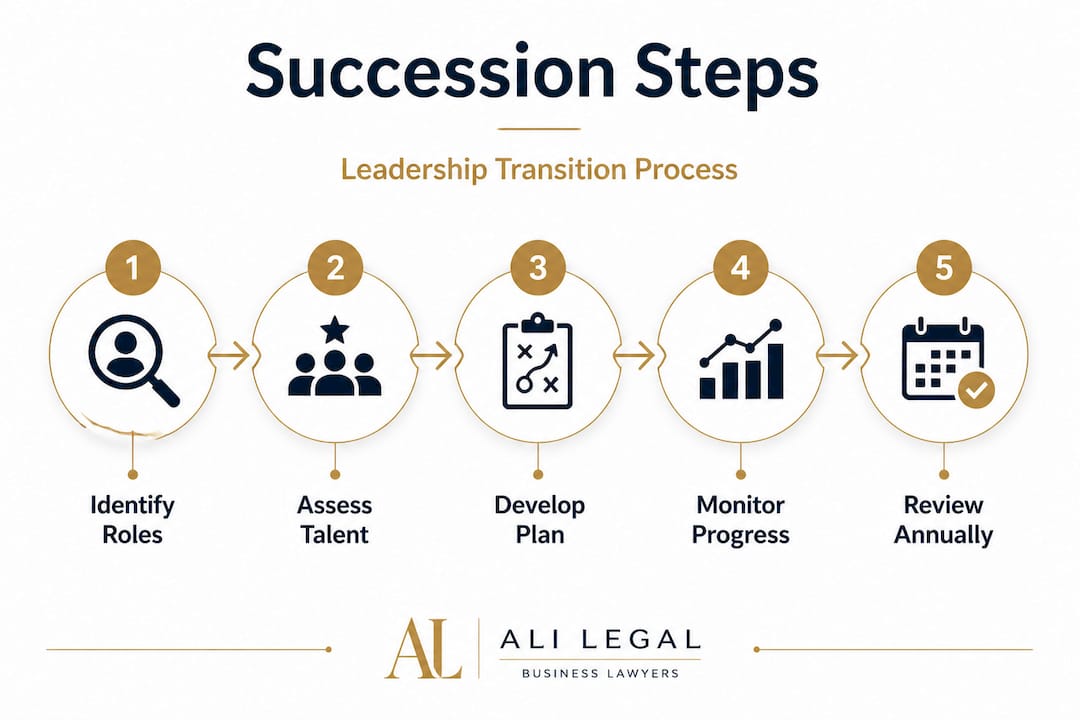
A practical methodology commonly starts with identifying critical roles and then assessing talent readiness and development needs. That structured approach is what transforms succession planning from a vague aspiration into something measurable and actionable.
Pro Tip: Do not wait for a crisis to trigger your succession planning. Treat it the same way you treat your financial planning: a regular, non-negotiable business discipline. Quarterly check-ins are far more effective than annual fire drills.
Strong corporate governance and succession oversight reinforces the credibility of your process. When boards and leadership teams treat succession planning as a governance priority rather than an HR task, the whole organisation takes it more seriously.
Understanding the value of succession planning, business leaders need a clear blueprint for moving from theory to practice. Here is a straightforward framework you can apply regardless of your organisation’s size.
Identify your critical roles. Start with the positions that would cause the most disruption if they became vacant tomorrow. These are not always the most senior roles. Think about the roles that carry unique client relationships, technical expertise, or institutional memory.
Define the competencies required. For each critical role, map out what skills, behaviours, and experience a successor would need. Do not just describe the current job holder. Think about what the role will require in three to five years as the business evolves.
Assess your current talent pool. Evaluate your existing team honestly against those competencies. Tools like nine-box talent grids (which plot performance against potential) can help structure this assessment without letting bias dominate the conversation.
Identify readiness gaps. Once you know where your people stand, you can see clearly where the gaps lie. Some candidates may be ready within twelve months with targeted development. Others may need two to three years. Some gaps may require external recruitment.
Build individual development plans. Pair each high-potential candidate with a tailored plan: mentoring, stretch assignments, cross-functional exposure, formal training, or external coaching. Development must be deliberate and monitored.
Review and update regularly. A practical methodology includes ongoing assessment of talent readiness against future requirements. Circumstances change. People move, retire, or surprise you. Your plan must move with them.
| Approach | Best suited for | Key advantage | Main risk |
|---|---|---|---|
| Phased long-term development | Planned retirements and known transitions | Deep preparation and alignment | Slow to respond to sudden changes |
| Emergency succession protocol | Unexpected departures | Speed and continuity | May lack depth without preparation |
| Hybrid ongoing pipeline | Most businesses | Flexibility and resilience | Requires consistent management attention |
For organisations with international operations or complex structures, succession strategy in global firms introduces additional layers of complexity around jurisdiction, governance, and culture. Getting external input at that stage is wise.

Pro Tip: Use a corporate succession planning checklist to ensure your process covers legal, governance, and operational requirements. Missing a single step in a cross-border succession can have significant consequences.
Even with a process in place, pitfalls abound. Understanding these helps leaders design more resilient succession plans.
The most common mistake is building a plan and then leaving it untouched. Business strategies change, roles evolve, and people develop in unexpected directions. A succession plan written in 2022 may be largely irrelevant by 2026 if it has not been revisited.
Succession planning must handle edge cases like unexpected departures and must stay current as business needs change. That means your plan needs two tracks: a long-term development track and a short-term emergency protocol.
Other frequent pitfalls include:
“Where traditional succession planning falls short is in its tendency to focus on replacement rather than readiness, overlooking the evolving demands of roles and the genuine potential of individuals.”
Modern approaches bring greater emphasis on psychological safety in assessment conversations, stronger links between succession and business strategy, and the use of external benchmarking to calibrate internal assessments honestly. Understanding your legal duties in succession also matters, particularly when governance obligations, shareholder agreements, or employment contracts are involved.
The final piece is ensuring strong oversight. Governance structures, especially boards of directors, fundamentally shape succession outcomes.
Boards and governance groups should treat CEO succession as an ongoing process with appropriate structure, timelines, and sufficient preparation of internal candidates. That means the board is not simply informed of a succession plan. It actively participates in shaping and monitoring it.
| Governance benchmark | Recommended practice |
|---|---|
| Board review frequency | At least twice per year for CEO succession |
| Formal succession policy | Documented and board-approved |
| Emergency successor identified | At all times for the CEO role |
| Readiness horizon for internal candidates | Two to three years of active preparation |
| HR and board alignment meetings | Quarterly minimum |
Key principles for effective board oversight include:
Strong board oversight in succession is not just about internal continuity. It reassures investors, lenders, and clients that the organisation can withstand change without losing strategic direction.
All of these frameworks and benchmarks point to one uncomfortable truth: succession planning is rarely failed at the technical level. It is failed at the human level.
In our experience working with business owners and executives, the most common reason succession plans fail is that they are treated as documents rather than dialogues. Leaders write a plan, feel satisfied, and move on. The plan then sits in a folder while the business, the people, and the environment all change around it.
The deeper issue is that many leaders conflate replacement with continuity. They are looking for someone to fill a seat rather than someone to carry forward a purpose. That distinction matters enormously. A business built around a charismatic founder does not need a replica of that founder. It needs a leader who understands the founding values and can evolve them for a new chapter.
We also see a consistent pattern of succession planning being treated as separate from business strategy. The two are inseparable. If your business plans to expand internationally in the next five years, your succession pipeline needs leaders who can operate across borders, manage diverse teams, and navigate different regulatory environments. A plan that ignores your strategic direction is not a succession plan. It is a list of names.
The most resilient organisations we work with treat succession planning as a form of institutional self-awareness. They know who they are, where they are going, and which human capabilities they need to get there. They build client trust through succession by ensuring that the relationships, values, and service standards clients depend on survive every leadership change.
Finally, stress-test your plan. Run scenarios. What happens if your top two candidates both leave? What if a critical role needs to be filled in four weeks rather than four months? Plans that have never been tested are plans that will fail under pressure.
Organisations that get succession planning right rarely do it alone. Legal expertise can safeguard your process and your future.
Succession planning touches employment law, shareholder agreements, corporate governance, and sometimes international structures. A poorly drafted plan can create disputes, challenge ownership arrangements, or leave key roles legally unprotected during transitions. Ali Legal provides strategic support across commercial litigation and leadership disputes as well as building board trust and governance frameworks. Whether you are formalising your first succession plan or restructuring an existing one for a growing business, our team offers clear, fixed-fee advice that aligns your succession strategy with your legal and organisational obligations.
Begin by identifying critical roles and mapping out internal talent against future needs, then create action plans to close the gaps. A practical methodology starts with role identification and talent readiness assessment before anything else.
Review succession plans at least annually and after any major business or leadership change. Because succession planning must handle unexpected departures, building in a formal mid-year review is also strongly advisable.
Boards, CEOs, and executive leadership are typically responsible for oversight, but HR leads the day-to-day planning. Effective governance means boards treat succession as a standing agenda item rather than an occasional conversation.
Key leadership or knowledge gaps can lead to costly disruption and lost stakeholder trust if transitions are not anticipated. A proactive leadership pipeline prevents the reactive, expensive hiring that typically follows unplanned departures.


