
Menu
Get Expert Legal Support Today

If you’re starting the process, find your original marriage certificate first, then decide whether you’re applying alone or jointly with your spouse. From there, the sequence runs: get advice, confirm eligibility, apply through GOV.UK, and wait at least 20 weeks for a conditional order, then 6 more weeks for the final order. A court fee applies, and money and children matters run on entirely separate tracks.
You don’t have to work this out alone, and trying to can cost you more than it saves. Relate offers counselling if the marriage itself needs exploring before you commit to ending it. Citizens Advice can talk you through your options for free. Mediators help separated couples agree on money and children without a solicitor’s hourly rate attached to every conversation.
If there’s any risk to your safety, skip mediation and speak to a solicitor immediately.
Pro Tip: Book a Mediation Information and Assessment Meeting (MIAM) even if you think mediation won’t work. It’s often required before you can apply to court for a financial order, so getting it done early saves a delay later.
You need to have been married for at least one year before you can apply, and the marriage must have irretrievably broken down under the no-fault system introduced in 2022. There’s no need to prove blame. If you’re under a year into the marriage, annulment or judicial separation are your only routes for now.
Before you touch the application form, gather:
Sole applications move faster when your spouse is unlikely to engage. Joint applications tend to feel less adversarial and can smooth the path if you’re both already broadly in agreement. Once you’ve picked, that choice shapes how service and response work later in the process, so it’s worth thinking through rather than defaulting to whichever feels easier now.
Here’s the part people consistently misunderstand: a divorce ends the marriage. It does nothing to sort out the house, the pension, or who has the children on weekends. Those are separate legal processes, and skipping them is the single most common reason people end up back in court years later, unravelling a “clean” divorce that left loose ends.
You have three practical routes:
One industry analysis makes a point worth sitting with: the divorce fee only pays to end the marriage. The real cost and the real delay almost always come from how finances and children get resolved, and mediation followed by a consent order is typically the cheapest way to reach a clean finish.
Before you negotiate anything, pull together bank statements, pension valuations, mortgage deeds, and a recent property valuation. Without these, you’re negotiating blind. If there’s a risk your spouse might sell assets or remove children from the country, seek urgent court protection rather than waiting for the standard timeline to catch up.
Most applicants now go through the online divorce service, which is quicker and cheaper to correct if you make an error.
Prefer paper? Complete Form D8, attach a certified copy of your certificate, and post it to the regional divorce centre. Solicitors have their own portal for lodging applications on a client’s behalf, which is worth knowing if you’d rather not manage the paperwork yourself.
Once submitted, you’ll get a case number. For sole applications, the respondent then has 14 days to acknowledge the application, which is where delays often start if they’re avoiding contact.
You can’t apply for the conditional order until at least 20 weeks have passed since the court issued your application. That reflection period exists deliberately, giving both parties time to settle finances and children arrangements rather than rushing straight through to a legal ending.
Delays at this stage are almost always administrative rather than legal. A blurry or cropped photo of the marriage certificate, a missing signature, or a mismatched name spelling will bounce your application back and cost you weeks. Once the court is satisfied, it will notify you that the conditional order has been granted, confirming you’re eligible to move to the final stage.
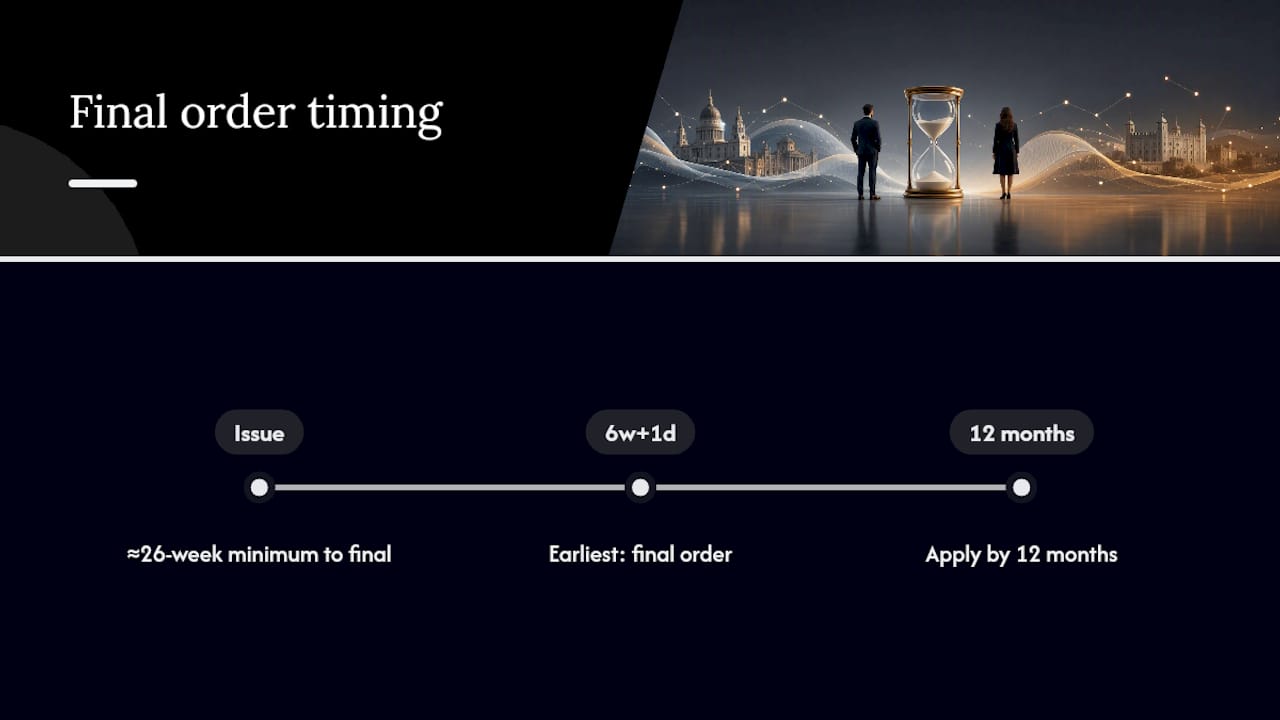
You can apply for the final order 6 weeks and 1 day after the conditional order, and you have up to 12 months to do so before needing to explain the delay to the court. The final order legally ends the marriage, which is exactly why many people deliberately hold off until a consent order covering finances is fully sealed. Once it’s final, update your will, notify pension providers and benefits agencies, and check any immigration or tax implications tied to your marital status.
As of 13 July 2026, the court fee for a divorce application in England and Wales is £628, whether you apply online or by post. Help with Fees can reduce or waive this if your income and savings fall below the threshold.
The EX50 fee schedule confirms these figures for July 2026. A straightforward divorce takes a minimum of around 26 weeks from issue to final order, longer if finances or children arrangements remain unresolved.
Pro Tip: When photographing your marriage certificate, use natural daylight and capture all four corners in one shot. HMCTS staff report this as one of the most common reasons applications get kicked back for correction.
I’d push most people to speak to a solicitor earlier than they think they need to, particularly where pensions, property abroad, or a partner who isn’t being straightforward are involved. A solicitor’s real value isn’t paperwork, it’s catching the financial claim you didn’t know you had before the final order closes the door on it. Many firms now offer fixed fees for consent order drafting, so cost needn’t be the barrier people assume. Before a first consultation, bring your certificate, a rough asset list, and a clear idea of what you actually want from the settlement.
— Panagiotis
Ali Legal Ltd works alongside the process described above rather than replacing it. Where DIY applications tend to stall is exactly where a solicitor earns their fee: drafting a consent order that actually holds up, negotiating a financial settlement without months of back and forth, or handling representation if court proceedings become unavoidable.

Legal firms often offer fixed-fee consultations for divorce and financial matters, so you know the cost before you commit rather than watching an hourly rate creep upward. Bring your marriage certificate, a summary of assets including any property, and details of any pension arrangements to your first meeting. If property forms part of your settlement, our guidance on property law for UK owners is a useful companion read before that conversation. Get in touch through our contact page to arrange a consultation and find out exactly where you stand.
This article is general information, not a substitute for advice from a qualified lawyer. Consult a qualified legal professional about your own circumstances before acting on anything here.
Locate your original marriage certificate and decide whether to apply alone or jointly, since both decisions shape everything that follows, including how the application is served and answered.
Broadly: seeking advice, confirming eligibility, applying, the respondent’s 14-day acknowledgement, the 20-week reflection period, the conditional order, and finally the final order at least 6 weeks and 1 day later.
Financial settlement runs separately from the divorce itself, through negotiation and a consent order, mediation, or a court application using Form A, and it’s rarely resolved automatically just because the marriage has ended.
Applying for the final order before finances are settled is the costliest error, since it can close off most financial claims once the marriage has legally ended.


