
Menu
Get Expert Legal Support Today

For most commercial agreements, the strongest option is a multi‑tier clause requiring negotiation, then mediation, then arbitration or court proceedings. This staged structure protects the relationship, narrows the real issues before anyone pays for a hearing, and keeps costs proportionate. The sample wording below covers the common scenarios contract drafters actually face, from a single arbitration clause to full escalation ladders.
Every clause below is a starting template, not finished drafting. Adapt the bracketed terms to your contract, jurisdiction and the parties’ appetite for delay.
Single arbitration clause (use when parties want a final, binding, confidential decision and no court involvement):
Multi-tier escalation clause (use when preserving the commercial relationship matters more than speed):
Mediation-only clause (use for ongoing supplier or partnership agreements where a binding outcome is not required):
Exclusive jurisdiction clause (use for simpler disputes, consumer‑facing terms, or where a regulator requires court oversight):
Interim relief carve‑out (add to any of the above so a party can still seek urgent protection):
Reviewing wording like this against your own risk profile is exactly where a lawyer earns their fee. For background on the mechanics of arbitration agreements and how they bind the parties, see what arbitration agreements mean for you.
Pro Tip: Never draft an escalation clause without a hard stop. If mediation has no fixed end date, one side can drag it out for months purely to delay the arbitration or litigation they know is coming.
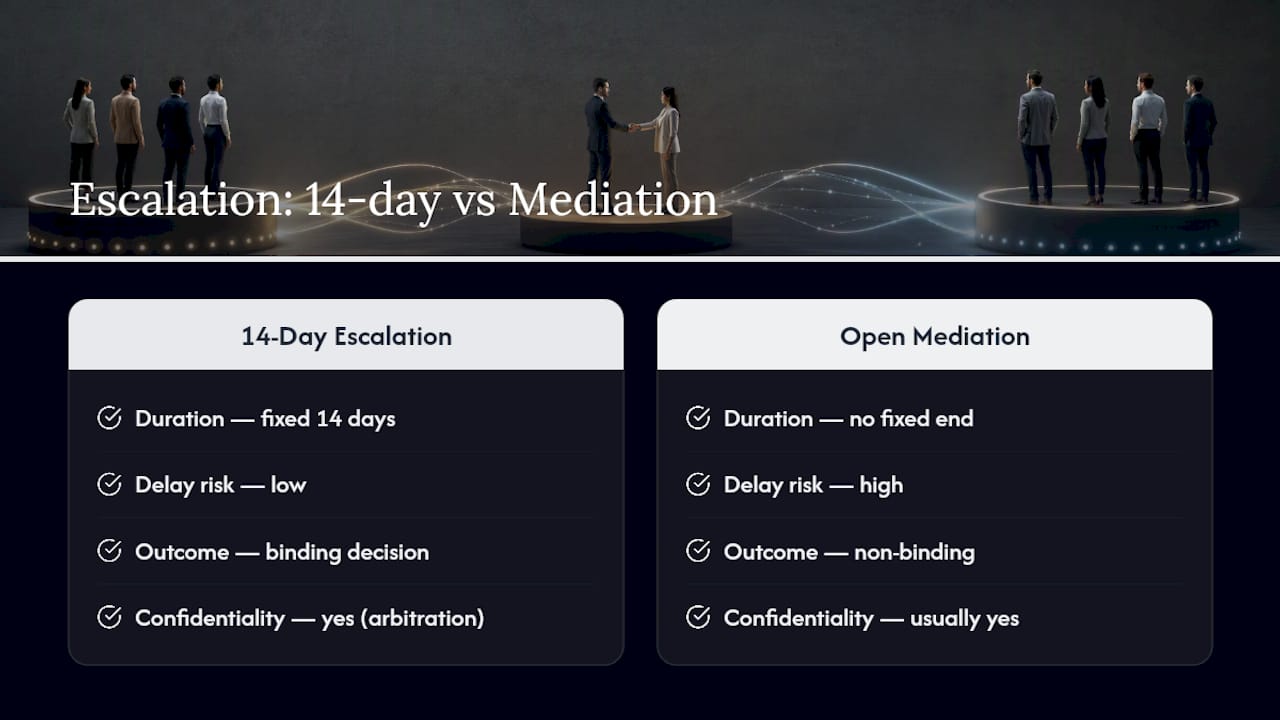
A clause that skips the mechanics invites argument about the mechanics themselves, which defeats the point of drafting one in the first place. Cover these elements every time:
A properly specified arbitration clause reduces the risk of a jurisdictional challenge later, because there is no ambiguity for either side to exploit over seat, rules or the arbitrator’s authority. Practical Law’s UK toolkits collate model wording practitioners rely on for exactly this level of detail.
English courts generally respect a properly drafted escalation clause and will stay proceedings brought in breach of it, but a vague “good faith negotiation” obligation on its own is weak. Courts are far more likely to enforce a negotiation obligation when it carries objective criteria, such as a fixed timeline or a named seniority of negotiators, rather than an open promise to “act reasonably.”
Common pitfalls that invite a procedural challenge include:
Wording that survives scrutiny usually reads something like “within 14 days of written notice, a director or equivalent senior officer of each party shall meet to attempt resolution,” rather than “the parties shall negotiate in good faith.” The former gives a court, or a tribunal, something concrete to test compliance against.
Before drafting anything, answer three questions: what outcome do the parties actually want, what features does the likely dispute have, and what form of enforcement will you need if you win? For a high-level overview of the differences and advantages, see arbitration vs litigation.
Our own primer on litigation, arbitration and mediation walks through this trade‑off in more depth if you want the fuller comparison before you draft.
Years of reviewing commercial contracts turn up the same avoidable mistakes repeatedly. Three shortcuts fix most of them:
Paste this into your own review workflow: seat named, governing law named, rules named, arbitrator count fixed, language fixed, escalation deadlines fixed, interim relief carved out, costs allocation stated.
Pro Tip: If a clause you’re reviewing has no deadline anywhere in it, that is the single fastest sign it was never tested against a real dispute.
Ali Legal Ltd’s international disputes and arbitration work regularly involves rebuilding clauses exactly like this before they cause a problem.
A construction contract, a shareholders’ agreement and a shipping charter each need a different clause shape, because the disputes they generate look nothing alike.
In construction and property, escalation clauses commonly reference PACT arrangements or adjudication under statute before arbitration, because speed matters more than finality at the first stage. RICS guidance on conflict avoidance recommends exactly this kind of tiered approach for lease and property disputes, reflecting the sector’s need to keep tenancies or projects running while a dispute is live.
In cross-border commercial contracts, a clause naming both the seat and an institutional rule set (LCIA, ICC or SIAC) is standard, because the parties are rarely from the same jurisdiction and need a neutral forum both sides will trust.
In shareholder and joint venture agreements, drafters often add a valuation or expert determination tier ahead of arbitration, since many shareholder disputes are really disagreements about a number rather than a legal question.
In maritime and shipping contracts, arbitration under specialist rules (often London-seated) remains the default, given the sector’s long history of arbitral practice and the international enforceability that comes with it. Ali Legal’s maritime law service reflects how entrenched that convention still is.
The lesson across all four: match the clause to how the dispute will actually surface, not to a generic template.
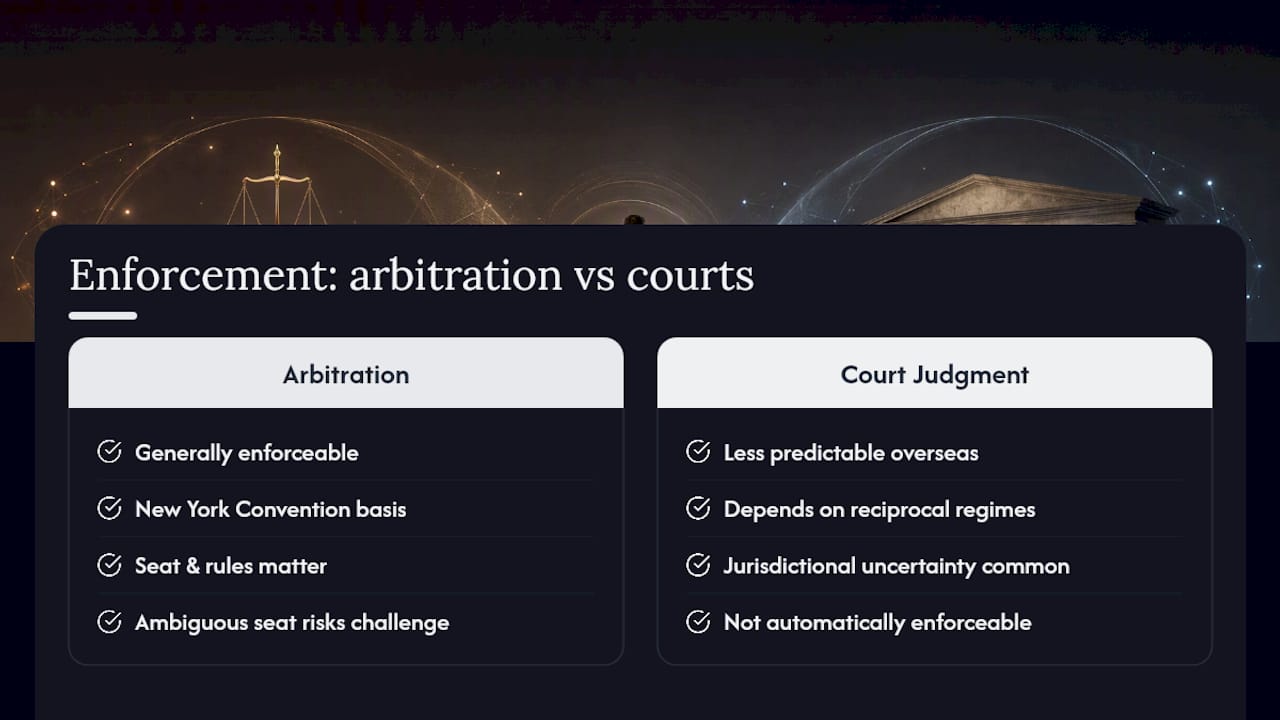
A clause that produces a binding decision is only useful if that decision can actually be enforced, and drafters too often stop at the arbitration or judgment stage without addressing what happens next.
For arbitration, enforceability across borders comes largely from the New York Convention, which is why specifying both the seat and the governing arbitration rules matters so much. If either is ambiguous, an award can face a jurisdictional challenge at the enforcement stage in a different country, long after the original dispute was resolved.
For court judgments, cross-border enforcement is far less predictable. A judgment from an English court is not automatically enforceable overseas in the way an arbitral award usually is, particularly outside reciprocal enforcement regimes. This is one of the strongest practical arguments for arbitration in any contract where the counterparty, or their assets, sit outside the jurisdiction where you might need to enforce.
A well-drafted clause can address this directly:
That last waiver is optional and worth discussing with your solicitor, since it removes a safety net as well as a delay tactic. For disputes with an international dimension, our page on international arbitration for cross-border interests covers enforcement considerations in more detail.
Disputes about who gets to decide the dispute are some of the most wasteful arguments a clause can generate, and they are entirely avoidable with three lines of drafting.
Specify the number of arbitrators upfront, typically one for lower-value or simpler disputes, three for higher-value or technically complex ones. Name an appointing authority to use if the parties cannot agree within a set period, commonly the institution running the arbitration itself under its own rules. And where technical expertise matters, such as a construction defect or a valuation dispute, consider requiring the arbitrator to hold a specific qualification or sector background.
Model wording might read:
Practitioners routinely build this level of specificity into commercial arbitration clauses precisely because a dispute over the tribunal’s composition can add months to a case before the actual substance is even addressed. It costs nothing to fix at the drafting stage and can cost a great deal to fix afterwards.
The legal seat and the physical venue for hearings are not the same thing, and conflating them causes real practical headaches for busy commercial parties spread across time zones.
The seat determines which courts have supervisory jurisdiction over the arbitration and which country’s arbitration law applies to the process. The venue is simply where hearings physically happen, and modern clauses increasingly allow flexibility here, particularly given how normal remote and hybrid hearings have become since the early 2020s.
Useful additional wording covers:
None of this replaces the seat clause. It supplements it, and it saves a genuinely tedious procedural argument early in a case when nobody wants to be arguing about video conferencing software.
Costs clauses are where a lot of otherwise well-drafted dispute resolution provisions fall apart, mostly because parties assume the default rule will simply apply and never say so explicitly.
Under most institutional rules, the tribunal has discretion over costs allocation unless the contract says otherwise, and English litigation generally follows the “loser pays” principle, subject to the court’s discretion. If you want something different, for example each party bearing its own costs regardless of outcome, or costs capped at a fixed amount, the contract needs to say so in plain terms.
Sample costs wording:
Fee arrangements for mediators and arbitrators are usually split equally between the parties pending the final outcome, and it is worth stating this explicitly rather than leaving it to be negotiated mid‑dispute, when neither side has much incentive to be generous. A clear costs clause also gives each party a realistic sense of exposure before they decide whether to escalate at all, which is often exactly the deterrent that keeps a dispute at the negotiation stage.
The clauses that quietly earn their keep are the ones nobody notices, because the dispute never reaches arbitration at all. A fixed 14-day negotiation deadline, with named job titles attending, resolves more disputes than any tribunal ever will. Tailor the tiers to the deal, not the template.
— Panagiotis
This service offers a practical alternative to drafting a dispute resolution clause from a generic online template and hoping it holds up when a real disagreement lands. Fixed‑fee reviews of existing clauses and bespoke drafting for contracts and international arbitration agreements are available, so clients get wording tested against how disputes actually unfold, not just how they read on paper.

Our international disputes and arbitration team handles exactly this kind of clause work daily, from single-jurisdiction supply agreements to cross-border joint ventures needing New York Convention enforceability. A typical fixed-fee review covers seat, rules, arbitrator appointment, escalation timing and costs allocation, with turnaround often quicker once the contract is received. If you are about to sign an agreement with a dispute clause you are not confident in, get in touch through our contact page and we will tell you plainly whether it needs work.
For model wording, the LCIA’s recommended clauses are a solid starting point, alongside RICS guidance for construction disputes. For UK practice notes, consult Practical Law, and for conceptual framing on choosing a mechanism, see Harvard’s PON programme.
This article is general information, not a substitute for advice from a qualified lawyer. Consult a qualified legal professional about your own circumstances before acting on anything here.


