
Menu
Get Expert Legal Support Today

Conciliation is a voluntary, confidential process where an impartial conciliator helps two sides reach a settlement, often by suggesting terms, rather than just facilitating talk. The most common route in the UK is ACAS early conciliation, a pre-claim step for most employment tribunal disputes. It works well when both parties want a quick, private resolution without the cost of a hearing, but it depends on willingness to compromise on both sides.
A conciliator sits between mediator and arbitrator. Unlike a mediator, who stays strictly facilitative, a conciliator often takes a more evaluative role, actively proposing settlement terms based on how similar disputes have been resolved before. Unlike an arbitrator, though, a conciliator has no power to impose a decision. Both sides must agree before anything becomes binding.
Conciliation turns up across several sectors, each with its own flavour:
In the UK, the main providers are ACAS for workplace disputes, sector-specific ombudsmen and trade bodies for consumer and commercial matters, and independent conciliators engaged privately for commercial disagreements. CEDR, a well-known UK dispute resolution body, frames ADR generally around cost-effectiveness and flexibility rather than formal procedure, which is exactly why conciliation appeals to parties who want to avoid a drawn-out court process.
The mechanics differ slightly between individual and collective conciliation, but the shape is consistent.
Statistic callout: Early conciliation through ACAS can run for a limited period by law by law, and it issues a certificate you must quote on tribunal form ET1 if you go on to bring a claim. That 12 week window is often shorter in practice, but it sets the outer limit before a tribunal claim can proceed.
Fees vary by context. ACAS early conciliation for employment disputes is free. Commercial and consumer conciliation run through trade bodies or private providers can carry a fee, though generally far less than arbitration or court proceedings.
Choosing the right ADR route comes down to how much control you want to keep, and how much you want the neutral to steer the outcome.
Conciliation tends to suit disputes where the parties want guidance towards a workable number or arrangement but are not ready to hand over decision making power. Mediation suits parties who want full control over the outcome. Arbitration suits parties who want a final, enforceable answer and are prepared to give up the flexibility of negotiation. On cost and speed, conciliation and mediation usually beat arbitration, which can resemble a mini trial in its formality. For a deeper look at how these methods stack up, see this comparison of ADR options.
When conciliation succeeds, the agreement needs to be captured properly or it risks being unenforceable, or worse, misunderstood by one side later. In employment cases, ACAS records the deal as a COT3, and once that’s signed, the tribunal claim is cancelled or closed. Outside employment, a written settlement agreement serves the same purpose, provided it is properly drafted and signed by both parties.
Before signing anything, check:
Pro Tip: Get a solicitor to review the settlement wording before you sign, even if the conciliator drafted it. A COT3 or written agreement is very hard to unpick once signed, so it pays to check the waiver clause covers precisely what you agreed and nothing broader.
If conciliation fails, the case moves to its next natural stage, tribunal claim, arbitration or litigation, and normal time limits apply. For employment claims, the early conciliation certificate effectively pauses the tribunal clock, so check the exact deadline before assuming you have more time than you do.
Walking into conciliation unprepared wastes the opportunity. A short list of groundwork makes a real difference to how the session goes.
Pro Tip: If talks stall, ask the conciliator what typically happens next in similar cases. They won’t advise you to accept a specific offer, but they can often outline how comparable disputes have been resolved, which gives useful context for your decision.
Conciliation is often recommended when a dispute is contained, both sides are willing to negotiate, and a quick, private outcome serves better than a lengthy tribunal or court fight. That covers plenty of employment disputes, consumer and commercial disagreements, and smaller contractual conflicts where the relationship is worth preserving.
Preparation is where most settlements are won or lost. Legal advisers can help clients build their evidence file, set a realistic fallback position, and draft or review settlement wording so it holds up if challenged later. Where conciliation does not resolve matters, cases can move forward into tribunal proceedings or litigation without a change of adviser. Fixed fee options are available for straightforward matters, and the firm’s contract dispute guidance covers the wider decision of when to escalate beyond negotiation.
Most guidance on conciliation treats it as a formality, something you do before the “real” process starts. That undersells it. Early conciliation resolves a meaningful share of workplace disputes before they ever reach a tribunal, and the parties who benefit most are the ones who treat those weeks as genuine negotiation, not paperwork.
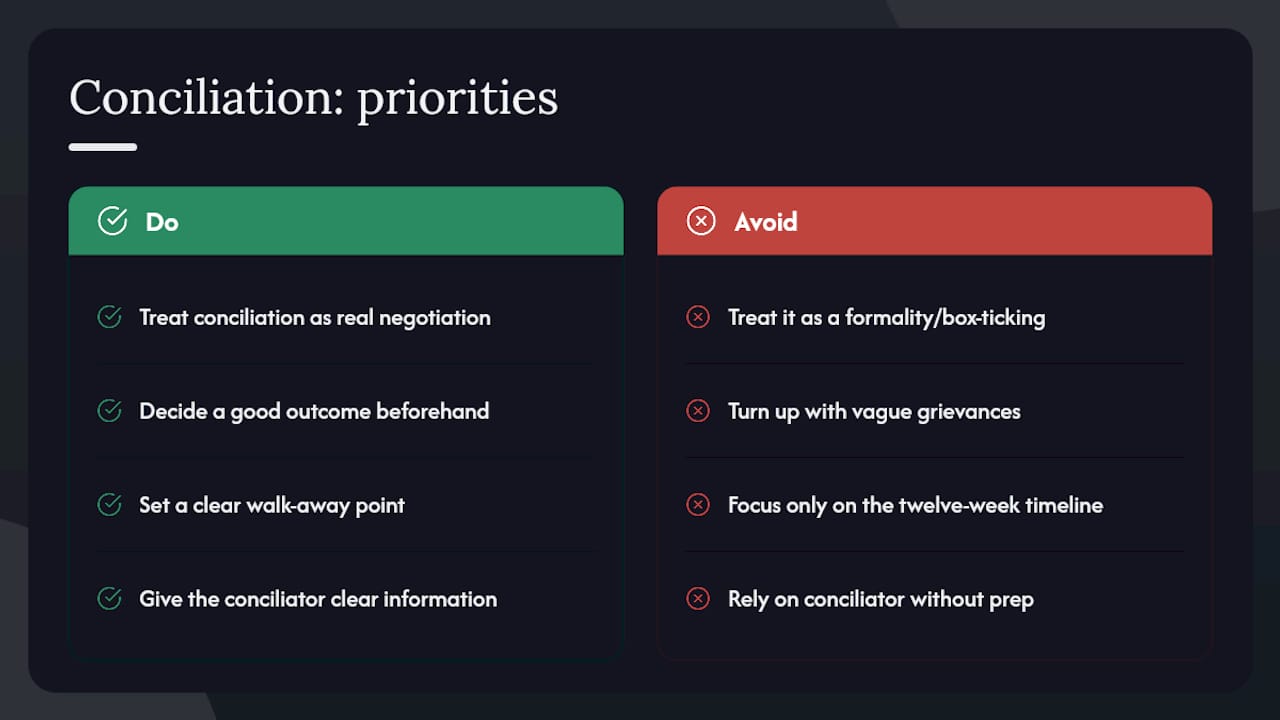
The conventional advice tends to focus heavily on process, what happens in what order, rather than on preparation quality. That’s backwards. The conciliator’s evaluative input is only as useful as the information you give them. Turn up with vague grievances and no fallback position, and you’ll get a vague, unsatisfying outcome, or no settlement at all.
What the reader should prioritise first is not learning the twelve-week timeline (worth knowing but easy to look up); it is deciding, before the conciliator ever calls, what a good outcome actually looks like and what the walk-away point is. Courts and tribunals increasingly expect parties to have engaged seriously with ADR before litigation, so treating conciliation as a box-ticking exercise carries its own risk further down the line.
— Panagiotis
Solicitor-led support is available if you’re heading into conciliation and want the settlement wording checked before you sign anything, not after.

Ali Legal Ltd advises on dispute resolution strategy, drafts and reviews settlement agreements, and represents clients when conciliation fails and a case moves to tribunal, arbitration or court. Fixed fee options are available for contained disputes where the scope of work is predictable. An initial consultation covers your position, the strength of your evidence, and a realistic view of what settlement range is achievable. Before that call, gather your key documents and set out, in your own words, what outcome you actually want. Get in touch through the international disputes and arbitration team to arrange a first consultation.
This article is general information, not a substitute for advice from a qualified lawyer. Consult a qualified legal professional about your own circumstances before acting on anything here.


