
Menu
Get Expert Legal Support Today

An arbitration agreement is a promise between two parties to send present or future disputes to a private arbitrator instead of a court. Sign one, and you have usually given up your right to sue in the ordinary courts for whatever falls within its scope. That single sentence explains most of the confusion people feel when a solicitor points to a clause buried in a contract and says “you’ll need to arbitrate this.”
What that means in practice:
Arbitration in law is a form of private dispute resolution created entirely by contract. There is no arbitration without an agreement, and that agreement can cover disputes that already exist or ones that have not happened yet. It doesn’t need to sit in a grand standalone document either. A single line referring to a separate set of rules, or even an email exchange confirming terms, can be enough to create a binding obligation to arbitrate.
You will find arbitration agreements in far more places than most people expect:
The common thread is that someone, at drafting stage, decided a private tribunal would serve the relationship better than open court. Our guide on the legal effect of arbitration clauses in UK contracts goes further into how these clauses interact with the rest of a contract’s terms.

Arbitration earns its popularity for reasons that hold up under scrutiny. Confidentiality is the big one: hearings and awards generally stay private, which matters enormously to businesses that don’t want a contract dispute splashed across a judgment database. Parties also get to pick a decision-maker with genuine subject expertise, a marine engineer for a shipping dispute, say, rather than a generalist judge working through a crowded list. Add procedural flexibility and easier cross-border enforcement of awards, and the appeal to commercial parties becomes obvious.
The criticisms are just as real, though. Legal commentary consistently flags arbitration’s trade-offs: limited grounds for appeal, cost that can spiral in a genuinely complex dispute, and a “repeat player” effect where large corporate parties who arbitrate often may have a procedural edge over a one-off consumer or small supplier.
Pro Tip: If confidentiality matters to your business, ask whether the arbitration rules you’re adopting actually guarantee it. Some institutional rules default to confidentiality; others leave it to the parties to agree separately.
Most arbitration clauses look deceptively short, four or five lines, but each phrase carries weight. Knowing what each element does lets you negotiate rather than simply sign.
Institutional model clauses exist precisely to stop parties reinventing this wheel badly. The ICC’s own clause and rules resources are a sensible starting point for anyone drafting from scratch, and our piece on what actually happens at arbitration walks through how these choices play out once a dispute actually starts.
UK arbitration law rests on the Arbitration Act 1996, and two provisions do most of the practical work.
First, the writing requirement. Section 5 of the Arbitration Act 1996 requires an arbitration agreement to be in writing before it takes effect under the Act. That threshold is broader than people assume: the agreement can be in writing, made through an exchange of written communications, or simply evidenced in writing by one party or an authorised third party, even where the underlying deal was agreed verbally.
Second, separability. Section 7 treats the arbitration clause as independent from the rest of the contract. If one party argues the whole contract is void, that argument doesn’t automatically kill the arbitration clause with it. The arbitrator can usually decide the validity question themselves, which is precisely the point of the doctrine.
Even where a party claims the contract itself was never validly formed, the arbitration clause typically survives that challenge and the arbitrator, not a court, gets to rule on it first.
Courts play a narrow, supporting role after that. They will generally enforce an arbitration agreement by staying court proceedings brought in breach of it, and they will enforce a valid award with only limited grounds for refusal. Judicial review of the merits is deliberately restricted; challenging an award is not a second bite at the argument you lost. Part I of the Act sets out this entire framework and is worth reading in full if you want the primary text rather than commentary.
You can challenge an arbitration agreement, but the grounds are narrower than most people hope, and none of them are “I changed my mind after signing.”
Raise a jurisdictional objection early and usually within the arbitration itself first; tribunals have the power to rule on their own jurisdiction, with court involvement typically reserved for a challenge after that ruling. Once you’ve signed, opting out unilaterally isn’t realistic. Your genuine leverage exists before signature, through negotiating a carve-out or amendment, not after.
Ask these questions before signing anything, not after a dispute has already started.
Pro Tip: If a clause designates a seat with unfamiliar or thin arbitration law, or gives the other party sole control over appointing the arbitrator, treat that as a red flag worth negotiating rather than accepting.
Reasonable amendments, narrowing scope, adding a carve-out for urgent injunctive relief, specifying a neutral seat, are common and rarely controversial to request. Seek legal advice before signing anything involving significant value, an unfamiliar jurisdiction, or a counterparty holding clearly superior bargaining power.
This explainer covers the statutory framework accurately, but every arbitration clause sits inside a specific commercial relationship with its own risks. Ali Legal Ltd advises on arbitration and international disputes, including clause drafting and fixed-fee review, and complex or high-value matters deserve tailored advice rather than a general guide.
Most guidance on arbitration agreements treats the decision to sign as binary: arbitration good, litigation bad, pick one. That framing misses the point. The real risk rarely sits in the choice between arbitration and court; it sits in vague scope wording and an unfamiliar seat slipped into a clause nobody negotiated.
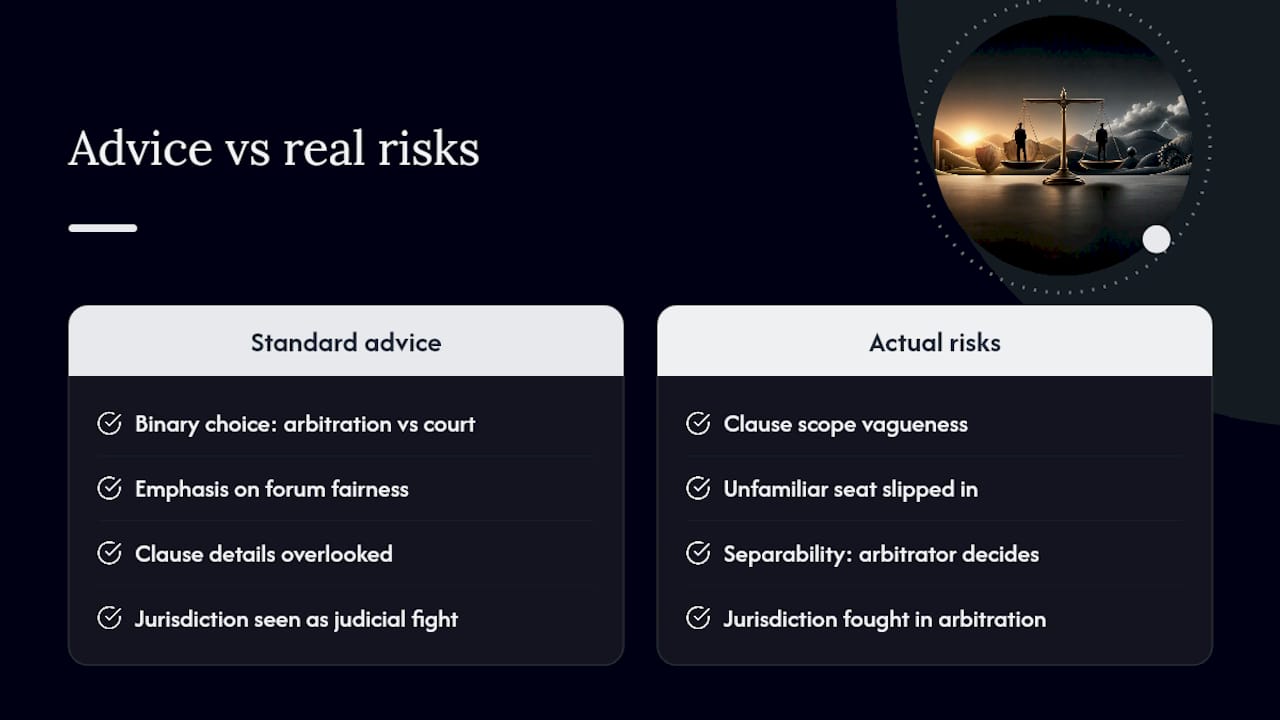
Separability, covered under section 7 of the Arbitration Act 1996, deserves more attention than it usually gets. It means a party cannot escape arbitration simply by arguing the underlying contract was invalid, which is exactly the argument a party in a weak position often reaches for first. Understanding that upfront changes how you negotiate, because it tells you the fight over jurisdiction will likely happen in front of the arbitrator, not a judge.
My honest view: readers should worry less about whether arbitration is “fair” in the abstract and more about whether the specific clause in front of them has a sensible seat, workable cost allocation, and scope wording tight enough to avoid a second dispute about the first one.
Reviewing a clause before you sign costs far less than disputing its consequences after a problem arises. Ali Legal Ltd drafts and reviews arbitration clauses, advises on seat and institutional rule choices, and represents clients through arbitration proceedings themselves, with fixed-fee options available for straightforward advisory work and bespoke arrangements for larger, cross-border matters.

If you’ve been handed a clause you don’t fully understand, or you’re heading into a dispute already covered by one, get in touch with details of the contract and a short summary of what’s at stake. Explore Ali Legal Ltd’s international disputes and arbitration services or read more on the key advantages of international arbitration before booking an initial consultation to get the clause looked at properly.
This article is general information, not a substitute for advice from a qualified lawyer. Consult a qualified legal professional about your own circumstances before acting on anything here.


