
Menu
Get Expert Legal Support Today

Your core family-law rights depend on your role and situation, but most people are dealing with one of four things: parental responsibility, child arrangements, money and property, or protection from harm. The first move is almost always the same: work out what applies to you before anything else.
Start here:
Pro Tip: Most court applications involving children now require proof you attended a Mediation Information and Assessment Meeting (MIAM) first. Book this early. It rarely delays things and can resolve the whole dispute before court is even necessary.
Family law splits broadly into three areas. Child law covers who a child lives with, who they see, and when the state steps in to protect them. Matrimonial and financial law covers divorce, dissolution of civil partnership, and how money and property get divided. Protection law covers domestic abuse injunctions and safeguarding.
You’ll run into specific terms fast. A child arrangements order sets out where a child lives and who they spend time with. A prohibited steps order stops a parent doing something specific, like taking a child abroad. A specific issue order resolves a single disagreement, such as which school a child attends. A care order gives a local authority parental responsibility alongside the parents.
Birth mothers hold parental responsibility automatically. Fathers and second parents get it through marriage or civil partnership to the mother at birth, joint registration on the birth certificate, a signed parental responsibility agreement, or a court order. GOV.UK’s guidance on parental rights sets out each route in detail.
Ways to acquire it if you don’t already have it:
Parental responsibility gives you a say in major decisions: schooling, medical treatment, religion, and where a child lives long-term. It does not automatically guarantee day-to-day contact or override the arrangements already in place. Having the legal status and getting practical time with your child are two separate questions, and conflating them is one of the most common mistakes fathers pursuing divorce rights for fathers make early on.
Pro Tip: If the other parent won’t sign a parental responsibility agreement, don’t wait months hoping they’ll change their mind. Apply to court promptly. Courts rarely refuse a father’s application unless there’s a welfare concern.
You can usually sort out where a child lives and who they see without a judge ever getting involved. GOV.UK confirms this is the expected default, not the exception.
Your main routes are:
Mediation typically starts with a MIAM. Vouchers are available to help cover the cost, and non-court dispute resolution is generally faster and cheaper than litigation. You’re exempt from the MIAM requirement if there’s evidence of domestic abuse. Once you’ve agreed terms, ask a solicitor to turn them into a consent order, so the arrangement becomes legally enforceable rather than a gentleman’s agreement that falls apart under pressure.
Pro Tip: Keep a written record of every proposal and response, even informal ones over text. If mediation stalls and you end up in court, that paper trail is often the difference between a smooth application and a drawn-out fight.
The court’s paramount consideration in any decision about a child’s upbringing is the child’s welfare, not either parent’s preference. That principle comes straight from statute.
Section 1 of the Children Act 1989 states that when a court determines any question concerning a child’s upbringing, the child’s welfare shall be the court’s paramount consideration.
In practice, that means judges lean towards not making an order at all unless doing so genuinely improves the child’s situation, a rule known as the “no order” principle. Public bodies only intervene when there’s a real welfare concern.
Typical triggers for intervention include:
The main public-law orders are the care order (local authority shares parental responsibility), the supervision order (local authority monitors without taking responsibility), and the emergency protection order (short-term removal to safety). None of these strip a parent of parental responsibility entirely, but they do limit how it’s exercised.
Pro Tip: If children’s services contact you, ask immediately what the specific concern is and request it in writing. You have a right to representation at any meeting where decisions about your child are discussed.
The three main private-law orders are the child arrangements order (living and contact arrangements), the prohibited steps order (stops a specific action), and the specific issue order (settles a single disputed decision). Each targets a different kind of disagreement.
The process generally runs like this:
First hearings are typically listed within several weeks of the application, though urgent safety matters can be heard far sooner. Fees apply for the C100 application, though you may qualify for a fee reduction or legal aid if you have evidence of domestic abuse or a low income.
Pro Tip: Bring proof you attempted mediation to your first hearing, such as your MIAM certificate. Courts expect it, and turning up without it can delay your case.
Contact the police straight away if a child faces immediate danger. For urgent but non-emergency concerns, a solicitor can apply for an emergency protection order through the court.
Gather this as soon as you safely can:
If social services contact you, you have the right to be told what the concern is, the right to bring a solicitor or supporter to meetings, and, in many cases, the right to see records held about your family.
Pro Tip: Stay factual and calm in every conversation with a social worker, and follow up verbal conversations with a short confirming email. It creates a clear record without escalating tension.
Before your first meeting, collect birth certificates, communication logs with the other parent, school and medical records, financial documents, and any relevant police or hospital reports.
Bring these questions:
Pro Tip: Organise your documents into a simple folder before you arrive. Solicitors often bill by the hour, so turning up prepared can shave a meaningful amount off your first invoice. Many firms also offer a free initial call, which is worth using to scope the problem before committing to paid advice.
Family law isn’t only about children. Married couples and civil partners have financial rights and obligations that exist independently of any parenting dispute, and these often carry more long-term consequence than people expect.
On divorce or dissolution, either party can apply for a financial remedy, covering the family home, pensions, savings, and income. Courts consider factors including the length of the marriage, each person’s needs, earning capacity, and contributions, both financial and non-financial. There’s no automatic 50/50 split; outcomes depend heavily on circumstances, which is why guesswork based on a friend’s settlement rarely holds up.
Spousal support, sometimes called maintenance, is separate from child maintenance. It’s awarded where one party has a genuine income need the other can meet, and it isn’t guaranteed just because a marriage ends. Property held in one person’s sole name isn’t automatically ring-fenced either; the family home is frequently treated as a matrimonial asset regardless of whose name is on the title.
Unmarried couples have far weaker protections. Without a marriage or civil partnership, there’s no automatic right to spousal maintenance and no automatic share of a partner’s property, however long the relationship lasted. This catches people out constantly, and it’s one of the sharpest gaps between assumed fairness and actual law. If you’re separating and property is involved, understanding your position early, particularly around jointly owned homes, is worth doing before emotions dictate decisions. Ali Legal Ltd’s guidance on property law covers ownership and title issues that often surface during separation.

Domestic abuse sits inside family law as both a safeguarding issue and grounds for urgent court intervention. If you’re at risk, you don’t need to wait for a mediation appointment or a MIAM exemption letter; you can apply directly to court.
The two main protective orders are the non molestation order, which stops an abuser from threatening, harassing, or contacting you, and the occupation order, which regulates who can live in or enter the family home. Breaching a non molestation order is a criminal offence, giving it real enforcement teeth beyond a civil warning.
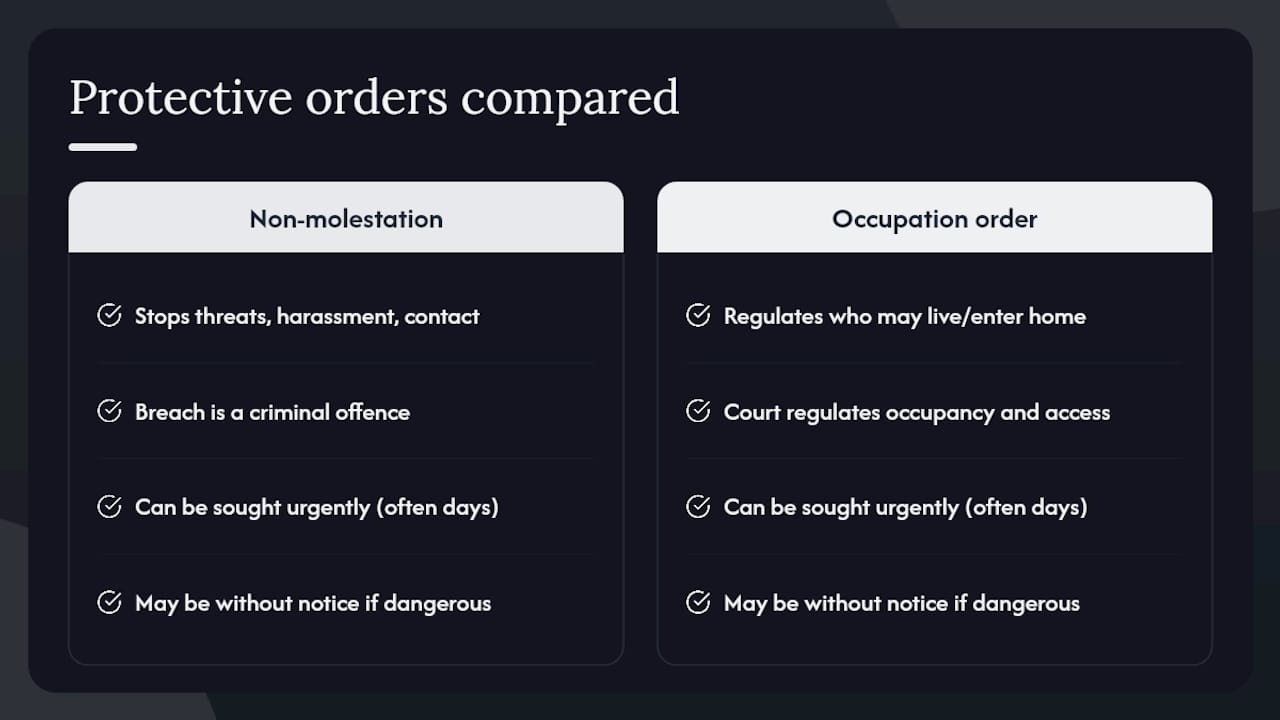
Evidence of domestic abuse also exempts you from the standard MIAM requirement before other family court applications, and it’s frequently the basis for legal aid eligibility that wouldn’t otherwise apply. Keep records: messages, photographs, medical notes, police reference numbers, and dates. A solicitor can apply for a protective order urgently, often within days where the risk is immediate, and applications can be made without notice to the other party in genuinely dangerous situations.
If you’re unsure whether what you’re experiencing counts as abuse in legal terms, coercive control, financial control, and threats all qualify, not just physical violence. Speaking to a solicitor early costs nothing to explore and can clarify what protection is actually available to you.
Adoption permanently transfers parental responsibility from birth parents to adoptive parents, extinguishing the birth parents’ legal status entirely. This makes it fundamentally different from a care order or fostering arrangement, where parental responsibility is shared rather than replaced.
Prospective adopters go through an assessment process run by an adoption agency or local authority, covering background checks, home visits, and preparation training. Once a match is made, there’s typically a placement period before an adoption order is finalised in court. Birth parents’ consent is normally required, though a court can dispense with it where the child’s welfare demands it, usually in cases involving significant harm or abandonment.
Step-parent adoption is a distinct route, allowing a step-parent to acquire full parental responsibility alongside a birth parent, though this legally removes the other birth parent’s status and isn’t granted lightly. Special guardianship orders offer a middle ground: they give a carer, often a grandparent or family friend, enhanced parental responsibility without severing the birth parents’ legal relationship entirely.
Adopted adults and birth parents both have rights around information access later in life, including routes to trace birth records once an adopted child reaches adulthood. If adoption is something you’re considering, whether as a prospective adopter or a birth parent facing a decision, get advice before signing anything, since the legal consequences are permanent in a way few other family law outcomes are.
People come to family law wanting certainty, and the honest answer is usually a range of outcomes shaped by evidence, not guarantees. Ali Legal Ltd’s approach is built around explaining that range clearly, with fixed fees where possible so cost never becomes a second crisis on top of the first. Practical advice matters more than clever advocacy in most family cases. A well-prepared parent with the right documents often gets further than one who arrives at court hoping the story alone will carry the day. That’s the basis for a fixed-fee initial conversation before committing to anything larger.
Consider instructing a solicitor when there’s urgent risk to a child, a contested court application on the horizon, or financial matters complex enough that a DIY agreement could leave you exposed later. Ali Legal Ltd offers fixed-fee initial advice so you know the cost before you commit, representation in negotiations or court where agreement breaks down, and hands-on help preparing evidence, MIAM documentation, and C100 applications.

If property is part of the picture, whether that’s a jointly owned home or a dispute over who stays where, Ali Legal Ltd’s property law guidance is a useful starting point before you speak to a solicitor directly. Where legal aid is a realistic option, given evidence of abuse or low income, we’ll flag that honestly rather than push paid representation you don’t need. Get in touch through the contact page to arrange an initial fixed-fee assessment and find out exactly where you stand.
Scotland and Northern Ireland operate under separate legislation, so check region-specific guidance, such as this Scottish inheritance and family rights overview, if you’re outside England and Wales.
This article is general information, not a substitute for advice from a qualified lawyer. Consult a qualified legal professional about your own circumstances before acting on anything here.


