
Menu
Get Expert Legal Support Today

Most buyers pay between £1,312 and £2,236 in solicitor legal fees, with a 2026 national average of £1,624, according to Compare My Move. On top of that, expect roughly £709 in disbursements, the third-party costs your solicitor pays out on your behalf. Add the two together and a typical buyer is looking at somewhere close to £2,300 in total legal costs before Stamp Duty Land Tax.
Other surveys land in a similar ballpark. Property Solvers puts the average conveyancing fee (including VAT) at £1,316.52 for freehold purchases, while HomeOwners Alliance quotes a broader band of £400 to £1,500 for standard transactions. The gap between these figures isn’t a red flag. It reflects differences in sample size, whether VAT is included, and whether disbursements are counted alongside the legal fee.
Average solicitor fee (2026): £1,624 | Average disbursements: £709 | Typical total: £2,300+
Two things push these numbers around more than anything else:
The phrase “solicitors fees” actually covers two separate things, and mixing them up is the single most common reason buyers feel blindsided at completion. There’s the legal fee, which is what your solicitor charges for their own work, and there are disbursements, which are third-party costs your solicitor pays on your behalf and passes on to you.
The legal fee covers the actual conveyancing work. That typically includes:
What’s usually excluded from the legal fee and billed separately as disbursements includes search fees, Land Registry registration fees, bank transfer (telegraphic transfer) fees, and the administrative cost of submitting your Stamp Duty Land Tax return. Some firms also charge separately for leasehold management pack requests or indemnity insurance if a title issue crops up mid-transaction.
Pro Tip: When a solicitor quotes a “fixed fee,” ask exactly what it covers in writing before you instruct them. A genuinely fixed fee should list every included task and name every likely exclusion, such as extra charges for a lease extension, a defective title, or a transaction that falls through and restarts with a new buyer. If a firm won’t put this in writing before you sign anything, treat that as a warning sign rather than a technicality.
Understanding this split matters because a headline number like “£800 conveyancing” is meaningless on its own. It might be an unusually cheap legal fee with disbursements added separately, or it might be the full picture. Ask for a total figure, not just the legal fee, every time you compare quotes. If you want a fuller picture of what a conveyancer actually does day to day, our guide to the conveyancer’s role breaks the process down stage by stage.

Disbursements are the costs your solicitor has no control over, set by government bodies, search providers, and banks rather than by the firm itself. Reallymoving is clear that these sit on top of, not inside, the solicitor’s own fee.
| Disbursement | Typical cost | Who requires it |
|---|---|---|
| Local authority search | £250–£300 | Standard for almost all purchases |
| Land Registry registration fee | £20–£250 (scales with price) | Legally required to register ownership |
| Bankruptcy/land charges search | £2–£5 | Required by mortgage lenders |
| Electronic ID/AML check | £10–£20 per person | Required under money laundering regulations |
| Bank transfer (telegraphic transfer) fee | £30–£40 | Charged by the solicitor’s bank |
| Leasehold management pack | £400 | Required for flats and leasehold houses |
MoneyHelper puts local search costs at around £250 to £300, which tallies with most firms’ quotes. Each disbursement exists for a specific reason:
On VAT: most solicitors’ legal fees are quoted plus VAT at 20%, so always ask whether a headline figure is VAT-inclusive. Some disbursements, like the Land Registry fee, carry no VAT because they’re statutory charges, while others, like search fees and bank transfer charges, usually do. This is exactly why MoneyHelper recommends asking for a full, VAT-clear breakdown before you commit to a firm.
Property price is only one variable in a much longer list. FindSolicitor’s 2026 market data shows conveyancing costs ranging from £500 to £2,500, and the spread comes down to a handful of recurring factors:
Fixed-fee pricing now dominates the residential market because it gives buyers certainty on a standard purchase. The trade-off is that fixed fees usually exclude unforeseen complications, so a title defect or a collapsed chain can trigger additional charges that weren’t in the original quote.
Pro Tip: A quote that looks unusually low is worth scrutinising rather than celebrating. Ask what happens if the transaction becomes more complex, whether the fee assumes a straightforward freehold purchase, and whether there’s a cap on additional charges. For an unusually complicated purchase, a solicitor quoting on an hourly basis with a not-to-exceed estimate can sometimes work out fairer than a fixed fee loaded with exclusions.
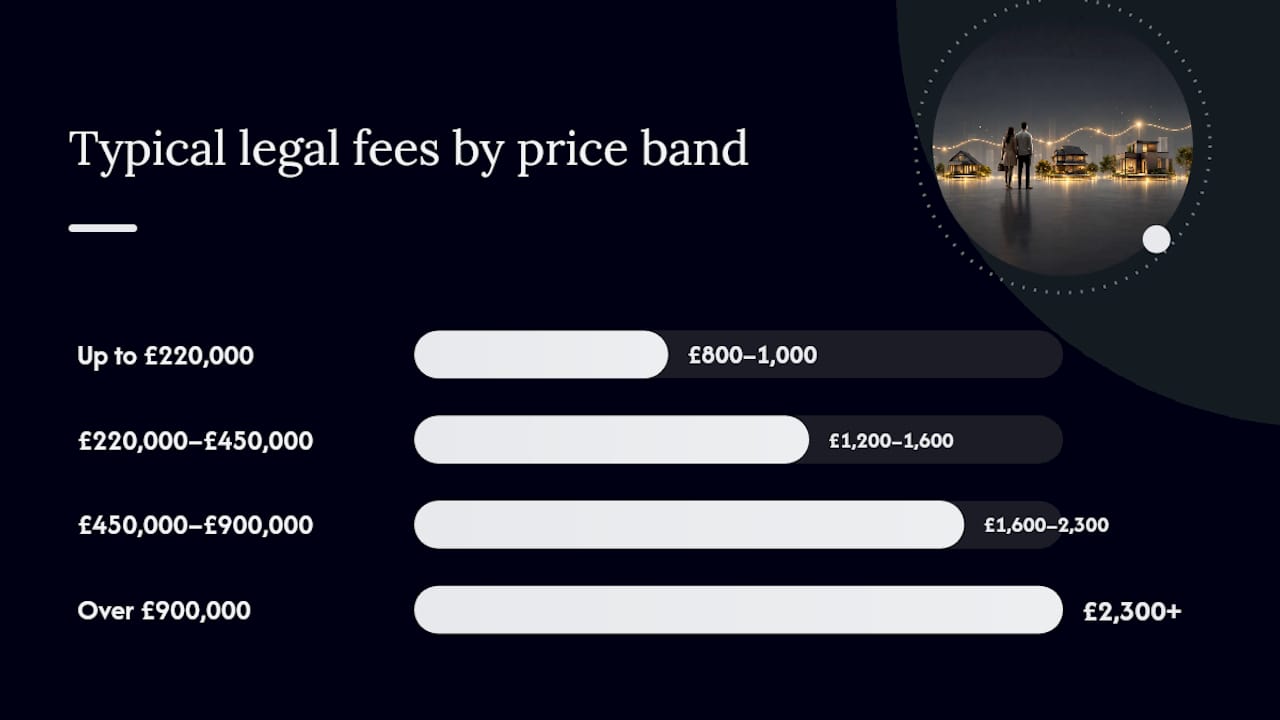
Legal fees typically rise with property value, partly because Land Registry fees scale with price and partly because higher-value transactions often carry more complexity. Based on the price-banded averages reported by Compare My Move, the pattern looks roughly like this:
| Property price | Typical legal fee | Typical disbursements | Estimated total |
|---|---|---|---|
| Up to £220,000 | £800–£1,000 | £600–£700 | £1,300–£1,600 |
| £220,000–£450,000 | £1,200–£1,600 | £650–£700 | £1,624–£2,300 |
| £450,000–£900,000 | £1,600–£2,300 | £700 | £2,300+ |
| Over £900,000 | £2,300 and above | £900 and above | £2,300 and above |
A first-time buyer purchasing a £220,000 flat leasehold might pay towards the upper end of the first band once the leasehold management pack is added, closer to £1,700 all in. A buyer of a £450,000 freehold house with a straightforward chain often lands nearer the lower end of the second band. A buyer completing on a £900,000 property with a simultaneous sale, meanwhile, should expect the full weight of the third band and possibly beyond it.
These figures are illustrative, not guaranteed. Every firm prices differently, and Clearscore’s figures for standard freehold purchases (legal fees of £790 to £1,000, disbursements of £450 to £600) sit noticeably lower than the Compare My Move averages, which underlines why getting a written quote for your specific transaction matters more than any published table.
Getting three quotes that all quote different things isn’t a comparison, it’s a guessing game. Follow these steps to get quotes you can actually put side by side:
Beyond the numbers, a handful of direct questions separate a reliable firm from a risky one:
The cheapest quote on paper isn’t automatically the best deal. A firm with slow response times or poor communication can cost you far more in delay and stress than a slightly higher fee ever would. Reputation and responsiveness are worth weighing alongside price, particularly if your purchase has any complexity at all. Our checklist for hiring a solicitor covers this vetting process in more depth, and for buyers arranging a mortgage as a non-UK national, Prosper Home Loans’ guide to mortgage documentation explains the extra paperwork lenders may require, which can also affect your solicitor’s AML workload.
Conveyancing runs through a fairly predictable sequence, and knowing where the money leaves your account helps you plan cashflow properly.
If your solicitor’s actual disbursement costs turn out lower than originally estimated, the difference should be refunded or offset against your final bill. Always ask for a completion statement that itemises exactly what you paid and why, so you can check the numbers match what you were quoted at the outset.
The averages quoted throughout this guide draw on a mix of consumer-facing conveyancing surveys, industry pricing guides, and government-adjacent guidance rather than a single dataset. Property Solvers surveyed 100 conveyancing firms across England and Wales to reach its 2026 average, while other figures come from aggregated quote data collected by comparison platforms.
Ranges differ between sources for a few consistent reasons:
The clearest explanation for the spread comes down to methodology rather than market volatility: whether disbursements and VAT are counted inside or outside the headline average changes the number more than actual market pricing does, as Property Solvers’ 2026 analysis makes clear.
Treat any single average as a starting point for budgeting, not a promise. The only figure that matters for your transaction is the written quote from the firm you actually instruct.
Buyers rarely complain about the size of a legal fee. They complain about being told one figure and billed another. A written client care letter that spells out the legal fee, every disbursement, and the circumstances that could trigger an extra charge removes almost all of that friction before it starts.
At Ali Legal Ltd, that’s the standard we hold every property instruction to: a fixed fee set out in writing, disbursements estimated honestly rather than optimistically, and no surprises buried in the small print. Clear pricing isn’t a marketing line, it’s what stops a stressful process from becoming an expensive one.
Ali Legal Ltd prices property purchases as a genuine fixed fee, not a low headline figure with disbursements bolted on afterwards. You’ll see the legal fee, an honest estimate of every disbursement, and a realistic timeline before you instruct us, so there’s nothing to discover at completion that wasn’t already in writing.

A fixed-fee quote from Ali Legal Ltd covers the same ground this guide has walked through: identity and AML checks, contract review, liaison with the seller’s solicitor, and every disbursement itemised separately with VAT treatment made explicit. Our property law guidance sets out how we handle purchases of varying complexity, from straightforward freehold sales to leasehold flats with management pack complications. Initial enquiries carry no obligation, so if you’re weighing up quotes or simply want a second opinion on one you’ve already received, get in touch for a fixed-fee quote and find out exactly what your purchase will cost before you commit to anything.
This article is general information, not a substitute for advice from a qualified lawyer. Consult a qualified legal professional about your own circumstances before acting on anything here.


