
Menu
Get Expert Legal Support Today

The single most useful thing you can do right now is ask your solicitor for a client care letter, set a written spending cap, and request interim bills at agreed intervals. Those three steps alone prevent the majority of fee disputes. If you are already in a dispute, the route is: internal complaint first, then the Legal Ombudsman, and if the bill itself is the problem, a detailed assessment application to the Senior Courts Costs Office within one month of receiving it.
Here is a quick-start checklist before you read further:
The priorities differ by matter type. A simple small claim for a faulty product rarely justifies a solicitor’s hourly rate; the online system and self-representation are often the better route. A contested civil matter over £25,000, by contrast, demands careful fee-arrangement negotiation from day one, because costs can exceed the value of the claim if left unmanaged.
A solicitor’s invoice is rarely just one number. The Law Society explains that a bill typically contains several distinct components, and understanding each one is the first step to checking whether you have been charged correctly.
Solicitor fees are the charges for the lawyer’s own time, either at an agreed hourly rate or as a fixed sum for a defined piece of work. Hourly rates vary considerably by seniority and location; a senior partner in central London charges far more per hour than a newly qualified solicitor in a regional firm.
Disbursements are out-of-pocket expenses the firm pays on your behalf and then recovers. Common examples include:
VAT at 20% is charged on solicitor fees and most disbursements, though some court fees are exempt. Always check whether a quoted figure is inclusive or exclusive of VAT.
Success fees apply under Conditional Fee Agreements (CFAs). They represent a percentage uplift on the base fee, payable only if you win, and are capped at 100% of the base fee in most cases (25% of damages in personal injury claims under the Legal Aid, Sentencing and Punishment of Offenders Act 2012 rules).
After-the-Event (ATE) insurance premiums cover the risk of paying the other side’s costs if you lose. In most cases since April 2013, ATE premiums are not recoverable from the losing party, so you bear that cost yourself.
A summary bill gives the total charge with a brief description of work done. A detailed bill itemises every attendance, letter, and task with the time spent and rate applied. You have the right to request a detailed breakdown in most circumstances, and doing so is the first practical step if a bill looks wrong. The Law Society’s guidance sets out the routes available, including the right to apply for a detailed assessment by the court.
The general rule in civil litigation in England and Wales is that the losing party pays the winning party’s costs. Civil Procedure Rules Part 44 governs this, and the court has wide discretion to depart from it based on conduct, offers to settle, and proportionality.
The small claims track is the significant exception. Advicenow’s guidance on legal costs confirms that in small claims, parties generally meet their own legal costs regardless of outcome. Winning a £3,000 dispute in the Small Claims Court does not mean the other side reimburses your solicitor’s bill.
| Track | Typical claim value | Cost recovery rule |
|---|---|---|
| Small Claims | Up to £10,000 | Each party pays own costs (with limited exceptions) |
| Fast Track | £10,000 to £25,000 | Recoverable costs apply, but fixed recoverable costs (FRC) cap what you can claim |
| Multi-Track | Claims exceeding the usual Fast Track range | Full costs shifting applies; court assesses reasonableness |
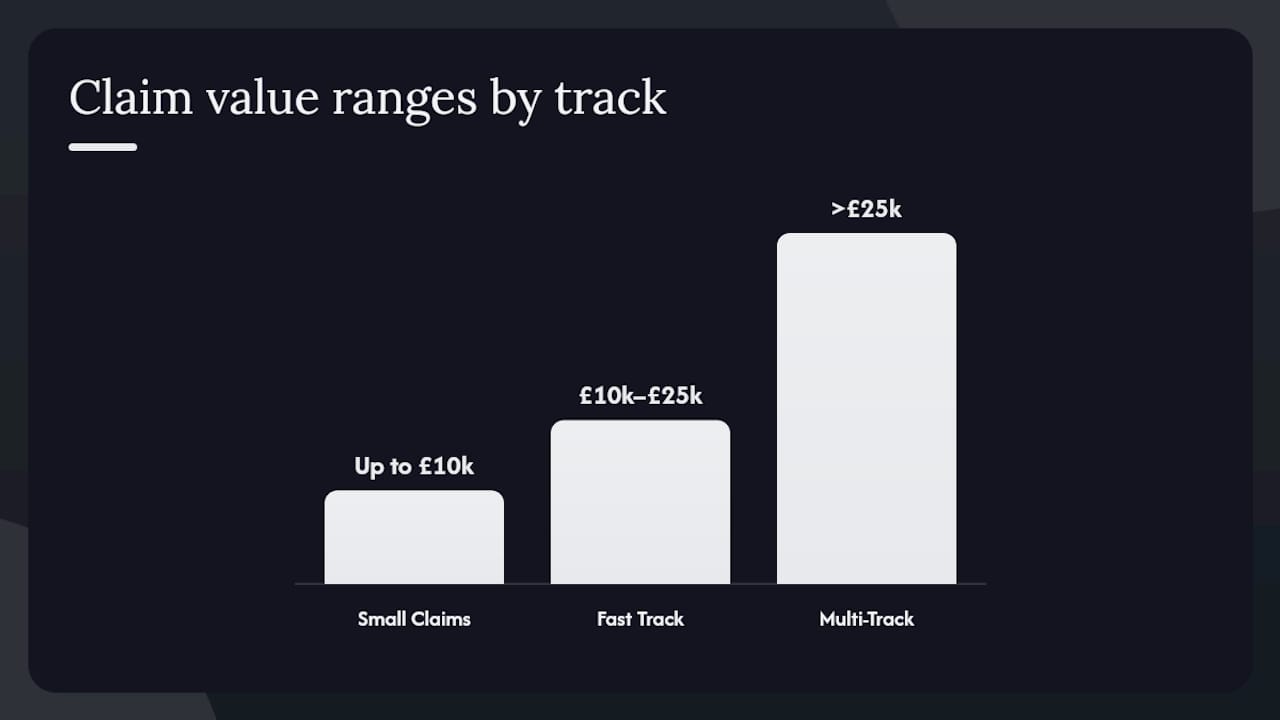
Fixed Recoverable Costs (FRC) apply to most Fast Track claims and, since October 2023, to a wider range of cases under the extended FRC regime. Practice Direction 45 sets out the tables of fixed amounts recoverable at each stage of a claim. The practical consequence: even if you win on the Fast Track, the amount you recover toward your solicitor’s fees is capped by those tables, not by what your solicitor actually charged you.
Key points to keep in mind:
Understanding the charging model before you sign anything is one of the most effective ways to manage legal costs. The SRA’s guidance on cost questions recommends asking about the arrangement type at the very first meeting.
| Arrangement | How it works | Who bears the risk |
|---|---|---|
| Hourly rate | You pay for time spent, billed at an agreed rate | You: costs rise if the matter takes longer than estimated |
| Fixed fee | A set price for a defined scope of work | Shared: firm absorbs overruns; you pay more if scope expands |
| Conditional Fee Agreement (CFA) | No win, no fee; success fee added if you win | Firm bears some risk; you may still pay disbursements and ATE premium |
| Damages-Based Agreement (DBA) | Firm takes a percentage of damages recovered | Firm bears most risk; percentage is capped by regulation |
| Private retainer (ongoing) | Regular monthly fee for access and defined work | You: ongoing commitment regardless of activity |
Conditional Fee Agreements are the most common “no win, no fee” arrangement in personal injury, employment, and some civil claims. The success fee is capped at 25% of the damages recovered in personal injury cases. In other civil matters the cap is 100% of the base fee, though in practice most firms charge far less.
Damages-Based Agreements are less common but available in employment tribunals and civil litigation. The DBA Regulations 2013 cap the percentage at 50% of damages in most civil claims (25% in employment cases).
After-the-Event insurance deserves a separate word. It protects you against paying the other side’s costs if you lose. Premiums vary widely depending on the risk profile of the case and the stage at which you take out cover. Because premiums are generally not recoverable from the other side, they add to your net outlay even on a CFA.
Pro Tip: Ask your solicitor to include a written approval step in the retainer: the firm must contact you before costs exceed a set threshold. Most firms will agree to this if asked, and it prevents the shock of a bill that has grown far beyond the original estimate.
The Solicitors Regulation Authority requires firms to give clients clear cost information at the outset and to keep them updated as the matter progresses. This is not a courtesy; it is a regulatory obligation.
The client care letter (sometimes called the retainer letter or terms of engagement) is the document that records the fee arrangement. It must include:
Keep this letter. It is your primary evidence if a bill later exceeds what was discussed.
The SRA’s price transparency rules require most firms to publish indicative costs for certain common services (conveyancing, probate, employment tribunals, motoring offences, and debt recovery) on their websites. This lets you compare before you instruct. If a firm refuses to give you a written estimate at all, that is itself a warning sign and potentially a breach of SRA conduct rules.
The SRA’s ten questions to ask your lawyer include asking whether the estimate is likely to change, what would cause it to change, and how you will be told if it does. Print that list and take it to your first meeting.
Checklist of minimum information to request at the outset:
Pro Tip: After any telephone conversation about costs, send a short email summarising what was agreed. “Following our call today, I understand the estimate is £X and you will contact me before costs exceed £Y.” That email creates a contemporaneous record that carries real weight in a complaint.
The SRA also requires that client money held on account is kept in a separate client account and used only for the purpose for which it was paid. If you are asked to pay money on account before work begins, you are entitled to ask how it will be held and what happens to any unused balance.
The most controllable variable in a legal bill is the amount of time your solicitor spends on your matter. Much of that time is driven by how efficiently you work with them.
Concrete steps that reduce billable hours:
Mediation typically costs a fraction of contested litigation and resolves a significant proportion of civil disputes before trial. Many courts now expect parties to have considered mediation before issuing proceedings, and refusing it without good reason can affect costs orders.

For claims under £10,000, the online Money Claims system lets you issue and manage a claim without a solicitor. Advicenow’s guidance encourages its use for lower-value disputes precisely because it reduces time and cost compared with instructing lawyers.
Representing yourself as a litigant in person is a realistic option for straightforward small claims. The court will explain the process, and resources such as Citizens Advice and Advicenow provide step-by-step guidance. The essential checklist for hiring a solicitor from Ali Legal Ltd can help you decide at which point professional representation genuinely adds value.
Pro Tip: Ask your solicitor to phase the work and quote each phase separately. You retain the option to handle later phases yourself or with a different firm if the first phase resolves the dispute or changes your assessment of the risk.
There are several realistic routes for people who cannot meet legal costs privately, and checking eligibility takes very little time.
Legal aid is means-tested and restricted to certain case types, primarily family matters involving domestic abuse or child protection, immigration, mental health, and some housing cases. Civil litigation for money claims is generally outside scope. Check eligibility and find a legal aid provider through GOV.UK. Ali Legal Ltd’s guide to legal aid eligibility and benefits explains the criteria and application process in plain terms.
Pro bono services are free legal advice provided by solicitors and barristers on a voluntary basis. The Law Society’s Pro Bono Protocol and organisations such as LawWorks connect eligible individuals with volunteer lawyers for civil matters outside legal aid scope.
Law Centres offer free legal advice and representation to people on low incomes, primarily in housing, employment, immigration, and welfare benefits. Find your nearest centre through the Law Centres Network.
Citizens Advice provides free, independent guidance on a wide range of legal problems and can help you understand your options before you decide whether to instruct a solicitor.
Payment plans are more available than many people realise. Most firms will discuss a payment schedule if you ask directly. Useful approaches:
For those facing court fee exemptions in family proceedings, fee remission (Help with Fees, form EX160) is available based on income and savings. This covers court issue fees, not solicitor fees, but it can make a meaningful difference to the total outlay.
Representing yourself is a genuine option for straightforward matters. The small claims process is designed to be accessible without legal representation, and the court staff can direct you to the right forms.
If a bill arrives and something looks wrong, the process is straightforward but time-sensitive.
Applying to the Senior Courts Costs Office for a detailed assessment within one month of receiving the bill gives you the strongest procedural position. Applications made between one month and 12 months are still possible but the court may require you to pay part of the bill upfront. After 12 months, the court’s discretion to allow an assessment narrows considerably. If the court reduces the bill, any overpayment is refunded.
Pro Tip: Before applying for a detailed assessment, write to the firm with a without-prejudice offer to settle the disputed amount. Many firms will negotiate rather than face the cost and time of a formal assessment, and a negotiated reduction is often faster and cheaper than the court process.
Key evidence to gather before challenging a bill:
The Legal Ombudsman’s complaints process sets its own time limits: generally, you must complain within one year of the act or omission, or within one year of when you reasonably should have known there was a problem. Failure to provide a bill at all can reset that awareness date.
Around one in ten complaints to the Legal Ombudsman involve legal costs, and the Ombudsman is clear that poor communication about costs, not the level of fees alone, is the leading cause of those disputes. A bill that significantly exceeds an estimate without prior warning is the most common trigger.
The Ombudsman applies three broad principles when investigating cost complaints:
What the Ombudsman typically expects to see from the firm:
Common outcomes when the Ombudsman upholds a complaint include requiring the firm to reduce the bill, issuing a refund of amounts already paid, and awarding modest compensation for distress or inconvenience. In one published case study, the Legal Ombudsman directed a fee reduction and awarded compensation after a client’s bill significantly exceeded the original estimate and the firm had failed to explain why.
The Ombudsman will generally not intervene where the client agreed to the fee arrangement in writing, received regular updates, and the final bill was proportionate to the work done. Time limits apply: complain within one year of the act or omission, or within one year of becoming aware of the problem.
Use this before you instruct a solicitor and at each billing stage.
Before you instruct:
Documents to get in writing before work starts:
Prompt templates you can email:
The SRA’s ten questions to ask your lawyer and Ali Legal Ltd’s legal consultation preparation guide both provide additional prompts worth reviewing before a first appointment.
The gap between what clients expect to pay and what they actually pay is almost never about the hourly rate. It is almost always about what was not said at the start.
At Ali Legal Ltd, the client care letter is treated as a working document, not a formality. Cost estimates are given in ranges, with a clear explanation of what would push the matter toward the higher end. Where a matter is suitable for a fixed fee, that is offered. Where it is not, a cost cap with a written approval step is the default approach. Clients receive interim bills at agreed intervals so that costs are visible throughout, not just at the end.
The SRA’s regulatory framework sets the floor for what firms must do. What distinguishes a good firm from a compliant one is whether those obligations are met in spirit as well as in letter. A client who understands their bill at every stage is a client who can make informed decisions about whether to continue, settle, or change course. That is not just good practice; it is the only way to run a matter fairly.
Fixed fees where the scope allows, cost caps where it does not, and a client care letter that actually explains what you are signing up for. That is the practical difference Ali Legal Ltd offers compared with firms that treat cost disclosure as a box-ticking exercise.

Ali Legal Ltd is a regulated firm covering civil litigation, property, employment, family, and corporate matters. Every instruction begins with a written fee estimate, a billing schedule, and a clear explanation of disbursements. For matters where costs are genuinely unpredictable, the firm agrees a written approval threshold so you are never presented with a bill you did not authorise.
If you are facing a dispute, a property transaction, or a corporate matter and want to understand the likely costs before committing, speak to the team. Ali Legal Ltd’s corporate litigation guide explains how costs work in commercial disputes specifically. To discuss your matter and get a clear fee estimate, contact Ali Legal Ltd directly.
These are the authoritative sources for forms, rules, and complaints in England and Wales. Use them in the order that matches your situation.
This article provides general information about legal costs in England and Wales. It is not legal advice. Rules, thresholds, and eligibility criteria change; confirm current requirements with GOV.UK, the relevant regulatory body, or a qualified solicitor before acting.
This article is general information, not a substitute for advice from a qualified lawyer. Consult a qualified legal professional about your own circumstances before acting on anything here.


