
Menu
Get Expert Legal Support Today

For most personal injury claims in England and Wales, mediation is worth pursuing before trial. It resolves disputes faster, costs considerably less than a contested hearing, and lets you agree terms a judge simply cannot order. If your case is live or about to be issued, the single most useful thing you can do right now is ask your solicitor to write to the other side proposing mediation.
The core advantages in brief:
Once you have read this guide, contact your solicitor and ask them to send a formal ADR proposal to the defendant’s insurer or legal representative. Keep a copy. If the other side refuses without good reason, that refusal can count against them on costs later.
Mediation is a structured, confidential negotiation facilitated by a neutral third party. The mediator does not decide who wins. Their job is to help both sides understand each other’s positions, identify the real gap between them, and find a settlement both can accept. Gov, mediation is a flexible process that can be used before or during court proceedings, and a signed mediated agreement can be legally binding.
That last point matters. Once both parties sign a settlement agreement at the end of a mediation, it is a contract. Breach of it can be enforced through the courts without needing to restart the original claim.
At trial, a judge hears evidence and imposes a decision. At mediation, the parties retain control throughout. You can walk away at any point if the offers are not acceptable, and nothing said in the room can be used as evidence if the case does proceed to trial. That protection is called “without prejudice” privilege, and it is what gives both sides the freedom to speak candidly.
Timing is flexible. Mediation can take place:
A straightforward road traffic accident claim might be mediated in half a day. A clinical negligence dispute involving multiple experts can run to a full day or longer. LexisNexis practice notes record sessions running from a few hours to one or two days depending on complexity.
Mediation works best when both sides have a genuine interest in settling and the evidence is developed enough to have a realistic conversation about value. Before proposing it, run through this checklist.
Mediation is likely suitable when:
Mediation may be premature or counterproductive when:
Mediation is inappropriate when:
The government’s consultation response confirms that courts recognise these circumstances and will not penalise a party for declining mediation where a genuine safeguarding or power-imbalance concern exists.
The practical case for settling injury claims through mediation rests on four things: time, money, privacy, and the range of outcomes available.
Speed and cost are the most immediate advantages. A contested personal injury trial can take two to four years from incident to judgment. Mediation can resolve the same dispute in a single session once the evidence is ready. Legal costs at trial, including counsel fees, expert attendance, and court time, routinely dwarf the cost of a mediation day.
Confidentiality means the terms of your settlement stay private. Court judgments are public. If the defendant is a business or employer, that distinction can matter to both sides, and it often makes defendants more willing to offer terms they would resist if the outcome were on the public record.
Flexibility in outcomes is where mediation genuinely outperforms litigation. A court can only award damages. Mediation can produce:
Settlement rates in civil mediation are consistently high. The Civil Mediation Council and practitioners regularly cite settlement-on-the-day rates above 70% for civil and commercial mediations, with many personal injury cases resolving either on the day or shortly afterwards.
For a broader look at how alternative dispute resolution compares with other routes, Ali Legal Ltd’s guide covers the full range of options.
Good preparation is the single biggest factor in whether a mediation settles. Turning up without a finalised schedule of loss or without clear authority to settle is one of the most common reasons sessions fail.
The typical structure of a personal injury mediation day runs as follows:
| Phase | What happens |
|---|---|
| Opening joint session | Mediator introduces the process and ground rules; each side briefly states their position |
| Private sessions (caucuses) | Mediator meets each party separately to explore interests, test positions, and carry offers |
| Offer and movement | Mediator shuttles between rooms carrying offers; each side adjusts their position incrementally |
| Joint session (if needed) | Parties may meet together to resolve a specific sticking point or narrow the final gap |
| Closing and agreement | If settlement is reached, a written settlement agreement or memorandum of understanding is drafted and signed before anyone leaves |

The signed agreement is legally binding. If the defendant later fails to pay, you can enforce it as a contract without restarting the original personal injury claim. Where a claimant is a protected party (a child or someone lacking mental capacity), the settlement must still be approved by the court even if reached through mediation.
Mediation is not free for most personal injury claims, but it is almost always cheaper than proceeding to trial. LexisNexis guidance on mediation costs sets out the typical cost items:
The parties typically split the mediator’s fee and venue costs equally, though this is negotiable. Each side bears its own legal costs unless the court orders otherwise.
Recovering mediation costs in litigation. If a case does not settle at mediation and proceeds to trial, the costs of the mediation are generally recoverable as part of the overall costs order if the mediation was reasonably incurred. Courts look at whether the mediation was a genuine attempt to settle and whether the costs were proportionate.
Small claims exception. For claims under £10,000, the position is different. Advicenow’s guidance explains that the court’s small claims mediation scheme provides a free telephone session, so claimants in that band pay nothing for the mediation itself.
Fixed-fee mediation is available through providers registered with the Civil Mediation Council (CMC), and getting a quote before committing is straightforward. Many CMC-registered providers publish their rates online.
Choosing the wrong mediator for a personal injury case is a genuine risk. A mediator who is skilled in commercial contract disputes but has no experience of personal injury quantum, care costs, or clinical negligence may struggle to help the parties bridge the gap on a complex schedule of loss.
Questions worth asking a prospective mediator:
Your solicitor’s role during mediation is more active than many claimants expect. They should:
Pro Tip: Ask your solicitor to prepare a one-page “authority note” before the mediation day. It sets out the minimum you will accept, the maximum you expect to achieve, and the key non-monetary terms that matter to you. Having it in writing stops the pressure of the room from eroding your position.
For a broader comparison of how mediation sits alongside litigation and arbitration, Ali Legal Ltd’s guide covers all three routes in detail.
The mediation room rewards preparation and patience. It punishes impulsive statements and positional bargaining.
Frame your losses concretely. Presenting a schedule of loss with clear, evidenced figures gives the mediator something to work with. Vague claims about “significant suffering” are harder to negotiate around than a specific care cost calculation supported by an expert report.
Use experts to narrow quantum. If the parties are far apart on, say, future care needs, having both experts speak briefly (even by phone) can resolve a factual dispute that is blocking settlement far faster than the lawyers going back and forth.
Make calibrated concessions. Move in decreasing increments. An opening move of £30,000 followed by £20,000 followed by £5,000 signals that you are approaching your limit. Random large movements suggest you have room you are not showing.
Consider non-monetary terms. An apology, a change in procedure, or a structured payment plan can sometimes unlock a settlement where a pure cash negotiation has stalled. These are also the kinds of outcomes a court cannot order, as noted in the alternatives to standard compensation discussion.
Pro Tip: Personal injury claimants often find mediation emotionally draining because they are negotiating their own suffering. Brief your client before the day that the mediator’s job is to test every position, including theirs, and that a challenging question from the mediator is not a sign the case is weak. Clients who understand this stay calmer and negotiate better.
Courts in England and Wales do not merely encourage ADR. They expect it, and they have the tools to penalise parties who refuse it without good reason.
The Pre-Action Protocol for Personal Injury Claims requires parties to consider ADR before issuing proceedings. The Protocol is explicit: unreasonable refusal to consider ADR may be reflected in costs decisions, even where the refusing party ultimately wins at trial. That means a defendant insurer who refuses mediation without a credible reason could face a costs penalty regardless of the trial outcome.
The Civil Procedure Rules on ADR reinforce this. Courts can stay proceedings to allow mediation, and judges increasingly ask at case management hearings what steps the parties have taken to explore settlement.
As of January 2026, the position for smaller claims has hardened further. The government’s response to its mediation consultation confirms that mediation is now compulsory for small claims under £10,000 in England and Wales. The court automatically offers a free one-hour telephone mediation session for those claims. Parties cannot simply opt out.
For personal injury claims above the small claims threshold, mediation remains technically voluntary, but the costs consequences of unreasonable refusal make it effectively obligatory in practice.
If you have a legitimate reason for declining mediation at a particular stage (evidence is incomplete, there is a safeguarding concern, the other side has shown no genuine intention to engage), document it in writing at the time. A letter to the other side explaining your reasons, kept on file, gives the court something to consider if costs are argued later. A bare refusal with no explanation is the most vulnerable position to be in.
The conventional wisdom about mediation in personal injury claims tends to focus on whether to mediate at all. The more interesting question, and the one that actually determines outcomes, is when to mediate and how thoroughly to prepare.
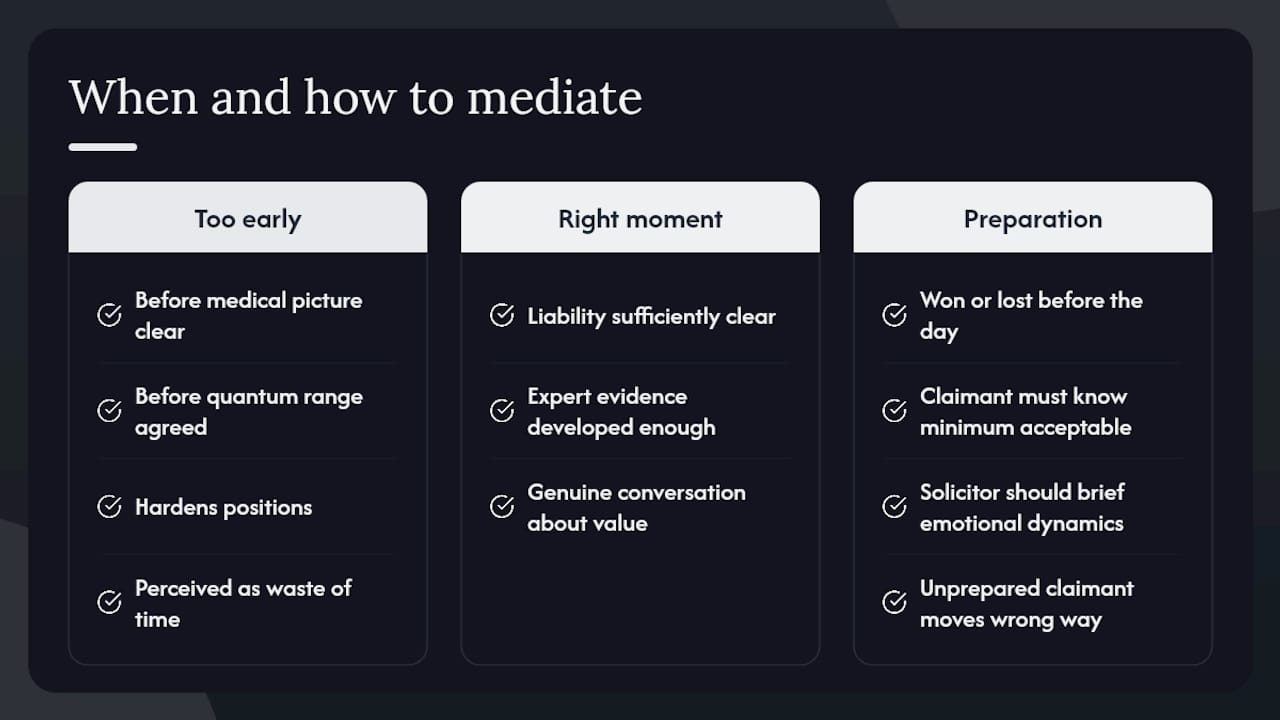
Mediation that happens too early, before the medical picture is clear or before a realistic quantum range can be agreed, tends to harden positions rather than resolve them. Both sides leave feeling the process was a waste of time and money, and the case becomes harder to settle afterwards because the failed mediation has become part of the narrative. The right moment is usually when liability is sufficiently clear and the expert evidence is developed enough that both sides can have a genuine conversation about value, not before.
Preparation is where most mediations are won or lost before the day begins. A claimant who arrives without a clear sense of their minimum acceptable outcome, or whose solicitor has not briefed them on the emotional dynamics of the process, is at a structural disadvantage from the opening session. The mediator’s job is to help both sides move, and an unprepared claimant moves in the wrong direction.
There is also a tactical dimension that rarely gets discussed openly. Defendants and their insurers attend mediations regularly. Many claimants attend once in their lives. That asymmetry of experience matters. An experienced solicitor who has sat in dozens of mediation rooms knows when an insurer’s final offer is genuinely final and when it is a pressure tactic designed to exploit the end-of-day fatigue that affects claimants far more than it affects professional negotiators. Choosing a solicitor with real mediation experience, not just litigation experience, is one of the most consequential decisions a claimant makes.
Ali Legal Ltd acts for claimants across a range of personal injury matters, from road traffic accidents and employer liability claims to more complex clinical negligence disputes. Where mediation offers a realistic route to settlement, the firm advises on timing, prepares position statements, attends the session, and drafts the binding settlement agreement.

The firm’s approach is direct: mediation is recommended when the evidence supports a genuine negotiation, not as a box-ticking exercise. Ali Legal Ltd’s solicitors prepare clients thoroughly before the day, manage authority carefully during the session, and advise on whether a late offer is worth accepting or whether the case is better taken further. Fixed-fee options are available for mediation preparation and attendance, so you know the cost before committing.
To discuss whether mediation is the right next step for your personal injury claim, contact Ali Legal Ltd for a consultation. The team can also advise on the full range of civil dispute resolution options if mediation is not yet the right fit.
This article provides general information about mediation in personal injury claims in England and Wales. It is not legal advice. You should confirm the current rules and your options with a qualified solicitor before making any decisions about your claim.
The sources below are the primary references for this guide. Each is freely accessible and carries significant weight with courts and practitioners.
This article is general information, not a substitute for advice from a qualified lawyer. Consult a qualified legal professional about your own circumstances before acting on anything here.


