
Menu
Get Expert Legal Support Today

TL;DR:
- An arbitration lawyer advises clients on dispute resolution outside courts, including drafting clauses and representing parties. Early instruction, especially at contract signing, reduces procedural costs, delays, and enforcement challenges in international arbitration. Their expertise spans drafting, case management, advocacy, enforcement, and proactively shaping dispute strategies.
An arbitration lawyer is a specialist in private dispute resolution who advises clients, drafts enforceable arbitration clauses, and represents parties in binding hearings outside the court system. If you are signing a high-value commercial contract, facing a cross-border dispute, or dealing with a matter where confidentiality matters, instructing one early can determine whether you end up in a costly procedural fight or a well-managed process. The governing statute in England and Wales is the Arbitration Act 1996, and the principal accreditation body for practitioners is the Chartered Institute of Arbitrators (CIArb). Ali Legal Ltd handles both contract-stage drafting and active dispute representation for UK individuals and businesses.
You need an arbitration lawyer in three broad situations:
Arbitration lawyers handle drafting arbitration clauses, advising on jurisdictional strategy, selecting arbitrators, managing evidence, preparing written submissions, and representing clients at hearings. That list spans the entire lifecycle of a dispute, and the value of good counsel shows at every stage.
| Stage | Core duties | What goes wrong without specialist advice |
|---|---|---|
| Pre-dispute | Drafting arbitration clauses; advising on seat, rules, and governing law | Poorly worded clauses trigger jurisdictional fights before the merits are even reached |
| Case management | Arbitrator selection; preliminary challenges; disclosure strategy; witness statements | Wrong arbitrator choice or weak disclosure strategy undermines the case from the start |
| Advocacy | Written submissions; skeleton arguments; oral advocacy; interim relief applications | Unstructured submissions lose credibility with the tribunal |
| Post-award | Explaining the award; advising on set-aside grounds; enforcement strategy | Missed deadlines or wrong enforcement route can render a valid award worthless |
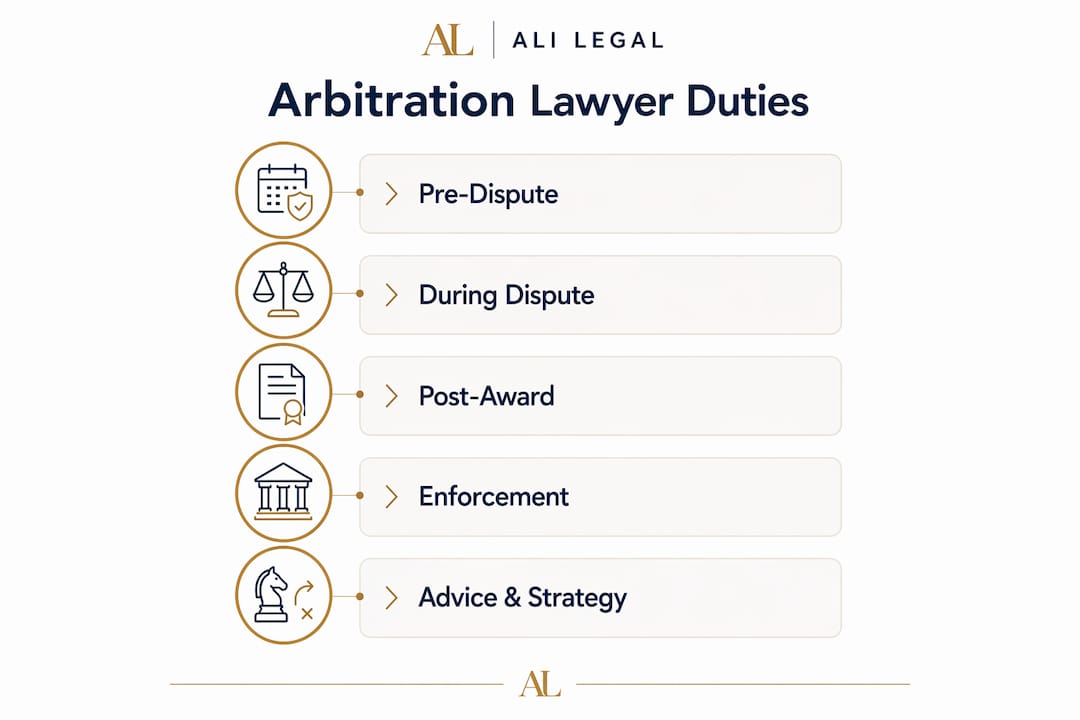
The pre-dispute stage is where most clients underestimate the value of specialist input. A poorly drafted arbitration clause is one of the most common causes of early procedural disputes that inflate cost and delay resolution. Bespoke drafting, tailored to the deal and the likely dispute profile, prevents that friction entirely.
Post-award work is equally specialist. Enforcement under the New York Convention requires understanding which assets are reachable, which courts in which jurisdictions will recognise the award, and whether any challenge grounds exist. An arbitration lawyer who has only ever run hearings but never enforced an award is only half the picture.
The honest answer is: earlier than most clients do. Instructing at contract stage costs a fraction of what procedural skirmishes cost once a dispute is live.

At the contracting stage, the lawyer’s job is to draft the arbitration clause as a bespoke commercial negotiation point. That means setting the seat explicitly (London is the most common choice for international contracts), agreeing the institutional rules (ICC, LCIA, or UNCITRAL are the main options), fixing the number of arbitrators, and specifying the language. It also means deciding whether to include an express confidentiality provision, since UK law does not guarantee privacy by statute. Getting this right at signing costs far less than litigating it later.
After a dispute arises, the priority shifts. The first questions are jurisdictional: does the clause actually cover this dispute? Is there a valid agreement to arbitrate? Can the other party challenge the tribunal’s jurisdiction? These are not academic points. A weak clause can allow a party to run to court instead, destroying the confidentiality and enforcement advantages you chose arbitration for in the first place.
The typical stages of an arbitration, once proceedings begin, run broadly as follows:
Timelines vary considerably. A straightforward two-party commercial dispute with a sole arbitrator and agreed procedures can conclude in under a year. Complex multi-party disputes with extensive disclosure, expert witnesses, and preliminary hearings regularly run to 18–24 months. Procedural skirmishes, particularly over jurisdiction or disclosure scope, are the single biggest driver of delay.
Pro Tip: Involve legal counsel at the contract stage, not just when a dispute arises. Decisions made at signing, such as the seat, the rules, and the number of arbitrators, directly control the cost and duration of any future proceedings.
The roles in arbitration are distinct, and conflating them leads to confusion when instructing.
Solicitors manage the overall conduct of proceedings: they advise the client, handle correspondence, coordinate evidence, and instruct barristers for advocacy where needed. Most arbitration teams at UK law firms are solicitor-led.

Barristers specialise in advocacy and written submissions. Under the Bar Council’s direct access rules, clients in the UK can instruct a barrister directly for hearing advocacy in some cases without a separate solicitor, which can reduce cost for specific, well-defined advocacy needs.
Arbitrators are a different role entirely. They are the decision-makers, not the advocates. Senior barristers, retired judges, and specialist solicitors frequently sit as arbitrators. CIArb accreditation is the principal qualification signal: membership grades range from Associate to Fellow, with Fellow (FCIArb) indicating the highest level of recognised expertise.
Beyond CIArb, the practical signals of genuine expertise are track record with specific institutional rules (ICC, LCIA, UNCITRAL), multi-jurisdictional experience, and sector knowledge. An arbitration lawyer who has handled ten construction disputes is a different proposition from one whose experience is entirely in financial services, even if both hold the same formal qualifications.
Arbitration is not automatically cheaper than litigation. Whether it is depends almost entirely on the procedural choices made at the contracting stage and the conduct of the parties once a dispute arises.
The primary cost drivers are:
Funding options available in England and Wales include conditional fee arrangements (CFAs), damages-based agreements (DBAs), and third-party litigation funding. Cost-shifting is possible: tribunals can award costs against the losing party, but the outcome is not guaranteed and depends on the rules chosen and the conduct of the proceedings.
Pro Tip: The seat, the number of arbitrators, and the chosen rules are the three variables that most directly control future costs. Negotiate them at contract stage, not after a dispute has started.
This is where a common assumption causes real problems. Many clients choose arbitration specifically because they believe it is private. It often is, in practice. But it is not guaranteed by statute.
The Arbitration Act 2025 introduced enhanced arbitrator disclosure duties and other discrete reforms, but it did not codify a universal confidentiality rule. Confidentiality in English-seated arbitration rests on common-law principles and, critically, on whatever the parties have agreed in their contract.
The practical implications are significant:
To strengthen confidentiality, the arbitration agreement should expressly prohibit disclosure of the proceedings, the award, and any documents produced in the process, subject to agreed exceptions for enforcement and regulatory obligations. The seat matters too: some jurisdictions provide statutory confidentiality that English law does not, which is a legitimate reason to choose a non-London seat for certain disputes.
Selection criteria matter more than most clients realise. Arbitration is a specialist field within a specialist field: a general commercial litigator with occasional arbitration experience is not the same as a practitioner whose practice is built around it.
What to look for:
Questions to ask in a first meeting:
Red flags to watch for:
For international matters, also check whether the lawyer has experience with international arbitration strategy across multiple jurisdictions, not just English-seated proceedings. The ICC accounted for a significant share of international arbitration filings in recent years, and familiarity with its specific procedural requirements is a practical differentiator.
An award is not automatically self-executing. What happens next depends on whether the losing party complies voluntarily, and if not, where their assets are.
Enforcement in the UK and abroad:
Arbitral awards are often easier to enforce across borders than foreign court judgments, because the New York Convention provides a recognised framework in over 170 signatory states. Enforcement in a Convention state involves applying to the local court for recognition; the grounds for refusal are narrow and defined.
Practical steps after an award:
Challenge and set-aside:
Under English law, the grounds for challenging an award are deliberately narrow. A party can apply to the court under the Arbitration Act 1996 on grounds of serious irregularity or on a point of law (the latter only where the parties have not excluded it). The seat determines which court has supervisory jurisdiction, which is one reason seat selection matters so much at the contracting stage.
Cross-border enforcement is where the choice of seat and governing law has its most direct commercial consequence. An award from a London-seated arbitration carries strong international recognition, which is a practical reason why London remains one of the world’s most frequently chosen arbitration seats.
Arbitration is often presented as a gentler alternative to litigation. In practice, it is a different kind of fight, with its own procedural culture, its own cost dynamics, and its own enforcement machinery. The clients who get the best outcomes are the ones who treat it strategically from the moment they sign a contract, not from the moment a dispute lands.
What I see repeatedly is that the procedural decisions made at contracting stage, the seat, the rules, the number of arbitrators, are treated as boilerplate. They are not. They are the architecture of any future dispute. A clause that looks standard can lock a client into a three-member ICC tribunal for a dispute that a sole arbitrator could have resolved in six months at a third of the cost. Conversely, a well-drafted clause with the right institutional rules can give a claimant genuine leverage before a hearing even begins.
The other underestimated point is enforcement. Winning an award means nothing if you cannot collect on it. The New York Convention framework is powerful, but it requires knowing where assets are, which courts will cooperate, and how to move quickly before a losing party reorganises. That is not a task for a lawyer who has only ever run hearings.
Ali Legal Ltd combines contract-stage drafting with active dispute management and post-award enforcement, which means clients get consistent advice across the full lifecycle rather than handing off between teams at the worst possible moment.
Ali Legal Ltd acts for UK individuals and businesses on international disputes and arbitration, from contract-stage clause drafting through to cross-border enforcement. The firm offers fixed fees and clear advice, with no unnecessary complexity in how it structures its services.

If you are reviewing a contract that includes an arbitration clause, or if a dispute has already arisen and you need to understand your position, Ali Legal Ltd can provide a focused case assessment. The team is familiar with ICC, LCIA, and UNCITRAL rules, and has experience enforcing awards across multiple jurisdictions. For corporate disputes, the firm’s corporate litigation guidance covers the full range of commercial dispute options. Contact Ali Legal Ltd to request a contract review or initial case assessment.
The following primary and secondary sources underpin the claims in this article and provide further reading for those who want to go deeper.
| Source | Type | Focus |
|---|---|---|
| Arbitration Act 1996 | UK statute | Governing framework for arbitration in England and Wales |
| Arbitration Act 2025 | UK statute / Mondaq analysis | Recent reforms including arbitrator disclosure duties |
| Chartered Institute of Arbitrators (CIArb) | Accreditation body | Membership grades, training, and practitioner standards |
| Chambers and Partners: Arbitration solicitors and agreements | Practice guide | Role definition, clause drafting, and cost drivers |
| ICLG: International Arbitration 2025, England & Wales | Comparative law guide | Legislative framework, rights of audience, funding options |
| Bar Council: International Arbitration brochure | Professional guidance | Direct access to barristers; advocacy cost optimisation |
| Mondaq: Should you arbitrate your disputes? | Practice commentary | Clause drafting pitfalls and New York Convention enforcement |
| Ali Legal: Role of arbitration clauses in UK contracts | Firm resource | Practical clause drafting guidance for UK contracts |
| Ali Legal: International arbitration strategies | Firm resource | Institutional strategy and ICC/LCIA considerations |
| ICC Cost Calculator | Tool | Estimate ICC administrative fees and arbitrator costs by dispute value |
This article provides general information about arbitration law in the UK and does not constitute legal advice. For advice specific to your situation, consult a qualified solicitor or contact Ali Legal Ltd directly.


