
Menu
Get Expert Legal Support Today

TL;DR:
- The legal aid helpline in England and Wales offers initial advice and eligibility checks for civil matters. It does not provide legal aid applications or find solicitors, which are handled separately through contracted legal professionals. Accessing funded legal support often requires contacting multiple solicitors or organizations due to limited capacity and market contraction.
The number to legal aid civil advice in England and Wales is 0345 345 4345, operated by the Civil Legal Advice (CLA) helpline. This free service covers housing, debt, and family law matters for eligible callers. Calling this number does not apply for legal aid. It is the first step: an initial advice call and eligibility check, managed by the Legal Aid Agency. Understanding the difference between this helpline and the formal application process saves you time and prevents the most common mistake people make when seeking funded legal representation.
The CLA helpline number is 0345 345 4345, open Monday to Friday, 9am to 8pm, and Saturday, 9am to 12:30pm. Calls from BT landlines cost 4p per minute. Calls from mobiles may cost more, depending on your network tariff.

The helpline covers civil matters only. Housing disputes, debt problems, and family law issues all fall within its scope. Criminal law cases are outside its remit entirely, so if your matter involves a criminal charge, you need to contact a solicitor directly rather than calling this number.
Accessibility options are available for callers who cannot use a standard phone. Textphone numbers 0345 609 6677 and 0345 435 4345 serve callers with hearing or speech difficulties. A text callback service also exists: text ‘legalaid’ and your name to 80010, and the helpline will respond within one working day.
Before you call, gather the following information:
Pro Tip: If phone lines are busy, use the text callback service by texting ‘legalaid’ and your name to 80010. This reduces wait times and still connects you to a qualified adviser, usually within one working day.
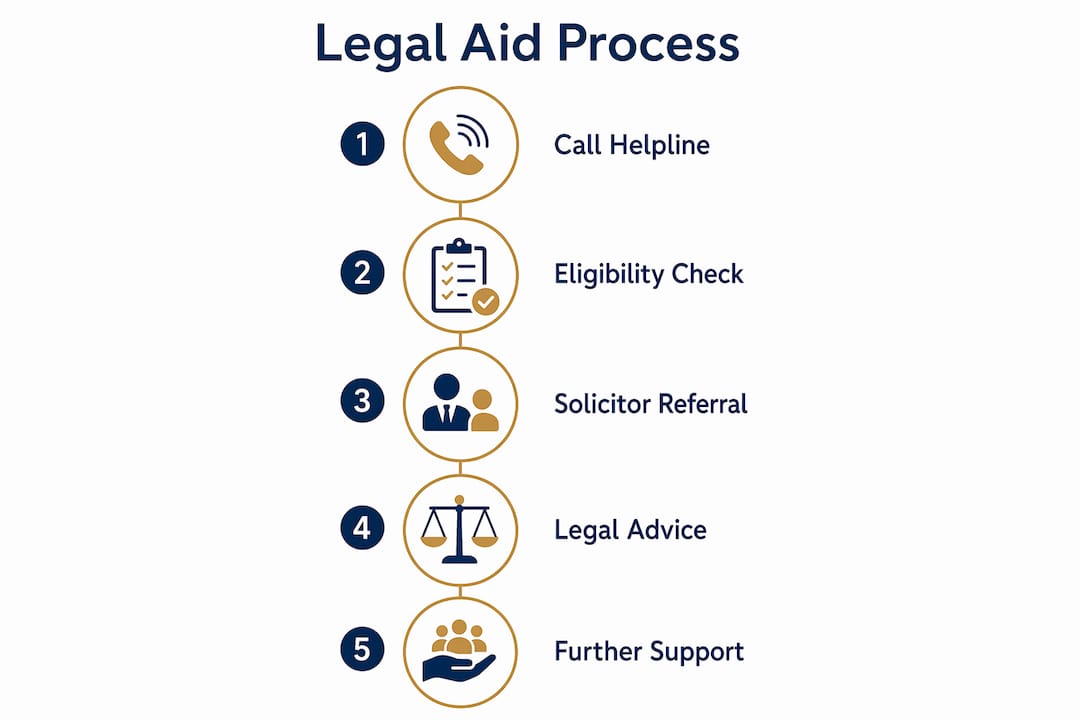
Legal aid is government funding for legal representation, administered by the Legal Aid Agency. You cannot apply for it by calling a helpline. A solicitor or mediator who holds a Legal Aid Agency contract must assess your case, confirm your eligibility, and submit the application on your behalf.
The formal process follows these steps:
Financial eligibility in 2026 follows specific thresholds. The table below summarises the current limits:
| Financial measure | 2026 threshold |
|---|---|
| Gross monthly income | Under £2,657 |
| Disposable monthly income | Under £733 |
| Capital (savings and assets) | Under £8,000 |
These 2026 eligibility thresholds apply to most civil legal aid cases. Emergency legislation introduced from june 2025 onwards waives contributions for new applications, which means qualifying applicants pay nothing upfront during this period.
Solicitors act as gatekeepers to the system. Without a practitioner who holds a Legal Aid Agency contract, you cannot access funded representation, regardless of how clearly you qualify on financial grounds. This is why the CLA helpline is a starting point, not an application route.
For urgent cases, do not wait for the helpline to refer you. Contact solicitors and Law Centres directly, as delays in urgent matters can affect the outcome of your case significantly.
Solicitor capacity for legal aid cases is restricted by contract limits, and many firms operate waiting lists. This contraction in the market means that even eligible individuals sometimes struggle to find representation quickly. Contacting multiple firms and local Law Centres is not a last resort. It is standard practice in 2026.
A common misunderstanding is that statutory legal aid and free legal advice are the same thing. They are not. Statutory legal aid is government-funded representation through the Legal Aid Agency. Free legal advice from charities and pro bono organisations is separate, with different eligibility rules and a different scope of service.
If you do not qualify for statutory legal aid, or cannot find a solicitor with capacity, the following organisations provide free or low-cost legal help:
Citizens Advice and LawWorks complement statutory legal aid but operate independently. Their scope and eligibility criteria differ, so do not assume that qualifying for one means you qualify for the other.
Pro Tip: Law Centres often have shorter waiting times than private solicitors for legal aid cases. Search for your nearest Law Centre through the Law Centres Network website before assuming no funded help is available in your area.
Legal professionals note that public confusion between statutory legal aid and charity-based advice is one of the most common barriers to people getting the right help. Knowing which system you are dealing with puts you ahead of most callers.
Getting the right outcome from the legal aid system depends on preparation and persistence. The steps below reflect what experienced advisers recommend to callers in 2026.
Pro Tip: If your case is urgent, state that clearly when you first contact a solicitor or Law Centre. Many firms prioritise urgent matters even when their general legal aid caseload is full. A personalised legal approach can make a significant difference in time-sensitive situations.
Understanding how to choose a solicitor with the right Legal Aid Agency contract is as important as knowing the eligibility rules. A solicitor who does not hold the relevant contract cannot help you, regardless of their expertise.
The CLA helpline at 0345 345 4345 is genuinely useful as a first call. Advisers are knowledgeable, and the eligibility check saves people from pursuing applications that will not succeed. What the helpline cannot do is find you a solicitor, manage your case, or substitute for proper legal representation.
The part that frustrates me is the gap between eligibility and access. You can meet every financial threshold and still spend weeks finding a solicitor with capacity. The contracting market for legal aid solicitors has shrunk considerably, and that reality does not show up in the official guidance. Callers who assume the helpline will connect them to a solicitor are often disappointed.
My recommendation is to treat the helpline as one tool among several, not the whole solution. Use it to confirm your case type qualifies and to get initial advice. Then contact solicitors and Law Centres directly and in parallel. The GOV.UK eligibility checker is worth completing before you call, because it gives you a clearer picture of where you stand and makes the helpline conversation more productive.
The people who navigate this system well are the ones who act quickly, contact multiple sources simultaneously, and do not wait for one route to fail before trying another.
— Panagiotis
Legal aid covers a defined range of civil matters, and not every legal problem falls within its scope. Property disputes, commercial agreements, and corporate matters often sit outside what the Legal Aid Agency funds, which is where professional legal representation becomes the practical route forward.
Ali Legal Ltd provides clear, fixed-fee legal advice across property law, corporate and commercial law, and international disputes. Whether you are a property owner navigating a complex transaction or a business facing a contractual dispute, Ali Legal Ltd offers direct access to qualified solicitors without the waiting lists associated with legal aid. Explore Ali Legal’s UK property law guidance or review the firm’s corporate law services to find the right support for your situation. Transparent fees and straightforward advice are the standard, not the exception.
The legal aid assistance phone number is 0345 345 4345, operated by Civil Legal Advice. It is open Monday to Friday, 9am to 8pm, and Saturday, 9am to 12:30pm.
No. Calling the CLA helpline provides initial advice and an eligibility check only. A solicitor with a Legal Aid Agency contract must submit the formal application on your behalf.
Eligibility requires gross monthly income under £2,657, disposable monthly income under £733, and capital under £8,000. Emergency legislation from june 2025 waives contributions for new applicants.
Contact multiple solicitors and local Law Centres simultaneously, as capacity is limited across the market. Organisations such as Citizens Advice and LawWorks also provide free legal advice for those who do not qualify or cannot find funded representation.
Yes. Text ‘legalaid’ and your name to 80010 for a callback, usually within one working day. Textphone users can call 0345 609 6677 or 0345 435 4345 for accessibility support.


