
Menu
Get Expert Legal Support Today

TL;DR:
- A commercial lawyer advises businesses on transactions, contracts, disputes, and compliance with laws and regulations. They draft agreements, manage risk, and support dispute resolution, often preventing costly issues through proactive guidance. Their expertise covers multiple specializations, emphasizing early legal advice to achieve better business outcomes.
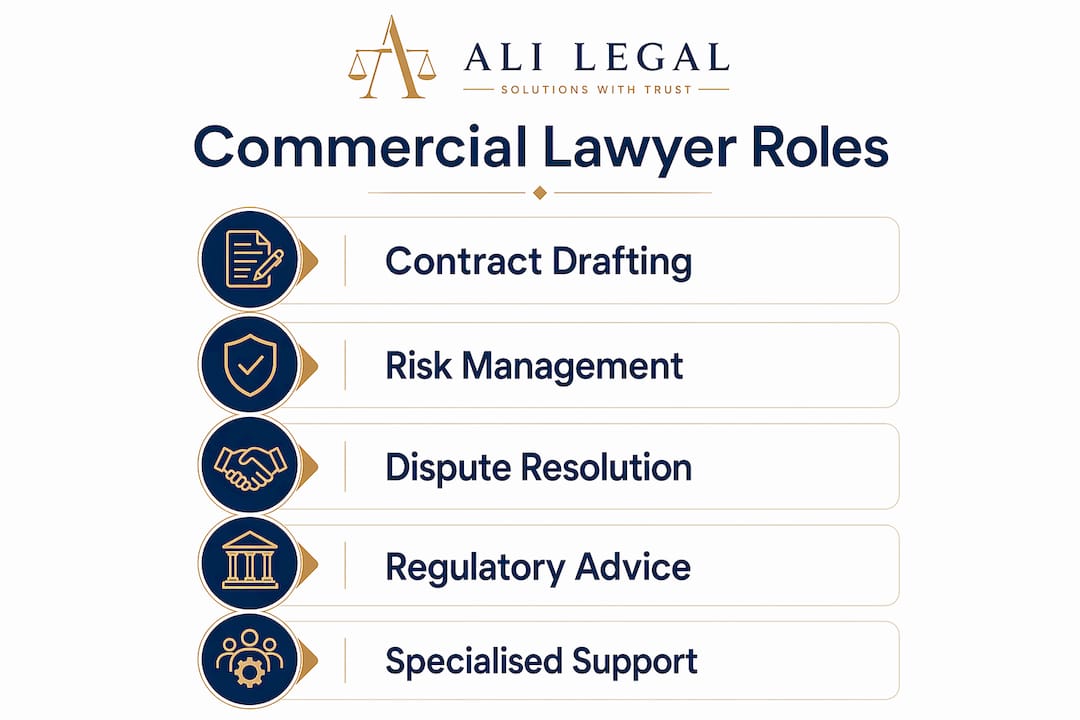
A commercial lawyer is a legal professional who specialises in advising businesses on their transactions, contracts, disputes, and compliance with relevant laws and regulations. In UK practice, the term “commercial solicitor” is the recognised professional title, though “commercial lawyer” is widely used and understood. What do commercial lawyers do in practical terms? They draft and negotiate agreements, manage regulatory risk, and act as a buffer between your business and costly legal disputes. Commercial law governs business trade involving contracts, supply agreements, intellectual property, data processing, and debt recovery. That scope makes commercial solicitors one of the most consequential advisers a business can retain.
Ali Legal Ltd operates across all of these areas, offering fixed-fee commercial legal services to businesses and individuals in the UK and internationally. The Law Society sets the professional standards that all practising solicitors must meet, and commercial solicitors are no exception. Understanding what these professionals actually do helps you decide when to call one, and how to get the most from the relationship.

Commercial solicitors perform a wide range of tasks that sit at the intersection of law and business operations. Their core function is to protect your commercial interests at every stage of a transaction.
The most frequent tasks include:
Professional legal advice is highly cost-effective for high-value or high-risk contracts, particularly those involving intellectual property or sensitive data. The cost of a solicitor reviewing a contract is almost always lower than the cost of litigating a poorly drafted one.
Pro Tip: Ask your solicitor to flag the top three risk clauses in any contract before you sign. That single conversation can save months of dispute later.
The role also extends to structuring contracts so that payment terms, confidentiality obligations, and exit clauses work together as a coherent whole, not as isolated provisions bolted together.
Business disputes are inevitable. What separates a manageable dispute from a damaging one is how quickly and effectively it is handled.
Commercial solicitors deal with a broad range of conflicts:
English courts actively encourage the use of Alternative Dispute Resolution (ADR) methods such as mediation and arbitration before litigation begins. That means your solicitor’s first move is rarely to issue proceedings. The advantages of ADR include lower costs, faster resolution, and the preservation of commercial relationships that litigation tends to destroy.
A commercial litigation solicitor spends significant time resolving disputes early, guiding clients through pre-action protocols, formal correspondence, evidence gathering, and negotiation. Court proceedings are the last resort, not the first response. Early intervention consistently produces better outcomes for businesses than waiting until a dispute has fully escalated.
When litigation does become necessary, commercial solicitors guide clients through every stage: issuing claims, managing disclosure, preparing witness evidence, and enforcing judgments. The role of a solicitor in this process is to manage both the legal strategy and the commercial reality, keeping disruption to your business to a minimum.
Delaying legal consultation reduces your leverage and risks locking you into unfavourable positions. Early advice allows stronger negotiation and often resolves issues without any court involvement at all.
Commercial law is not a single discipline. It draws on contract law, company law, property law, intellectual property, and regulatory compliance, often simultaneously.
The Law Society provides specialist training programmes that reflect this complexity. Courses covering commercial leases and cross-border compliance typically require a 70% pass mark for proficiency, with modules lasting 40–60 minutes focused on landlord and tenant law, business dynamics, and commercial awareness. That standard exists because the consequences of getting it wrong, such as a poorly drafted break clause or an unenforceable guarantee, fall directly on the client.
The key competencies a well-trained commercial solicitor brings to the table are:
In-house lawyers must shift from purely legal analysis to business advisory, understanding company needs and external industry factors. That shift reflects a broader truth: the best commercial solicitors think like business people who happen to have legal training, not the other way around.
Legal risk management is therefore a core skill, not an optional extra. A solicitor who cannot connect legal exposure to business consequence is only doing half the job.
“Commercial lawyer” is an umbrella term. The role varies considerably depending on the area of practice.
| Specialisation | Core focus | Typical tasks |
|---|---|---|
| Commercial contracts | Trading relationships and agreements | Drafting, reviewing, and negotiating supply, service, and licensing contracts |
| Commercial real estate | Property transactions and tenancies | Leases, licences, acquisitions, and disposals of business premises |
| Corporate law | Company structure and governance | Mergers, acquisitions, shareholder agreements, and board-level compliance |
| Intellectual property | Ownership and exploitation of ideas | Trade mark registration, licensing, and infringement claims |
| International trade | Cross-border transactions | Export contracts, jurisdiction clauses, and cross-border compliance |
| Mergers and acquisitions | Business sales and purchases | Due diligence, deal structuring, and transaction management |
Commercial real estate lawyers occupy a distinct niche. What do commercial real estate lawyers do that differs from general commercial solicitors? They focus specifically on the legal aspects of business property: negotiating leases, advising on break options, managing licences to alter, and handling the purchase or sale of commercial premises. Accuracy when drafting commercial leases mitigates future risks, particularly around break options and tenancy variations. A poorly negotiated lease can bind a business to unfavourable terms for a decade or more.
Corporate lawyers, by contrast, focus on company structure rather than trading relationships. They handle mergers and acquisitions, shareholder disputes, and the legal framework within which a business operates. The corporate law guide from Ali Legal Ltd covers the full range of duties and risks that businesses face in this area.
Pro Tip: When selecting a solicitor, match their specialisation to your specific need. A corporate lawyer is not the right choice for a commercial lease negotiation, and vice versa.
Ali Legal Ltd covers multiple specialisations under one roof, including commercial property law, corporate and M&A work, and international disputes, which means clients do not need to manage multiple firms for related matters.
The conventional view of lawyers is reactive: something goes wrong, you call a solicitor. That model is expensive and often avoidable.
My experience working across commercial transactions is that the businesses which get the best legal outcomes are those that bring their solicitor in before a contract is signed, not after a dispute has started. A commercial lawyer acts as a strategic partner by spotting risks early, defining clear deliverables, and protecting cash flow through contract terms. That is a fundamentally different proposition from fixing a problem after it has already cost you money.
The distinction matters practically. A solicitor reviewing a contract before signature can renegotiate a liability cap, tighten a payment clause, or remove an ambiguous termination provision in a single conversation. The same solicitor, brought in after a dispute has arisen from that clause, faces months of correspondence, potential litigation, and a client who has already suffered financial harm.
Engaging a commercial lawyer early in negotiations builds leverage and helps avoid unfavourable terms that may otherwise become binding. That is not a sales pitch for legal services. It is a straightforward observation about where legal advice delivers the most value. The businesses I have seen struggle most with legal costs are those that treated solicitors as a last resort rather than a first call.
— Panagiotis
Ali Legal Ltd provides commercial legal services to businesses and individuals across the UK and internationally, covering contracts, disputes, real estate, and corporate transactions.

Whether you need a commercial contract reviewed before signing, advice on a lease negotiation, or representation in a dispute, Ali Legal Ltd offers clear, fixed-fee guidance without the uncertainty of open-ended billing. The firm’s practice covers commercial property law in full, from lease drafting to property acquisitions, as well as corporate and M&A matters for businesses at every stage of growth. Clients receive direct access to experienced solicitors who combine legal precision with an understanding of commercial reality. Contact Ali Legal Ltd to discuss your specific legal needs and get advice that protects your business interests from the outset.
A commercial solicitor drafts and reviews contracts, advises on regulatory compliance, negotiates commercial terms, and manages disputes. Day-to-day work ranges from reviewing supply agreements to advising on intellectual property licensing and debt recovery.
Fees vary by firm, complexity, and location. Some firms offer fixed fees for defined tasks such as contract reviews, while others charge hourly rates. Ali Legal Ltd offers fixed-fee commercial legal services, which provides cost certainty from the outset.
Commercial real estate lawyers advise on the acquisition, disposal, and leasing of business premises. Their work includes negotiating lease terms, advising on break options, managing licences, and handling property transactions for businesses.
A business should consult a commercial solicitor before signing any significant contract, when entering a new trading relationship, or at the first sign of a dispute. Early advice consistently produces better outcomes and lower costs than waiting until a problem has escalated.
Commercial law governs trading relationships, including contracts, supply agreements, and intellectual property. Corporate law focuses on company structure, governance, shareholder rights, and transactions such as mergers and acquisitions. Many businesses need both, depending on the matter at hand.


