
Menu
Get Expert Legal Support Today

TL;DR:
- Contract dispute mediation is a voluntary, confidential process that helps parties reach settlement without court involvement. It outperforms litigation in cost, time, privacy, and preserving relationships, with a high success rate of over 89%. Preparation, genuine willingness, and skilled mediators increase the chances of successful resolution.
Contract dispute mediation is a voluntary, confidential process in which a neutral third party facilitates a mutually acceptable settlement between parties in disagreement over a contract. Unlike litigation, mediation gives both sides control over the outcome rather than leaving a decision to a judge. Commercial mediations settle at a rate exceeding 89%, making it the most reliable form of alternative dispute resolution available to businesses and individuals in England and Wales. Under the Civil Procedure Rules, parties are expected to consider mediation before or alongside litigation to reduce costs and delays. The result is a process that resolves disputes faster, at a fraction of the cost, and without the reputational exposure of a public court hearing.
Mediation follows a structured process, though it remains far more flexible than court proceedings. Understanding each stage helps parties prepare properly and participate with confidence.
Before the session, each party submits a position paper to the mediator. This document outlines the key facts, the issues in dispute, and the outcome the party seeks. The mediator reviews both papers privately, identifies areas of potential agreement, and plans the session accordingly. Parties also agree on a mediator at this stage, either through a recognised body such as CEDR (Centre for Effective Dispute Resolution) or through mutual selection.
Most commercial mediations conclude within a half or full day session, with preparation completed in the weeks prior. The session typically opens with a joint meeting where both parties and their legal advisers present their positions. The mediator then moves between private rooms in a process known as shuttle negotiation, or caucus. In these private sessions, the mediator explores each party’s real interests, tests the strength of their positions, and identifies where movement is possible.
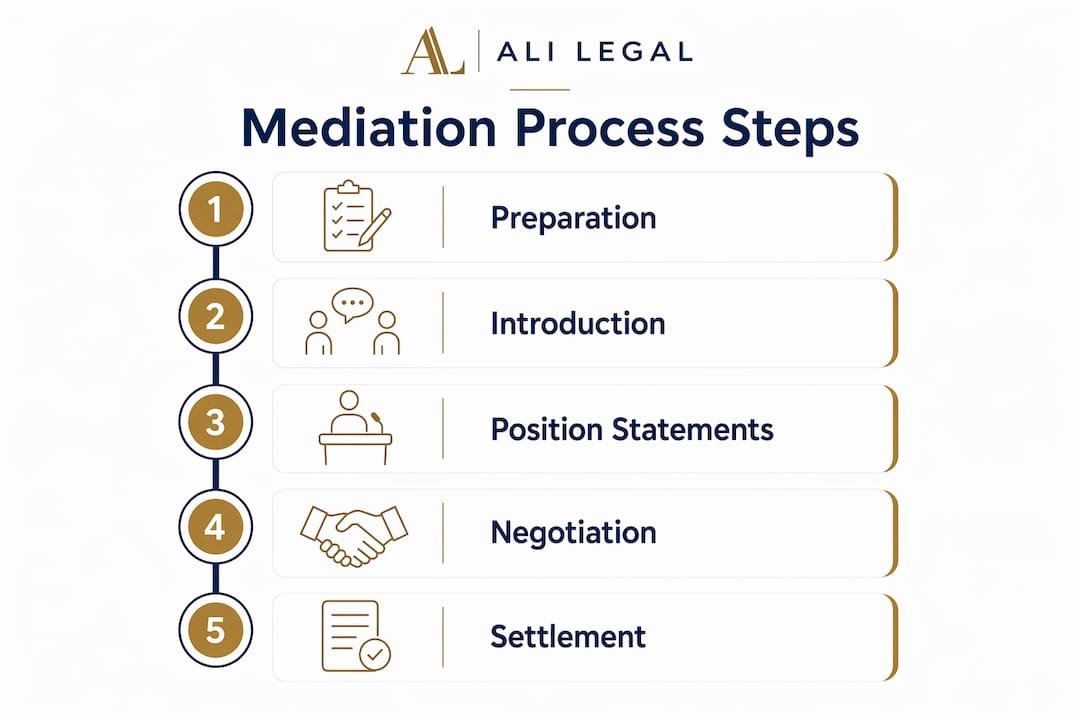
The mediator does not impose a decision. Mediation is confidential, voluntary, and facilitated by a neutral who guides negotiation without binding either party. This distinction matters enormously. Parties retain full authority over whether to settle and on what terms.
Pro Tip: Bring a draft settlement agreement to the mediation session. Having a template ready removes a common reason for delay when parties reach agreement late in the day.
Mediation outperforms litigation on every practical measure that matters to businesses and individuals: cost, time, privacy, and outcome flexibility.
Typical commercial mediation costs range between £1,500 and £3,500 per party. Court litigation for a comparable commercial dispute routinely runs into tens of thousands of pounds once you account for solicitor fees, barrister fees, court fees, and the cost of management time. The financial case for mediation is clear before any other factor is considered.

Commercial mediation resolves disputes within 2–6 weeks, compared to 18 months to 3 years for court litigation. For a business with a live contract dispute, that difference is not merely convenient. It is often the difference between preserving a commercial relationship and watching it collapse under the weight of prolonged legal conflict.
Court proceedings are public. Mediation is entirely private. Sensitive commercial terms, pricing structures, and internal communications never enter the public record. Beyond confidentiality, mediation preserves business relationships and facilitates creative commercial solutions that courts simply cannot order. A judge can award damages. A mediator can help parties agree a revised contract, a phased payment schedule, or a joint statement that protects both reputations.
| Factor | Mediation | Litigation |
|---|---|---|
| Typical cost per party | £1,500–£3,500 | Tens of thousands of pounds |
| Typical timeframe | 2–6 weeks | 18 months to 3 years |
| Outcome control | Parties decide | Judge decides |
| Confidentiality | Yes, fully private | No, public record |
| Relationship preservation | High | Low |
| Creative solutions | Yes | Limited to legal remedies |
Pro Tip: If your dispute involves an ongoing supplier or client relationship, choose mediation before issuing proceedings. A court win that destroys a valuable commercial relationship is rarely a true win.
For a broader view of dispute resolution options available to UK businesses, the range of methods extends well beyond mediation and litigation alone.
Preparation is the single greatest factor within a party’s control. Parties who arrive at mediation without clear objectives, authority to settle, or organised documentation consistently achieve worse outcomes.
Ali Legal Ltd works with clients ahead of mediation sessions to prepare position papers, identify settlement parameters, and ensure the right people attend with the right authority. That preparation work frequently determines whether a mediation ends in agreement.
Pro Tip: Draft a Heads of Terms document before the session. If full settlement drafting runs late in the day, signing Heads of Terms preserves the agreement reached and prevents overnight reconsideration from unravelling progress.
Settlement is not guaranteed, but specific factors consistently separate mediations that succeed from those that stall.
“The parties who succeed in mediation are rarely those with the strongest legal case. They are the ones who arrive prepared, stay focused on outcomes, and treat the mediator as an asset rather than an obstacle.”
Understanding the role of a solicitor in dispute resolution helps parties get the most from both their legal adviser and the mediation process itself.
My experience with commercial contract disputes has taught me one consistent lesson: parties almost always underestimate how much mediation can achieve, and they almost always overestimate how well they would fare in court.
The 89% settlement rate is not a marketing figure. It reflects a structural reality. Mediation creates conditions that litigation destroys. Both parties speak directly, often for the first time since the dispute escalated. A skilled mediator surfaces the commercial interests beneath the legal positions. And because the process is confidential, parties can make concessions without fear of those concessions being used against them in subsequent proceedings.
The most common misconception I encounter is that attending mediation signals weakness. The opposite is true. Courts in England and Wales now look unfavourably on parties who refuse reasonable mediation proposals. Refusing mediation can result in adverse cost orders even for a winning party. That is not a theoretical risk. It is a documented consequence under current Civil Procedure Rules guidance.
My advice to any business or individual facing a contract dispute is straightforward. Engage a solicitor who understands mediation, not just litigation. Prepare your position with the same rigour you would apply to a court hearing. And attend with genuine authority and genuine willingness to resolve. Those three steps account for the vast majority of successful outcomes I have seen.
— Panagiotis
Ali Legal Ltd supports businesses and individuals at every stage of the mediation process, from preparing position papers and advising on settlement parameters to attending sessions and drafting binding agreements.
The firm’s solicitors bring direct experience in commercial dispute resolution and understand how to prepare clients for mediation in a way that maximises the chance of settlement. Ali Legal Ltd offers clear, fixed-fee advice with no hidden costs, so you know exactly what you are committing to before the process begins. Whether your dispute involves a supplier contract, a service agreement, or a complex commercial arrangement, the team provides practical guidance focused on protecting your interests and reaching resolution efficiently. Contact Ali Legal Ltd to discuss your situation and take the first step towards resolving your dispute.
Contract dispute mediation is a confidential, voluntary process in which a neutral mediator helps disputing parties reach a mutually acceptable settlement without going to court. The mediator facilitates negotiation but does not impose a decision on either party.
Most commercial mediations conclude within a half or full day session, with the overall process from instruction to resolution typically taking 2–6 weeks. This compares to 18 months to 3 years for court litigation.
Typical commercial mediation costs between £1,500 and £3,500 per party, which is substantially lower than the tens of thousands of pounds that litigation routinely costs when solicitor fees, barrister fees, and court fees are combined.
If no settlement is reached on the day, the mediator summarises progress without prejudice and helps parties plan further negotiations. Parties may also sign Heads of Terms to formalise the progress made and maintain momentum towards a final agreement.
Mediation is not currently mandatory, but under the Civil Procedure Rules parties are expected to consider it before or alongside litigation. Courts can impose adverse cost orders on parties who unreasonably refuse to engage with mediation, even if those parties ultimately win their case.


